



 Chat with AI
Exam 1: Earth As a Planet

Exam 1: Earth As a Planet85 Questions
Exam 2: Earth Materials75 Questions
Exam 3: How Old Is Old the Rock Record and Geologic Time72 Questions
Exam 4: Plate Tectonics74 Questions
Exam 5: Earthquakes and Earths Interior72 Questions
Exam 6: Volcanoes and Igneous Rocks80 Questions
Exam 7: Weathering and Erosion73 Questions
Exam 8: From Sediment to Sedimentary Rock75 Questions
Exam 9: Folds, faults, and Geological Maps75 Questions
Exam 10: Metamorphism: New Rock From Old76 Questions
Exam 11: Water on and Under the Ground75 Questions
Exam 12: The Ocean and the Atmosphere75 Questions
Exam 13: Climatic Extremes: Deserts and Glaciers74 Questions
Exam 14: Earths Climates: Past, present, future80 Questions
Exam 15: A Brief History of Life on Earth75 Questions
Exam 16: Understanding Earths Resources75 Questions
Select questions type


Earth's four very large subsystems are the geosphere,hydrosphere,atmosphere,and ______.

Free
(Short Answer)
4.9/5  (81)
(81) Correct Answer: Verified
biosphere
The formation of Earth and other planetary bodies through the processes of condensation and accretion was essentially complete _____ years ago.
Free
(Multiple Choice)
4.9/5 (95)
(95) Correct Answer:Verified
VerifiedC
The study of how rocks deform (break and bend)is referred to as _____.
Free
(Multiple Choice)
4.9/5 (93)
(93) Correct Answer:Verified
VerifiedD
The ______ cycle circulates water through various reservoirs of the Earth system: the ocean,the atmosphere,the geosphere,and the biosphere.
(Short Answer)
4.8/5 (72)
(72) What is the difference between physical geology and historical geology?
(Essay)
4.9/5 (73)
(73) The early planets of the solar system formed as gravity caused larger debris to attract smaller chunks,thereby growing larger through the process of _____.
(Multiple Choice)
5.0/5 (70)
(70) In the illustration below,which of the three models depicts an "open system?" 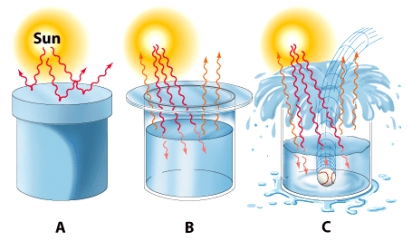
(Multiple Choice)
4.9/5 (90)
(90) The illustration below shows four stages in the development of the solar system.Describe the changes that take place in stage 3 of this evolution.
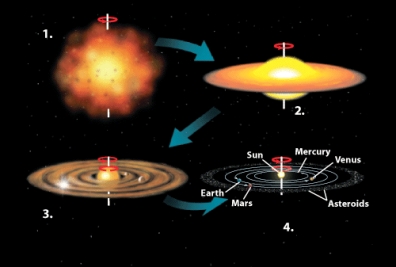
(Essay)
4.9/5 (86)
(86) ______ is the older,thicker,and less dense part of Earth's crust that forms the majority of Earth's land masses.
(Short Answer)
4.9/5 (81)
(81) The model that describes the movement of water through the reservoirs of the Earth System is called the _____ cycle.
(Multiple Choice)
4.8/5 (77)
(77) The hydrosphere comprises all of Earth's water and ice,both on the surface and underground.
(True/False)
4.8/5 (79)
(79) At the end of the Cretaceous period,an asteroid hit Earth and may have led to the extinction of many species,including the dinosaurs.How do you reconcile this event with Hutton's concept of uniformatarianism?
(Essay)
4.8/5 (80)
(80) The model of ______ describes the movement and interactions of large segments of Earth's lithosphere.
(Short Answer)
4.7/5 (81)
(81) The cloud of gas and dust from which the moons and planets of our solar system eventually formed is called the _____.
(Multiple Choice)
4.9/5 (85)
(85) In the two photographs below,A shows structures within a modern sand dune that are identical to the structures in the sandstone shown in B.Geologists interpret the structures in the ancient sandstone to be formed by the same processes as those that produced the structures in the modern sand dune.A geologist's ability to interpret these structures by comparing them to modern processes is an example of--------------------.
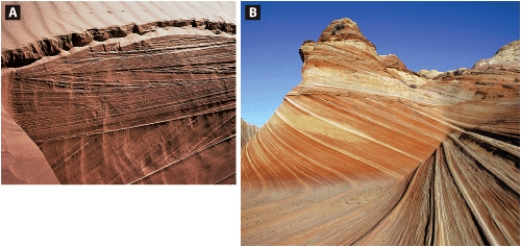
(Multiple Choice)
4.9/5 (68)
(68) The ______ is the innermost compositional layer of solid Earth.
(Short Answer)
4.9/5 (81)
(81) 
Filters
- Essay(0)
- Multiple Choice(0)
- Short Answer(0)
- True False(0)
- Matching(0)