



 Chat with AI
Exam 1: Earth As a Planet

Exam 1: Earth As a Planet85 Questions
Exam 2: Earth Materials75 Questions
Exam 3: How Old Is Old the Rock Record and Geologic Time72 Questions
Exam 4: Plate Tectonics74 Questions
Exam 5: Earthquakes and Earths Interior72 Questions
Exam 6: Volcanoes and Igneous Rocks80 Questions
Exam 7: Weathering and Erosion73 Questions
Exam 8: From Sediment to Sedimentary Rock75 Questions
Exam 9: Folds, faults, and Geological Maps75 Questions
Exam 10: Metamorphism: New Rock From Old76 Questions
Exam 11: Water on and Under the Ground75 Questions
Exam 12: The Ocean and the Atmosphere75 Questions
Exam 13: Climatic Extremes: Deserts and Glaciers74 Questions
Exam 14: Earths Climates: Past, present, future80 Questions
Exam 15: A Brief History of Life on Earth75 Questions
Exam 16: Understanding Earths Resources75 Questions
Select questions type


Differentiation of the inner planets probably means that each of the rocky planetary bodies _____.
(Multiple Choice)
4.9/5  (73)
(73) Volcanism is common to the histories of all of the terrestrial planets.What type of volcanic rock is common to all of the terrestrial planets?
(Essay)
4.8/5 (91)
(91) Movements and interactions in the lithosphere and the internal Earth processes that drive them are referred to as the _____ cycle.
(Multiple Choice)
4.8/5 (75)
(75) The innermost planets of the solar system are also referred to as the ______ planets,because of their similarities to Earth.
(Short Answer)
4.7/5 (84)
(84) The Principle of Uniformitarianism is based on the premise that _____.
(Multiple Choice)
4.8/5 (78)
(78) The ______ forms the outermost compositional layer of solid Earth.
(Short Answer)
4.9/5 (79)
(79) Impact craters cover the surface of large parts of other terrestrial bodies in the solar system,such as Mars and the Moon.Why don't we see many covering Earth's surface?
(Essay)
4.7/5 (76)
(76) The physical processes that occur on Earth have not changed over time,but the physical conditions of Earth ______ (have changed/have not changed)dramatically.
(Short Answer)
4.8/5 (90)
(90) The set of crustal processes that form new rock,modify it transport it,and break it down is known as the ____ cycle.
(Multiple Choice)
4.8/5 (72)
(72) The term ______ refers to the chemical alteration and mechanical breakdown of rock caused by exposure to water,air,and living organisms.
(Short Answer)
4.9/5 (80)
(80) ______ geology focuses on how materials and processes in the natural geologic environment affect,and are affected by,human activities.
(Short Answer)
4.8/5 (90)
(90) The nebular hypothesis proposes that the solar system coalesced out of a swirling cloud of interstellar dust and gas.
(True/False)
4.8/5 (69)
(69) Given scientists' current understanding of the formation of the Moon,how might the composition of the Moon compare to that of the Earth?
(Essay)
4.8/5 (86)
(86) The illustration below shows TWO different systems labeled A and B.For each of the modeled systems,provide its name and explain how it differs from the other.
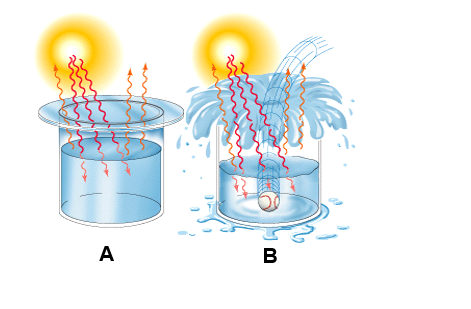
(Essay)
4.9/5 (84)
(84) Explain why the inner planets are rocky,while the outer planets of the solar system contain higher proportions of gas and ice.
(Essay)
4.8/5 (78)
(78) 
Filters
- Essay(0)
- Multiple Choice(0)
- Short Answer(0)
- True False(0)
- Matching(0)