



 Chat with AI
Exam 8: From Sediment to Sedimentary Rock

Exam 1: Earth As a Planet85 Questions
Exam 2: Earth Materials75 Questions
Exam 3: How Old Is Old the Rock Record and Geologic Time72 Questions
Exam 4: Plate Tectonics74 Questions
Exam 5: Earthquakes and Earths Interior72 Questions
Exam 6: Volcanoes and Igneous Rocks80 Questions
Exam 7: Weathering and Erosion73 Questions
Exam 8: From Sediment to Sedimentary Rock75 Questions
Exam 9: Folds, faults, and Geological Maps75 Questions
Exam 10: Metamorphism: New Rock From Old76 Questions
Exam 11: Water on and Under the Ground75 Questions
Exam 12: The Ocean and the Atmosphere75 Questions
Exam 13: Climatic Extremes: Deserts and Glaciers74 Questions
Exam 14: Earths Climates: Past, present, future80 Questions
Exam 15: A Brief History of Life on Earth75 Questions
Exam 16: Understanding Earths Resources75 Questions
Select questions type


_____ is the process in which substances dissolved in pore water are precipitated out and join grains together.
(Short Answer)
4.8/5  (78)
(78) In the figure below,the accretionary wedge is associated with divergent plate boundaries.
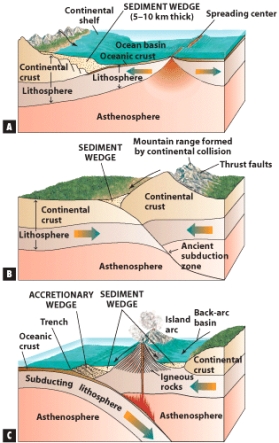
(True/False)
4.9/5 (87)
(87) When all the grains in a rock are roughly the same size,the rock is said to be _____.
(Multiple Choice)
4.9/5 (88)
(88) The Bonneville Salt Flats in Utah are primarily composed of _____ sediments.
(Short Answer)
4.8/5 (70)
(70) Discuss the similarities and differences between calcareous and siliceous ooze.
(Essay)
4.9/5 (77)
(77) In the figure below,a divergent plate boundary contains a sedimentary wedge.
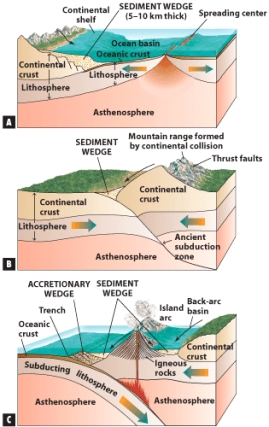
(True/False)
4.9/5 (87)
(87) Mudcracks are sedimentary structures formed in wet/dry environments.
(True/False)
4.7/5 (81)
(81) Marine evaporite basins form in coastal areas with hot and arid climates.
(True/False)
4.9/5 (76)
(76) Since all the grains in the figure below are roughly the same size,the sediment can be said to be _____.
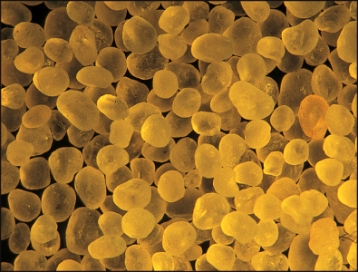
(Short Answer)
4.8/5 (76)
(76) In the figure below,a(n)_____ is an area where a freshwater stream meets the ocean.
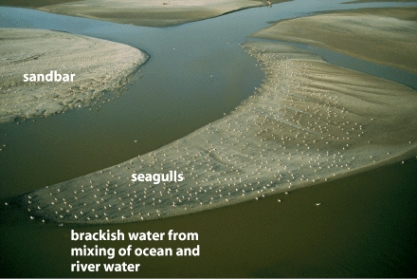
(Short Answer)
4.9/5 (88)
(88) The group of processes that transform sediments into rock is known as _____.
(Multiple Choice)
5.0/5 (75)
(75) _____ is the type of sedimentary structure in the figure below. 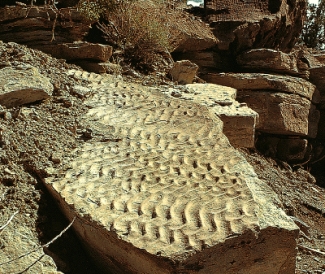
(Multiple Choice)
4.8/5 (78)
(78) Fossilized footprints provide inferences about depositional environment.
(True/False)
4.8/5 (80)
(80) 
Filters
- Essay(0)
- Multiple Choice(0)
- Short Answer(0)
- True False(0)
- Matching(0)