



 Chat with AI
Exam 5: Earthquakes and Earths Interior

Exam 1: Earth As a Planet85 Questions
Exam 2: Earth Materials75 Questions
Exam 3: How Old Is Old the Rock Record and Geologic Time72 Questions
Exam 4: Plate Tectonics74 Questions
Exam 5: Earthquakes and Earths Interior72 Questions
Exam 6: Volcanoes and Igneous Rocks80 Questions
Exam 7: Weathering and Erosion73 Questions
Exam 8: From Sediment to Sedimentary Rock75 Questions
Exam 9: Folds, faults, and Geological Maps75 Questions
Exam 10: Metamorphism: New Rock From Old76 Questions
Exam 11: Water on and Under the Ground75 Questions
Exam 12: The Ocean and the Atmosphere75 Questions
Exam 13: Climatic Extremes: Deserts and Glaciers74 Questions
Exam 14: Earths Climates: Past, present, future80 Questions
Exam 15: A Brief History of Life on Earth75 Questions
Exam 16: Understanding Earths Resources75 Questions
Select questions type


The crust is thicker under the oceans than it is under the continents.
(True/False)
5.0/5  (88)
(88) According to the figure below,which of the following would cause more damage? 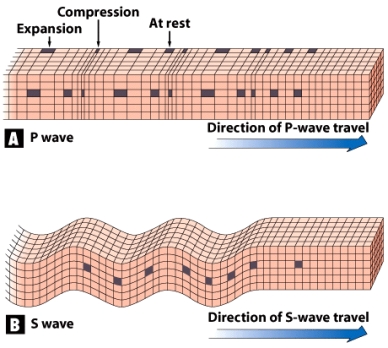
(Multiple Choice)
4.9/5 (86)
(86) 
In the figure below,what is the approximate time of the arrival of the S-waves? 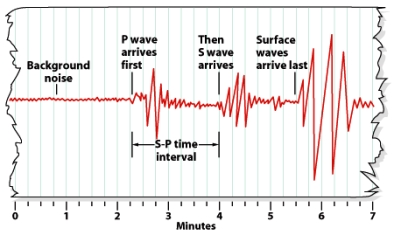
(Multiple Choice)
4.8/5 (91)
(91) The Modified Mercalli Intensity Scale qualifies the effects of an earthquake on humans,objects of nature,and man-made structures on a scale of I through XII,with I denoting a weak earthquake and XII one that causes almost complete destruction.
(True/False)
4.9/5 (81)
(81) Using the diagram below,explain why the P-wave shadow zone is smaller than the S-wave shadow zone.
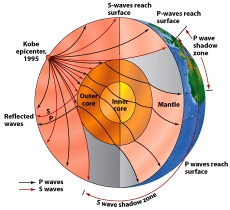
(Essay)
4.7/5 (71)
(71) The _______ is the part of Earth's interior where rocks start to melt.
(Multiple Choice)
4.9/5 (70)
(70) A(n)_______ wave is an elastic rebound wave that travels outward in all directions from the point of an earthquake.
(Multiple Choice)
4.9/5 (75)
(75) Primary waves can travel approximately 6 km/sec in the uppermost portion of the crust.
(True/False)
4.9/5 (92)
(92) 
Filters
- Essay(0)
- Multiple Choice(0)
- Short Answer(0)
- True False(0)
- Matching(0)