



 Chat with AI
Exam 2: Earth Materials

Exam 1: Earth As a Planet85 Questions
Exam 2: Earth Materials75 Questions
Exam 3: How Old Is Old the Rock Record and Geologic Time72 Questions
Exam 4: Plate Tectonics74 Questions
Exam 5: Earthquakes and Earths Interior72 Questions
Exam 6: Volcanoes and Igneous Rocks80 Questions
Exam 7: Weathering and Erosion73 Questions
Exam 8: From Sediment to Sedimentary Rock75 Questions
Exam 9: Folds, faults, and Geological Maps75 Questions
Exam 10: Metamorphism: New Rock From Old76 Questions
Exam 11: Water on and Under the Ground75 Questions
Exam 12: The Ocean and the Atmosphere75 Questions
Exam 13: Climatic Extremes: Deserts and Glaciers74 Questions
Exam 14: Earths Climates: Past, present, future80 Questions
Exam 15: A Brief History of Life on Earth75 Questions
Exam 16: Understanding Earths Resources75 Questions
Select questions type


Which rock sample is formed from cooling and solidifying magma? 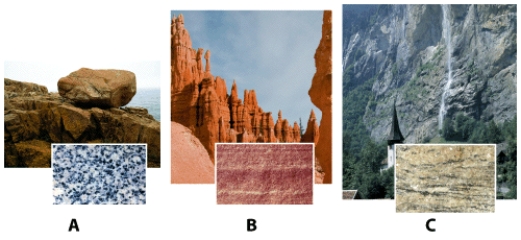
(Multiple Choice)
4.8/5  (71)
(71) What are the three families of rocks? How does each of these families differ?
(Essay)
5.0/5 (76)
(76) Sample (A,B,or C)_____ is of a rock whose original sedimentary or igneous form and mineral assemblage have been changed as a result of exposure to high temperature,high pressure or both.This type of rock is referred to as a metamorphic rock.
(Multiple Choice)
4.8/5 (88)
(88) The two most abundant mineral families of Earth's crust are the silicates and the _____.
(Short Answer)
4.8/5 (77)
(77) The mass number of an atom is the sum of the protons and ______.
(Short Answer)
4.9/5 (75)
(75) Which element is the most abundant (by weight)in Earth's crust?
(Multiple Choice)
4.8/5 (74)
(74) 
The properties of compounds are not the same as the properties of their constituent elements.
(True/False)
4.8/5 (81)
(81) In the illustration below,the part of the atom in which virtually all the mass is concentrated is referred to as the: 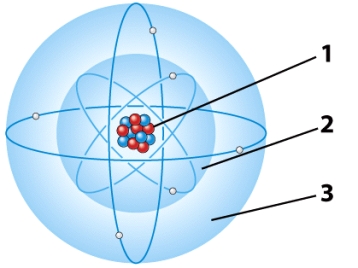
(Multiple Choice)
4.7/5 (93)
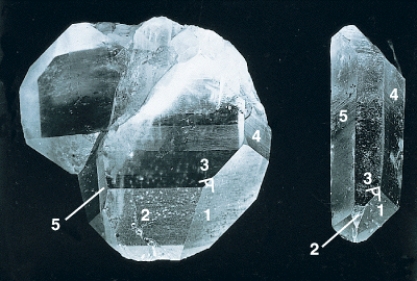
(93) The photo below shows two specimens of the mineral quartz.According to Steno's law the angle shown between faces 1 and 3 will be ______ in both samples.
(Short Answer)
5.0/5 (81)
(81) In the illustration below,the part(s)of the atom that has a negative charge is referred to as the: 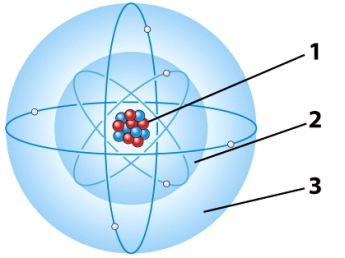
(Multiple Choice)
4.9/5 (82)
(82) The natural samples of corundum pictured below show variations of color from red (ruby)to blue (sapphire).The differences in color is best explained by: 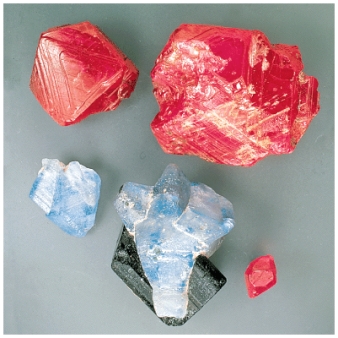
(Multiple Choice)
4.7/5 (96)
(96) The illustration below shows five different silicate structures.Of these,the structure labeled _____ exhibits the strongest structure for silicates.
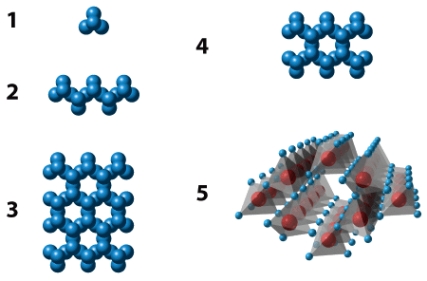
(Short Answer)
4.9/5 (88)
(88) One atom of a hypothetical element X has 27 protons while another has 29.This would make the two atoms of the element
(Multiple Choice)
4.9/5 (63)
(63) Explain why it is not necessary to chemically analyze a common mineral in order to make an identification.
(Essay)
4.9/5 (90)
(90) 
Filters
- Essay(0)
- Multiple Choice(0)
- Short Answer(0)
- True False(0)
- Matching(0)