



 Chat with AI
Exam 23: The Sun, Stars, and Deep Space

Exam 1: The Earth in Context60 Questions
Exam 2: The Way the Earth Works: Plate Tectonics59 Questions
Exam 3: Patterns in Nature: Minerals59 Questions
Exam 4: Up From the Inferno: Magma and Igneous Rocks60 Questions
Exam 5: A Surface Veneer: Sediments and Sedimentary Rocks60 Questions
Exam 6: A Process of Change: Metamorphism and the Rock Cycle60 Questions
Exam 7: Crags, Cracks, and Crumples: Crustal Deformation and Mountain Building59 Questions
Exam 8: A Violent Pulse: Earthquakes60 Questions
Exam 9: Deep Time: How Old Is Old59 Questions
Exam 10: A Biography of Earth60 Questions
Exam 11: Riches in Rock: Energy and Mineral Resources60 Questions
Exam 12: Shaping the Earths Surface: Landscapes, the Hydrologic Cycle, and Mass Wasting60 Questions
Exam 13: Freshwater: Streams, Lakes, and Groundwater60 Questions
Exam 14: Extreme Realms: Desert and Glacial Landscapes61 Questions
Exam 15: Ocean Waters: the Blue of the Blue Marble61 Questions
Exam 16: Marine Geology: the Study of Ocean Basins and Coasts60 Questions
Exam 17: The Air We Breathe: Introducing Earths Atmosphere60 Questions
Exam 18: Winds of the World: the Earths Major Weather Systems60 Questions
Exam 19: Thunderstorms, Tornadoes, and Local Weather Systems60 Questions
Exam 20: Climate and Climate Change60 Questions
Exam 21: Our Solar System and Beyond60 Questions
Exam 22: Our Neighborhood in Space60 Questions
Exam 23: The Sun, Stars, and Deep Space60 Questions
Exam 24: Prelude: Welcome to Earth Science30 Questions
Select questions type


The Hertzsprung-Russell diagram shows astronomers the relationship between
(Multiple Choice)
5.0/5  (90)
(90) The reaction known as the ____________ chain reaction involves the fusion of hydrogen atoms to form helium for our Sun.
(Multiple Choice)
4.9/5 (80)
(80) What provides the energy of a nova? What provides the energy of a supernova?
(Essay)
4.7/5 (78)
(78) An astronomer classifies nebulae that have distinct geometry by dividing the nebulae into
(Multiple Choice)
4.9/5 (71)
(71) What are the differences between black-, white-, and red-dwarf stars in terms of their size, mass, temperature, formation mechanism, and life cycle stage?
(Essay)
4.8/5 (83)
(83) Edwin Hubble classified galaxies into four basic types based on their shape. Those types are
(Multiple Choice)
4.8/5 (76)
(76) A square meter at the top of Earth's atmosphere, aligned perpendicular to the Sun's rays at a distance of 1 AU from the Sun, receives 1,362 watts. Researchers refer to this number, 1,362 watts/m², as the ____________ constant because it has varied by less than 0.2% over the last 400 years.
(Multiple Choice)
4.9/5 (86)
(86) A ____________ dwarf is in the same size range as a white dwarf but is much cooler in temperature.
(Multiple Choice)
5.0/5 (74)
(74) What objects do you encounter in your daily life that provide evidence that our Sun is not a first-generation star; meaning that it was not one of the first stars that formed after the Universe came into existence? Explain your answer.
(Essay)
4.9/5 (82)
(82) Outbursts of glowing gas and plasma emerging from the Sun's surface, following the magnetic field lines back to the surface, look like particularly huge arcs of plasma and are known as
(Multiple Choice)
4.8/5 (75)
(75) The property of a star that is most important in determining if it will end its life cycle as a white dwarf, a neutron star, or a black hole is its
(Multiple Choice)
4.9/5 (81)
(81) Our Universe is a ____________-dimensional mesh composed of stringlike filaments and screenlike walls, whose long dimensions are on the order of ____________ light-years.
(Multiple Choice)
4.7/5 (74)
(74) Which type of stars appear at the bottom of the Hertzsprung-Russell diagram shown below? 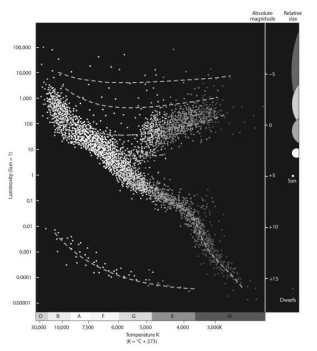
(Multiple Choice)
4.8/5 (79)
(79) What are the two most abundant elements that make up the composition of the Sun?
(Multiple Choice)
4.9/5 (67)
(67) What important forces balance each other within a star as it reaches its equilibrium condition?
(Multiple Choice)
4.7/5 (81)
(81) 
Filters
- Essay(0)
- Multiple Choice(0)
- Short Answer(0)
- True False(0)
- Matching(0)