



 Chat with AI
Exam 23: The Sun, Stars, and Deep Space

Exam 1: The Earth in Context60 Questions
Exam 2: The Way the Earth Works: Plate Tectonics59 Questions
Exam 3: Patterns in Nature: Minerals59 Questions
Exam 4: Up From the Inferno: Magma and Igneous Rocks60 Questions
Exam 5: A Surface Veneer: Sediments and Sedimentary Rocks60 Questions
Exam 6: A Process of Change: Metamorphism and the Rock Cycle60 Questions
Exam 7: Crags, Cracks, and Crumples: Crustal Deformation and Mountain Building59 Questions
Exam 8: A Violent Pulse: Earthquakes60 Questions
Exam 9: Deep Time: How Old Is Old59 Questions
Exam 10: A Biography of Earth60 Questions
Exam 11: Riches in Rock: Energy and Mineral Resources60 Questions
Exam 12: Shaping the Earths Surface: Landscapes, the Hydrologic Cycle, and Mass Wasting60 Questions
Exam 13: Freshwater: Streams, Lakes, and Groundwater60 Questions
Exam 14: Extreme Realms: Desert and Glacial Landscapes61 Questions
Exam 15: Ocean Waters: the Blue of the Blue Marble61 Questions
Exam 16: Marine Geology: the Study of Ocean Basins and Coasts60 Questions
Exam 17: The Air We Breathe: Introducing Earths Atmosphere60 Questions
Exam 18: Winds of the World: the Earths Major Weather Systems60 Questions
Exam 19: Thunderstorms, Tornadoes, and Local Weather Systems60 Questions
Exam 20: Climate and Climate Change60 Questions
Exam 21: Our Solar System and Beyond60 Questions
Exam 22: Our Neighborhood in Space60 Questions
Exam 23: The Sun, Stars, and Deep Space60 Questions
Exam 24: Prelude: Welcome to Earth Science30 Questions
Select questions type



Identify the three internal layers of our Sun using the figure below. 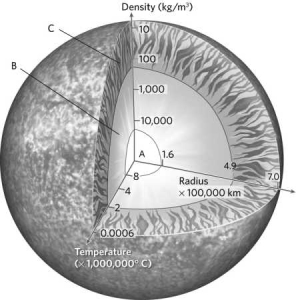
(Multiple Choice)
4.7/5  (85)
(85) What will be the fate of Earth when the Sun's hydrogen fuel is exhausted?
(Multiple Choice)
4.8/5 (86)
(86) Label the key features of the Milky Way galaxy using the features below.
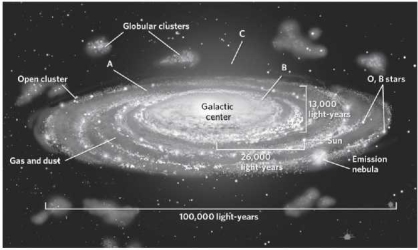
(Essay)
4.8/5 (83)
(83) If you plot the positions of thousands of stars on the H-R diagram, most of those stars fall along the main sequence. Why are so many stars found along this line rather than in other parts of the diagram?
(Multiple Choice)
4.9/5 (82)
(82) Currently, astronomers think that since the Big Bang the Universe
(Multiple Choice)
4.8/5 (89)
(89) The Sun currently falls on the main sequence of the H-R diagram. How will it evolve as it nears the end of its life as a visible star?
(Essay)
4.9/5 (93)
(93) How might expansion rates of the Universe change in the future, and what would such changes mean for the future of the Universe?
(Essay)
5.0/5 (70)
(70) If the Universe becomes larger and larger, its matter will become more and more dispersed and eventually, in this scenario, all that will be left are
(Multiple Choice)
4.9/5 (71)
(71) When a bright eruption of plasma shoots out of the Sun's surface, it releases a huge number of particles as well as energy in the form of x-rays and UV rays. This explosion of energy at the Sun's surface is called a
(Multiple Choice)
4.9/5 (85)
(85) The measure of power for the electromagnetic energy emitted by a star in a specified amount of time is known as the star's
(Multiple Choice)
4.7/5 (82)
(82) What mechanism is responsible for producing the energy that comes from inside the Sun?
(Multiple Choice)
4.7/5 (79)
(79) Astronomers describe the apparent brightness of stars using a scheme that classifies starsvisible to the naked eye using a scale divided into ____________, with 1 being the brightest and 6 being the faintest.
(Multiple Choice)
4.8/5 (76)
(76) 
Filters
- Essay(0)
- Multiple Choice(0)
- Short Answer(0)
- True False(0)
- Matching(0)