



 Chat with AI
Exam 11: Riches in Rock: Energy and Mineral Resources

Exam 1: The Earth in Context60 Questions
Exam 2: The Way the Earth Works: Plate Tectonics59 Questions
Exam 3: Patterns in Nature: Minerals59 Questions
Exam 4: Up From the Inferno: Magma and Igneous Rocks60 Questions
Exam 5: A Surface Veneer: Sediments and Sedimentary Rocks60 Questions
Exam 6: A Process of Change: Metamorphism and the Rock Cycle60 Questions
Exam 7: Crags, Cracks, and Crumples: Crustal Deformation and Mountain Building59 Questions
Exam 8: A Violent Pulse: Earthquakes60 Questions
Exam 9: Deep Time: How Old Is Old59 Questions
Exam 10: A Biography of Earth60 Questions
Exam 11: Riches in Rock: Energy and Mineral Resources60 Questions
Exam 12: Shaping the Earths Surface: Landscapes, the Hydrologic Cycle, and Mass Wasting60 Questions
Exam 13: Freshwater: Streams, Lakes, and Groundwater60 Questions
Exam 14: Extreme Realms: Desert and Glacial Landscapes61 Questions
Exam 15: Ocean Waters: the Blue of the Blue Marble61 Questions
Exam 16: Marine Geology: the Study of Ocean Basins and Coasts60 Questions
Exam 17: The Air We Breathe: Introducing Earths Atmosphere60 Questions
Exam 18: Winds of the World: the Earths Major Weather Systems60 Questions
Exam 19: Thunderstorms, Tornadoes, and Local Weather Systems60 Questions
Exam 20: Climate and Climate Change60 Questions
Exam 21: Our Solar System and Beyond60 Questions
Exam 22: Our Neighborhood in Space60 Questions
Exam 23: The Sun, Stars, and Deep Space60 Questions
Exam 24: Prelude: Welcome to Earth Science30 Questions
Select questions type


A buried body of rock that is induced by heat to exude oil is termed a ____________ rock.
(Multiple Choice)
4.9/5  (71)
(71) In 1900, the most commonly used source of energy in the United States was 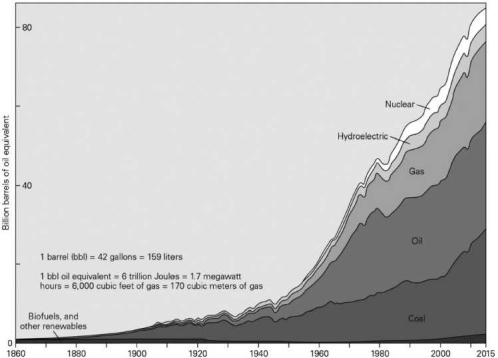
(Multiple Choice)
4.9/5 (87)
(87) A large portion of the coal reserves in the world formed during the ____________ period.
(Multiple Choice)
4.8/5 (83)
(83) If the average geothermal gradient in an area is 15°C/km, oil shale must be buried at depths of greater than ____________ but no more than ____________ to be transformed into oil.
(Multiple Choice)
4.9/5 (74)
(74) A reservoir rock contains ____________ porosity and permeability, whereas a seal rock contains ____________ porosity and permeability.
(Multiple Choice)
4.8/5 (77)
(77) Which of the following is a nonmetal mineral formed by evaporation and used to make drywall?
(Multiple Choice)
4.9/5 (84)
(84) Explain Hubbert's Peak. What implications does it have for the future of human civilization?
(Essay)
4.8/5 (88)
(88) The stereotypical gold rush prospector panning for gold in a streambed is an example of exploiting ____________ deposits.
(Multiple Choice)
4.7/5 (74)
(74) Source rocks are always sedimentary because sedimentary rocks
(Multiple Choice)
4.7/5 (78)
(78) Which of the following occurs when a neutron strikes a radioactive parent atom?
(Multiple Choice)
5.0/5 (83)
(83) In a nuclear reactor, failure of control rods may cause the system to become too hot and melt down because the control rods absorb ____________ and thus decrease the number of atoms undergoing ____________.
(Multiple Choice)
4.8/5 (81)
(81) Gold is often found at the bottom of streambeds in placer deposits. Describe the process that forms these deposits.
(Essay)
4.8/5 (85)
(85) Which of the following nonmetallic resources has an igneous origin?
(Multiple Choice)
4.8/5 (93)
(93) Which organic substance is produced by black organic shale at temperatures below (cooler than) the oil window?
(Multiple Choice)
4.8/5 (84)
(84) Which sequence shows an increase in coal rank from lowest to highest?
(Multiple Choice)
4.8/5 (69)
(69) Salt and fine-grained limestone are good candidates to serve as ____________ within an oil field.
(Multiple Choice)
4.9/5 (82)
(82) A ____________ rock would make the best reservoir rock in a conventional hydrocarbon system.
(Multiple Choice)
4.8/5 (84)
(84) 
Filters
- Essay(0)
- Multiple Choice(0)
- Short Answer(0)
- True False(0)
- Matching(0)