



 Chat with AI
Exam 9: Materiality and Risk

Exam 1: The Demand for Audit and Other Assurance Services47 Questions
Exam 2: The Cpa Profession79 Questions
Exam 3: Audit Reports140 Questions
Exam 4: Professional Ethics119 Questions
Exam 5: Legal Liability115 Questions
Exam 6: Audit Responsibilities and Objectives132 Questions
Exam 7: Audit Evidence105 Questions
Exam 8: Audit Planning and Analytical Procedures102 Questions
Exam 9: Materiality and Risk113 Questions
Exam 10: Internal Control, Control Risk, and Section 404 Audits116 Questions
Exam 11: Fraud Auditing93 Questions
Exam 12: The Impact of Information Technology on the Audit Process106 Questions
Exam 13: Overall Audit Strategy and Audit Program94 Questions
Exam 14: Audit of the Sales and Collection Cycle: Tests of Controls and Substantive Tests of Transactions109 Questions
Exam 15: Audit Sampling for Tests of Controls and Substantive Tests of Transactions119 Questions
Exam 16: Completing the Tests in the Sales and Collection Cycle: Accounts Receivable101 Questions
Exam 17: Audit Sampling for Tests of Details of Balances114 Questions
Exam 18: Audit of the Acquisition and Payment Cycle: Tests of Controls, Substantive Tests of Transactions, and Accounts Payable116 Questions
Exam 19: Completing the Tests in the Acquisition and Payment Cycle: Verification of Selected Accounts101 Questions
Exam 20: Audit of the Payroll and Personnel Cycle113 Questions
Exam 21: Audit of the Inventory and Warehousing Cycle116 Questions
Exam 22: Audit of the Capital Acquisition and Repayment Cycle91 Questions
Exam 23: Audit of Cash and Financial Instruments121 Questions
Exam 24: Completing the Audit120 Questions
Exam 25: Other Assurance Services104 Questions
Exam 26: Internal and Governmental Financial Auditing and Operational Auditing73 Questions
Select questions type


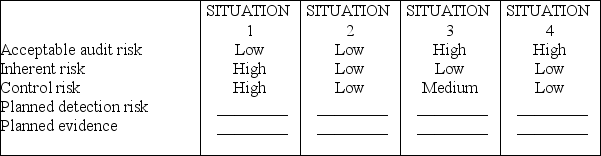
In practice, auditors rarely assign numerical probabilities to inherent risk, control risk, or acceptable audit risk.It is more common to assess these risks as high, medium, or low.For each of the four situations below, fill in the blanks for planned detection risk and the amount of evidence you would plan to gather ("planned evidence")using the terms high, medium, or low.
(Essay)
4.9/5  (80)
(80) The auditing profession has established guidelines for setting inherent risk.
(True/False)
5.0/5 (80)
(80) Auditor's allocate the preliminary judgment about materiality to financial statement segments rather than by financial statements as a whole.What is the term for the auditor's allocation of preliminary misstatement to account balances?
What are three difficulties auditor's face when allocating materiality to balance sheet accounts?
(Essay)
4.8/5 (79)
(79) If acceptable audit risk is low, and inherent risk and control risk are both low, then planned detection risk should be high.
(True/False)
4.8/5 (88)
(88) Due to qualitative factors, certain types of misstatements are likely to be more important to users than others, even if the dollar amounts are the same.Identify two qualitative factors that might significantly affect an auditor's materiality judgment, and give an example of each.
(Essay)
5.0/5 (72)
(72) A high detection risk equates to a low amount of audit evidence needed.
(True/False)
4.7/5 (66)
(66) If an auditor believes the chance of financial failure is high and there is a corresponding increase in business risk for the auditor, acceptable audit risk would likely:
(Multiple Choice)
4.8/5 (80)
(80) Which of the following is the primary basis used to decide materiality for a for-profit entity?
(Multiple Choice)
4.8/5 (81)
(81) If the auditor approaches the audit of the accounts in s sequential manner, the findings of the audit of accounts audited earlier can be used to revise the performance materiality established for accounts audited later.
(True/False)
4.8/5 (82)
(82) To maximize audit efficiency, the auditor should allocate less tolerable misstatement to accounts that can be verified by using low-cost audit procedures, such as analytical procedures, than to accounts that are more costly to audit.
(True/False)
4.7/5 (78)
(78) Inherent risk is ________ related to detection risk and ________ related to the amount of audit evidence.
(Multiple Choice)
5.0/5 (69)
(69) Net assets are the most often used base for deciding materiality.
(True/False)
4.8/5 (82)
(82) Sampling error represents the minimum misstatement amount that exists in all accounts subjected to sampling.
(True/False)
4.9/5 (84)
(84) The auditor's preliminary judgment about materiality is the maximum amount by which the auditor believes the financial statements could be misstated and still not affect the decisions of reasonable users.
(True/False)
4.9/5 (77)
(77) ________ misstatements are those where the auditor can determine the amount of the misstatement in the account.
(Multiple Choice)
4.9/5 (74)
(74) When taken together, the concepts of risk and materiality in auditing:
(Multiple Choice)
4.9/5 (75)
(75) 
Filters
- Essay(0)
- Multiple Choice(0)
- Short Answer(0)
- True False(0)
- Matching(0)