



 Chat with AI
Exam 4: Professional Ethics


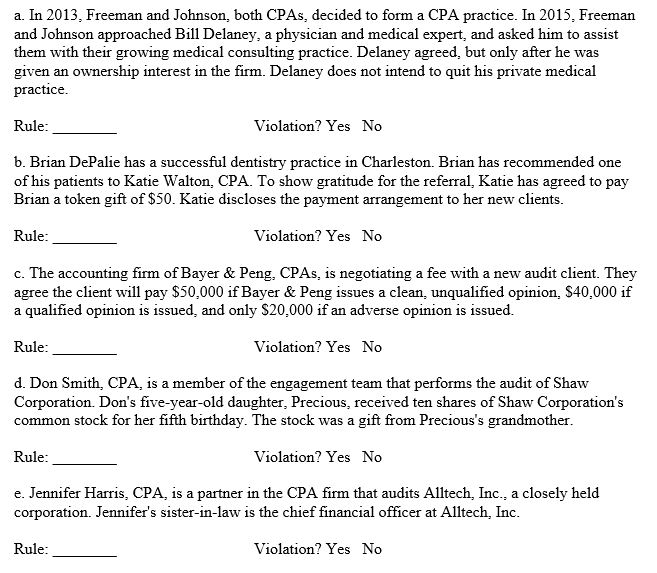
The following situations involve a possible violation of the AICPA's Code of Professional Conduct.For each situation, (1)determine the applicable rule from the Code, (2)decide whether or not the Code has been violated, and (3)briefly explain how the situation violates (or does not violate)the Code.

 (77)
 Verified
a.Violation of the rule on Form of Organization and Name (Rule 505).Non-CPA ownership of firms is allowable, however, non-CPA owners must actively provide services to the firm's clients as their principal occupation.
b.No violation of the Commissions and Referral Fees rule (Rule 503).A CPA may pay a referral fee to a non-CPA as long as the payment is disclosed to the client.
c.Violation of the Contingent Fees rule (Rule 302).This is a contingent fee agreement and is prohibited by Rule 302.
d.Violation of the Independence rule (Rule 101).Don is a covered member for purposes of Rule 101.Because his daughter is a dependent, her ownership interest in Shaw is treated as a direct financial interest of her father.
e.No violation of the Independence rule (Rule 101).According to the Code a close relative is defined as a parent, sibling, or nondependent child.Thus, a sister-in-law is not considered to be a close relative.
Which of the following is required for a firm to designate itself "Member of the American Institute of Certified Public Accountants" on its letterhead?
(82) VerifiedB
In determining independence with respect to any audit engagement, the ultimate decision as to whether or not the auditor is independent must be made by the:
(65) VerifiedA
Which of the following circumstances impairs an auditor's independence?
I.Litigation by a client against an audit firm claiming a deficiency in the previous audit
II.Litigation by a client against an audit firm related to tax services
III.Litigation by an audit firm against a client claiming management fraud or deceit
(99) The AICPA's Code of Professional Conduct states that a CPA should maintain integrity and objectivity.The term "objectivity" in the Code refers to a CPA's ability to:
(81) The Code of Conduct rule on independence indicates that materiality must be considered when:
(82) Which of the following is(are)true concerning the Ethical Principles of the Code of Professional Conduct?
I.They identify ideal conduct.
II.They are general ideals and are not enforceable.
(101) The Sarbanes-Oxley Act ________ a CPA firm from doing both bookkeeping and auditing services for the same public company client.
(68) Rule 201 - General Standards requires members to comply with certain standards and interpretations.Which of the following is not a standard specifically addressed in Rule 201?
(77) In the AICPA Code of Professional Conduct, the sixth principle of professional conduct, entitled "Scope and Nature of Services," applies to members of the AICPA who work in public practice, business, government, or education.
(71) Which of the following services are allowed by the SEC whenever a CPA also audits the company?
(77) According to the Principles section of the Code of Professional Conduct, all members:
(74) Freedom from ________ means the absence of relationships that might interfere with objectivity or integrity.
(71) A CPA firm may practice public accounting only in a form of organization permitted by federal law or regulation.
(87) Which of the following instances would impair a CPA's independence when they have been retained as the auditor?
I.A charitable organization where the CPA serves as treasurer
II.A municipality where the CPA owns $250,000 of the $25 million outstanding bonds of the municipality
III.A company that the CPA's investment club owns a 10% investment interest
(80) Interpretations of the rules regarding independence allow an auditor to serve as:
(93) Under Rule 505, Form of Organization and Name, a CPA firm may not designate itself as "Members of the American Institute of Certified Public Accountants" unless a majority of its owners are members of the Institute.
(74) CPAs are prohibited from which of the following forms of advertising?
(72) Companies are required to disclose in their proxy statement or annual filings with the SEC the total amount of audit and non-audit fees paid to the audit firm for the two most recent years.Which of the following is not one of the categories of fees that must be disclosed?
(86) 
Filters
- Essay(0)
- Multiple Choice(0)
- Short Answer(0)
- True False(0)
- Matching(0)