



 Chat with AI
Exam 4: Professional Ethics

Exam 1: The Demand for Audit and Other Assurance Services47 Questions
Exam 2: The Cpa Profession79 Questions
Exam 3: Audit Reports140 Questions
Exam 4: Professional Ethics119 Questions
Exam 5: Legal Liability115 Questions
Exam 6: Audit Responsibilities and Objectives132 Questions
Exam 7: Audit Evidence105 Questions
Exam 8: Audit Planning and Analytical Procedures102 Questions
Exam 9: Materiality and Risk113 Questions
Exam 10: Internal Control, Control Risk, and Section 404 Audits116 Questions
Exam 11: Fraud Auditing93 Questions
Exam 12: The Impact of Information Technology on the Audit Process106 Questions
Exam 13: Overall Audit Strategy and Audit Program94 Questions
Exam 14: Audit of the Sales and Collection Cycle: Tests of Controls and Substantive Tests of Transactions109 Questions
Exam 15: Audit Sampling for Tests of Controls and Substantive Tests of Transactions119 Questions
Exam 16: Completing the Tests in the Sales and Collection Cycle: Accounts Receivable101 Questions
Exam 17: Audit Sampling for Tests of Details of Balances114 Questions
Exam 18: Audit of the Acquisition and Payment Cycle: Tests of Controls, Substantive Tests of Transactions, and Accounts Payable116 Questions
Exam 19: Completing the Tests in the Acquisition and Payment Cycle: Verification of Selected Accounts101 Questions
Exam 20: Audit of the Payroll and Personnel Cycle113 Questions
Exam 21: Audit of the Inventory and Warehousing Cycle116 Questions
Exam 22: Audit of the Capital Acquisition and Repayment Cycle91 Questions
Exam 23: Audit of Cash and Financial Instruments121 Questions
Exam 24: Completing the Audit120 Questions
Exam 25: Other Assurance Services104 Questions
Exam 26: Internal and Governmental Financial Auditing and Operational Auditing73 Questions
Select questions type


The following situations involve a possible violation of the AICPA's Code of Professional Conduct.For each situation, (1)determine the applicable rule from the Code, (2)decide whether or not the Code has been violated, and (3)briefly explain how the situation violates (or does not violate)the Code.
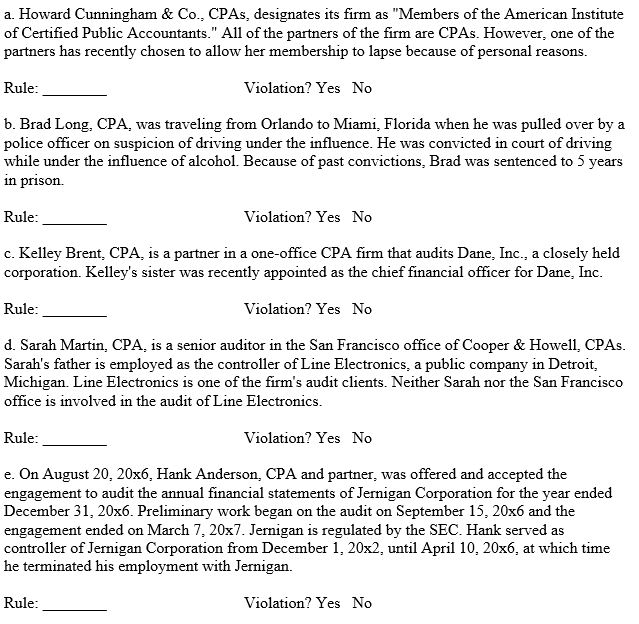
(Essay)
4.7/5  (73)
(73) The Sarbanes-Oxley Act requires a cooling off period of ________ before a member of an audit team can work for a client in a key management position?
(Multiple Choice)
4.8/5 (91)
(91) Expulsion from the AICPA for failing to follow the rules of conduct is, by itself, sufficient to prevent a CPA from practicing public accounting.
(True/False)
4.7/5 (82)
(82) In which of the following circumstances would a CPA be ethically bound to refrain from disclosing any confidential client information?
(Multiple Choice)
4.8/5 (81)
(81) The Code of Professional Conduct is established by the membership of the AICPA, and the Interpretations of the Rules of Conduct are prepared by the:
(Multiple Choice)
4.9/5 (69)
(69) Briefly describe the advantages and disadvantages of a code of conduct based on general statements of ideal conduct as opposed to specific rules that define unacceptable behavior.
(Essay)
4.9/5 (76)
(76) A rationalization method that can easily result in unethical behavior is the argument that "everybody does it."
(True/False)
4.8/5 (68)
(68) Which of the following is not defined as an act discreditable in either the Rules or the Interpretations of the AICPA's Code of Professional Conduct?
(Multiple Choice)
4.8/5 (74)
(74) Julie and Lisa are sisters.Julie is a CPA auditing the company where Lisa works.Julie's independence is impaired if:
(Multiple Choice)
4.8/5 (83)
(83) A direct financial interest violates independence in which of the following circumstances?
(Multiple Choice)
4.9/5 (75)
(75) Information obtained by a CPA from a client is legally privileged in federal court.
(True/False)
4.8/5 (77)
(77) When a member observes the profession's technical and ethical standards and strives to continually improve her competence and quality of services, she is exercising:
(Multiple Choice)
4.8/5 (66)
(66) The AICPA Code of Professional Conduct permits the auditor to perform a wide variety of non-audit services for audit clients.
(True/False)
4.8/5 (77)
(77) In the AICPA Code of Professional Conduct, the second principle of professional conduct, entitled "The Public Interest," applies only to members of the AICPA in public practice and not to members who work as accountants in business, government, or education.
(True/False)
4.9/5 (90)
(90) Which of the following statements is true when the CPA has been engaged to perform an audit of financial statements?
(Multiple Choice)
4.9/5 (73)
(73) Under Rule 101, Independence, independence is considered to be impaired if fees remain unpaid for professional services provided more than six months before the date of the current year's report.
(True/False)
4.8/5 (80)
(80) Which of the following would be considered a violation of the AICPA Code of Conduct?
(Multiple Choice)
4.7/5 (93)
(93) The AICPA's Code of Professional Conduct requires independence for all:
(Multiple Choice)
4.9/5 (72)
(72) A public company may obtain internal audit services from their financial statement auditor if it is approved by the company's audit committee.
(True/False)
4.8/5 (71)
(71) If the board of accountancy in the state in which a CPA firm is licensed has rules that are different than the AICPA's rules, the CPA firm must follow:
(Multiple Choice)
4.8/5 (80)
(80) 
Filters
- Essay(0)
- Multiple Choice(0)
- Short Answer(0)
- True False(0)
- Matching(0)