



 Chat with AI
Exam 2: The Cpa Profession

Exam 1: The Demand for Audit and Other Assurance Services60 Questions
Exam 2: The Cpa Profession79 Questions
Exam 3: Audit Reports157 Questions
Exam 4: Professional Ethics126 Questions
Exam 5: Legal Liability118 Questions
Exam 6: Audit Responsibilities and Objectives153 Questions
Exam 7: Audit Evidence135 Questions
Exam 8: Audit Planning and Analytical Procedures147 Questions
Exam 9: Materiality and Risk83 Questions
Exam 10: Fraud Auditing110 Questions
Exam 11: Internal Control and Coso Framework126 Questions
Exam 12: Assessing Control Risk and Reporting on Internal Controls81 Questions
Exam 13: Overall Audit Strategy and Audit Program100 Questions
Exam 14: Audit of the Sales and Collection Cycle: Tests of Controls123 Questions
Exam 15: Audit Sampling for Tests of Controls and Substantive Tests of Transactions126 Questions
Exam 16: Completing the Tests in the Sales and Collection Cycle: Accounts Receivable112 Questions
Exam 17: Audit Sampling for Tests of Details of Balances118 Questions
Exam 18: Audit of the Acquisition and Payment Cycle: Tests of Controls,124 Questions
Exam 19: Completing the Tests in the Acquisition and Payment Cycle:104 Questions
Exam 20: Audit of the Payroll and Personnel Cycle113 Questions
Exam 21: Audit of the Inventory and Warehousing Cycle122 Questions
Exam 22: Audit of the Capital Acquisition and Repayment Cycle92 Questions
Exam 23: Audit of Cash and Financial Instruments129 Questions
Exam 24: Completing the Audit130 Questions
Exam 25: Other Assurance Services112 Questions
Exam 26: Internal and Governmental Financial Auditing and Operational Auditing75 Questions
Select questions type


Which staff level in a CPA firm performs most of the detailed audit work?
(Multiple Choice)
5.0/5  (79)
(79) The difference between the Securities Act of 1933 and the Securities Act of 1934 is that only the 1934 act requires audited financial statements.
(True/False)
4.8/5 (92)
(92) Listed below are policies or procedures that the Crystal Cove audit firm has in place.For each identified policy or procedure state if it is an auditing standard or a quality control standard.
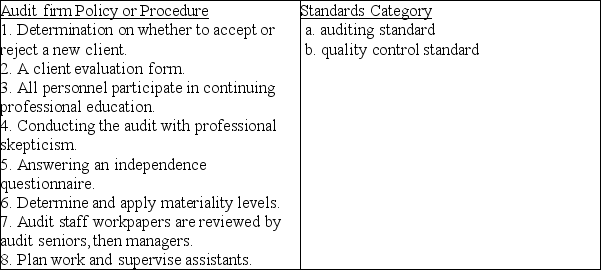
(Essay)
4.8/5 (66)
(66) Performance is one of the principles underlying an audit.List three performance responsibilities.
(Essay)
4.9/5 (81)
(81) List and describe the six elements of quality control.Who establishes the standards for quality control?
(Essay)
4.7/5 (88)
(88) In addition to attestation and assurance services,CPA firms provide other services to their clients.List three of these services.
(Essay)
4.9/5 (88)
(88) Quality controls are established for the entire CPA firm whereas auditing standards are applicable to the individual engagement.
(True/False)
4.9/5 (71)
(71) Which of the following is True with regards to the various auditing standards?
(Multiple Choice)
4.7/5 (86)
(86) When assessing the risk of material misstatements in the financial statements,
(Multiple Choice)
4.8/5 (87)
(87) Which of the following is not an essential component of quality control?
(Multiple Choice)
4.9/5 (81)
(81) Principles related to the auditor's responsibilities in the audit stress three important personal qualities that the auditor should possess.List and discuss these three qualities.
(Essay)
4.7/5 (80)
(80) Historically,auditing standards have been organized into three categories,including
(Multiple Choice)
4.9/5 (77)
(77) Which of the following is a True statement regarding auditing standards?
(Multiple Choice)
4.8/5 (74)
(74) The AICPA principles and the auditing standards should be viewed by practitioners as
(Multiple Choice)
4.8/5 (89)
(89) Which of the following are audit standards used in professional practice by audit firms?
(Multiple Choice)
4.8/5 (92)
(92) The Sarbanes-Oxley Act established the Public Company Accounting Oversight Board (PCAOB).What are the PCAOB's primary functions?
(Essay)
4.9/5 (98)
(98) Limited liability companies are structured and taxed like a general partnership,but their owners have limited personal liability similar to that of a general corporation.
(True/False)
4.8/5 (89)
(89) Sarbanes-Oxley and the Securities and Exchange Commission restrict auditors from providing many consulting services to their publicly traded audit clients.Which of the following is True for auditors of publicly traded companies?
I. They are restricted from providing consulting services to privately held companies.
II. There is no restriction on providing consulting services to non-audit clients.
(Multiple Choice)
4.7/5 (76)
(76) 
Filters
- Essay(0)
- Multiple Choice(0)
- Short Answer(0)
- True False(0)
- Matching(0)