



 Chat with AI
Exam 15: Perfect Competition

Exam 1: Getting Started337 Questions
Exam 2: The Usand Global Economies201 Questions
Exam 3: The Economic Problem273 Questions
Exam 4: Demand and Supply322 Questions
Exam 5: Elasticities of Demand and Supply335 Questions
Exam 6: Efficiency and Fairness of Markets352 Questions
Exam 7: Government Actions in Markets239 Questions
Exam 8: Taxes267 Questions
Exam 9: Global Markets in Action276 Questions
Exam 10: Externalities300 Questions
Exam 11: Public Goods and Common Resources177 Questions
Exam 12: Markets With Private Information101 Questions
Exam 13: Consumer Choice and Demand287 Questions
Exam 14: Production and Cost266 Questions
Exam 15: Perfect Competition275 Questions
Exam 16: Monopoly377 Questions
Exam 17: Monopolistic Competition213 Questions
Exam 18: Oligopoly222 Questions
Exam 19: Markets for Factors of Production178 Questions
Exam 20: Economic Inequality155 Questions
Select questions type


 -The above figure shows three possible average total cost curves.If all firms in a perfectly competitive industry each have an average total cost curve identical to ATC₁, each produce 30 units, and the market price of the good is $16 per unit, then the firms
 (Multiple Choice)
4.8/5  (84)
(84) 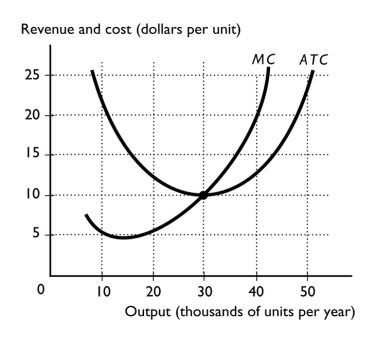 -The above figure shows a perfectly competitive firm.If the market price is $5, the firm
 (Multiple Choice)
4.8/5 (91)
(91) 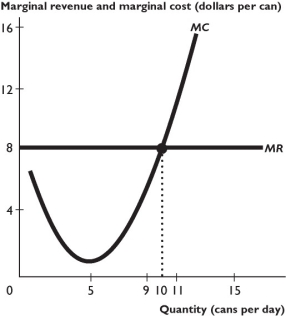 The figure above shows a firm's marginal revenue and marginal cost curves.
-Suppose the firm's marginal cost of producing a can increases by $1 per can.Then the firm would
The figure above shows a firm's marginal revenue and marginal cost curves.
-Suppose the firm's marginal cost of producing a can increases by $1 per can.Then the firm would (Multiple Choice)
4.8/5 (83)
(83) A market is ________ when a small number of firms compete.
(Multiple Choice)
4.9/5 (58)
(58)  The figure above shows some of a firm's cost curves and its marginal revenue curve.
-Based on the figure above, what is the price of a can?
The figure above shows some of a firm's cost curves and its marginal revenue curve.
-Based on the figure above, what is the price of a can? (Multiple Choice)
4.7/5 (67)
(67) What must be the case if a perfectly competitive firm's economic loss is less by shutting down rather than by producing and selling some output?
(Essay)
4.8/5 (84)
(84) 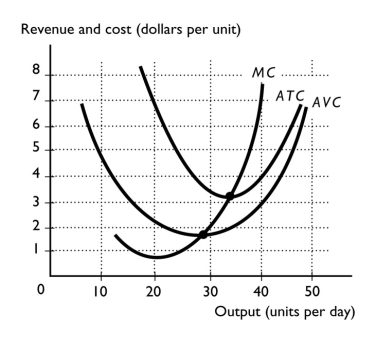 -The above figure shows the cost curves of a profit-maximizing perfectly competitive firm.If the price equals $7,
a∙how much will the firm produce?
b∙how much is the firm's average total, average variable, and marginal costs?
c∙how much is the firm's total, total variable, and total fixed costs?
d∙how much is the firm's total revenue and economic profit?
e∙what will happen in this market in the long run?
-The above figure shows the cost curves of a profit-maximizing perfectly competitive firm.If the price equals $7,
a∙how much will the firm produce?
b∙how much is the firm's average total, average variable, and marginal costs?
c∙how much is the firm's total, total variable, and total fixed costs?
d∙how much is the firm's total revenue and economic profit?
e∙what will happen in this market in the long run? (Essay)
4.9/5 (82)
(82) Consider a short-run equilibrium in a perfectly competitive market.Suppose that the firms' average total cost and marginal cost schedules differ.In the short run,
(Multiple Choice)
4.7/5 (73)
(73) If a perfectly competitive firm finds that price is less than its ATC, then the firm
(Multiple Choice)
5.0/5 (73)
(73) 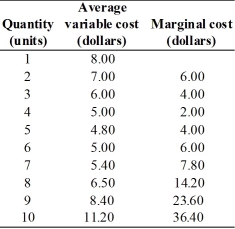 -Acme is a perfectly competitive firm.It has the cost schedules given in the above table and has a fixed cost of $12.00.The price of Acme's product is $14.20.What is Acme's most profitable amount of output? What is Acme's total economic profit or loss?
 (Essay)
4.9/5 (83)
(83) Which of the following market types has only a few competing firms?
(Multiple Choice)
4.8/5 (79)
(79) The characteristics that describe a perfectly competitive industry include
(Multiple Choice)
4.8/5 (89)
(89) If it does not shut down, a perfectly competitive firm produces where marginal cost is equal to the marginal revenue
(Multiple Choice)
4.8/5 (77)
(77) 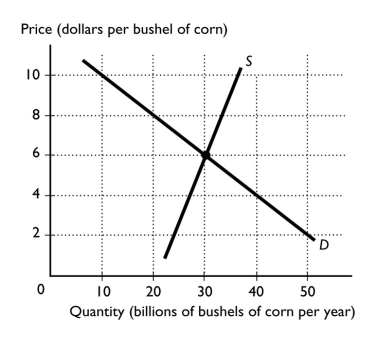 -Farmer Brown produces corn in a perfectly competitive market.Farmer Brown produces and sells 500 bushels of corn.The market supply and demand curves are illustrated in the above figure.
a∙What is Farmer Brown's total revenue?
b∙What is Farmer Brown's marginal revenue?
-Farmer Brown produces corn in a perfectly competitive market.Farmer Brown produces and sells 500 bushels of corn.The market supply and demand curves are illustrated in the above figure.
a∙What is Farmer Brown's total revenue?
b∙What is Farmer Brown's marginal revenue? (Essay)
4.8/5 (84)
(84) For a perfectly competitive firm, profit maximization occurs when output is such that
(Multiple Choice)
4.8/5 (84)
(84) 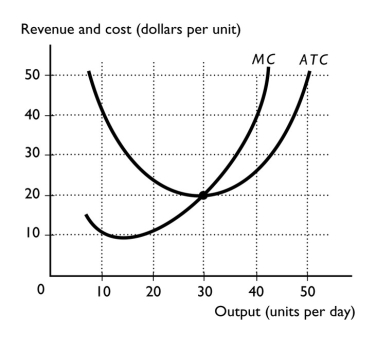 -The figure above shows a perfectly competitive firm.If the market price is $20 per unit, then the firm produces ________ units and makes an economic profit that is ________.
 (Multiple Choice)
4.8/5 (93)
(93) 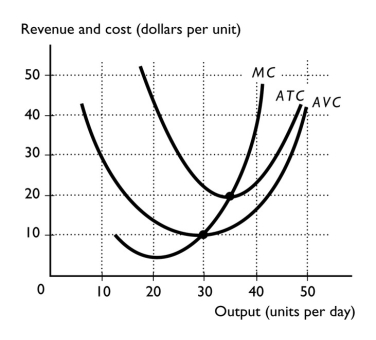 -The above figure shows a perfectly competitive firm.If the market price is $5 per unit, the firm
 (Multiple Choice)
4.9/5 (79)
(79) If Henry, a perfectly competitive lime grower in Southern California, can sell his limes at a price greater than his average total cost, Henry will
(Multiple Choice)
4.9/5 (85)
(85) 
Filters
- Essay(0)
- Multiple Choice(0)
- Short Answer(0)
- True False(0)
- Matching(0)