



 Chat with AI
Exam 8: Taxes

Exam 1: Getting Started337 Questions
Exam 2: The Usand Global Economies201 Questions
Exam 3: The Economic Problem273 Questions
Exam 4: Demand and Supply322 Questions
Exam 5: Elasticities of Demand and Supply335 Questions
Exam 6: Efficiency and Fairness of Markets352 Questions
Exam 7: Government Actions in Markets239 Questions
Exam 8: Taxes267 Questions
Exam 9: Global Markets in Action276 Questions
Exam 10: Externalities300 Questions
Exam 11: Public Goods and Common Resources177 Questions
Exam 12: Markets With Private Information101 Questions
Exam 13: Consumer Choice and Demand287 Questions
Exam 14: Production and Cost266 Questions
Exam 15: Perfect Competition275 Questions
Exam 16: Monopoly377 Questions
Exam 17: Monopolistic Competition213 Questions
Exam 18: Oligopoly222 Questions
Exam 19: Markets for Factors of Production178 Questions
Exam 20: Economic Inequality155 Questions
Select questions type


If the government eliminates a tax on a good with a perfectly elastic supply, who benefits most?
(Multiple Choice)
5.0/5  (92)
(92) In the Village of Punjab, Sheryl owns a well, which is the only source of drinking water.The supply of water is perfectly inelastic at a quantity of 1,000 gallons of water per day.At a price of $2.00 per gallon, the quantity demanded per day is 1,000 gallons.The government imposes a $0.50 per gallon tax.
a∙After the tax is imposed, what is the price paid by the villagers? What is the price received by Sheryl?
b∙How much revenue does the government collect?
c∙What fraction of the tax does Sheryl pay? What fraction is paid by the villagers?
(Essay)
4.8/5 (73)
(73) What are the similarities and differences between horizontal and vertical equity?
(Essay)
4.9/5 (82)
(82) Which of the following taxes best illustrates the benefits principle of taxation?
(Multiple Choice)
4.9/5 (59)
(59) The marriage tax problem in the U.S.tax code is a problem involving which of the following?
(Multiple Choice)
4.9/5 (74)
(74) Because the supply of capital is highly elastic, taxing the income from capital results in
I∙firms that demand capital paying the greater share of the tax.
Ii∙a decrease in the equilibrium quantity of capital.
Iii∙a deadweight loss.
(Multiple Choice)
4.8/5 (87)
(87) 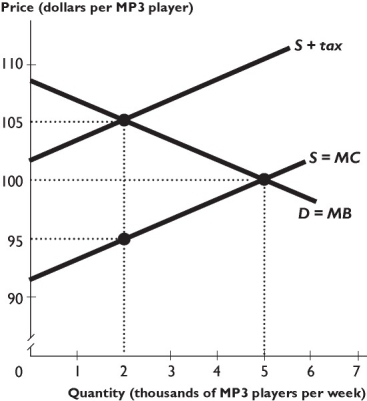 The figure above shows the market for MP3 players, where S is the supply curve and D is the demand curve before any tax is imposed. The government imposes a $10 per unit tax on sellers of MP3 players.
-Based on the figure above, after the tax is imposed the consumer surplus
The figure above shows the market for MP3 players, where S is the supply curve and D is the demand curve before any tax is imposed. The government imposes a $10 per unit tax on sellers of MP3 players.
-Based on the figure above, after the tax is imposed the consumer surplus (Multiple Choice)
4.8/5 (74)
(74) Explain under what conditions a sales tax on a specific good would be paid entirely by buyers.
(Essay)
4.9/5 (80)
(80)  -The figure above shows the labor supply and labor demand curves for personal trainers in the state of Florida.The initial equilibrium hourly wage is $10.Suppose the state of Florida institutes an income tax on labor income of $6 an hour in order to buy voting machines for the next election.How much of the tax is paid by employers?
 (Multiple Choice)
4.9/5 (83)
(83)  -The above figure shows the labor market for land surveyors.Dave is a land surveyor.The total tax paid by Dave's employer is equal to
 (Multiple Choice)
4.8/5 (82)
(82) Neither the supply of nor demand for a good is perfectly elastic or perfectly inelastic.So, imposing a tax on the good results in a ________ in the price received and kept by sellers and a ________ in the price paid by buyers.
(Multiple Choice)
4.8/5 (91)
(91)  -The above figure shows the market for capital.With the tax on capital income, the total tax paid is equal to
 (Multiple Choice)
4.9/5 (72)
(72) Suppose that, after government imposed an income tax on labor income, the wages paid by employers rose $1.00 and the wages received by employees fell by $0.20.What does that reveal about the elasticities of supply and demand?
(Multiple Choice)
4.9/5 (74)
(74)  -The demand for apple pies is perfectly elastic.If the government taxes apple pies at $1 a pie, then ________.
 (Multiple Choice)
4.8/5 (81)
(81) If the demand curve for a good is horizontal, a tax is levied on this product is
(Multiple Choice)
5.0/5 (80)
(80) If a $10 sales tax is imposed on a good and the equilibrium price increases by $10, the tax is
(Multiple Choice)
4.8/5 (85)
(85) Suppose everybody paid the same total amount of tax regardless of their income.This type of tax system would be
(Multiple Choice)
4.9/5 (80)
(80) 
Filters
- Essay(0)
- Multiple Choice(0)
- Short Answer(0)
- True False(0)
- Matching(0)