



 Chat with AI
Exam 8: Taxes

Exam 1: Getting Started337 Questions
Exam 2: The Usand Global Economies201 Questions
Exam 3: The Economic Problem273 Questions
Exam 4: Demand and Supply322 Questions
Exam 5: Elasticities of Demand and Supply335 Questions
Exam 6: Efficiency and Fairness of Markets352 Questions
Exam 7: Government Actions in Markets239 Questions
Exam 8: Taxes267 Questions
Exam 9: Global Markets in Action276 Questions
Exam 10: Externalities300 Questions
Exam 11: Public Goods and Common Resources177 Questions
Exam 12: Markets With Private Information101 Questions
Exam 13: Consumer Choice and Demand287 Questions
Exam 14: Production and Cost266 Questions
Exam 15: Perfect Competition275 Questions
Exam 16: Monopoly377 Questions
Exam 17: Monopolistic Competition213 Questions
Exam 18: Oligopoly222 Questions
Exam 19: Markets for Factors of Production178 Questions
Exam 20: Economic Inequality155 Questions
Select questions type


The elasticity of supply of capital is larger than the elasticity of supply of land, so a tax on capital income has ________ deadweight loss and a ________ effect on the equilibrium quantity than does an equal tax on land.
(Multiple Choice)
4.7/5  (75)
(75) Which of the following taxes best illustrate the ability-to-pay principle of tax fairness?
(Multiple Choice)
4.8/5 (79)
(79) If the supply of automobiles becomes more inelastic, then a tax on automobiles is
(Multiple Choice)
4.9/5 (82)
(82) 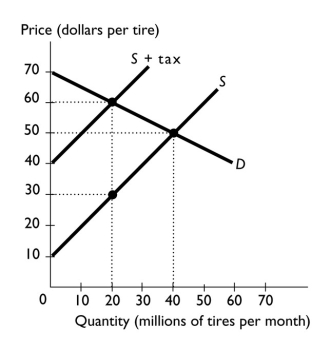 -The figure above shows the market for tires.According to the figure, the price elasticity of demand is ________ the price elasticity of supply.
 (Multiple Choice)
4.9/5 (67)
(67) Suppose the government decides to tax salt.The demand for salt is inelastic and the supply is quite elastic.Who bears most of the tax incidence and pays most of this tax?
(Essay)
4.9/5 (94)
(94)  -The above figure shows the labor market for land surveyors.The total amount collected as taxes equals
 (Multiple Choice)
4.7/5 (90)
(90) 
Filters
- Essay(0)
- Multiple Choice(0)
- Short Answer(0)
- True False(0)
- Matching(0)