



 Chat with AI
Exam 8: Taxes

Exam 1: Getting Started337 Questions
Exam 2: The Usand Global Economies201 Questions
Exam 3: The Economic Problem273 Questions
Exam 4: Demand and Supply322 Questions
Exam 5: Elasticities of Demand and Supply335 Questions
Exam 6: Efficiency and Fairness of Markets352 Questions
Exam 7: Government Actions in Markets239 Questions
Exam 8: Taxes267 Questions
Exam 9: Global Markets in Action276 Questions
Exam 10: Externalities300 Questions
Exam 11: Public Goods and Common Resources177 Questions
Exam 12: Markets With Private Information101 Questions
Exam 13: Consumer Choice and Demand287 Questions
Exam 14: Production and Cost266 Questions
Exam 15: Perfect Competition275 Questions
Exam 16: Monopoly377 Questions
Exam 17: Monopolistic Competition213 Questions
Exam 18: Oligopoly222 Questions
Exam 19: Markets for Factors of Production178 Questions
Exam 20: Economic Inequality155 Questions
Select questions type


A tax for which the average tax rate decreases as income increases is defined as
(Multiple Choice)
4.8/5  (88)
(88)  The figure above shows the market for MP3 players, where S is the supply curve and D is the demand curve before any tax is imposed. The government imposes a $10 per unit tax on sellers of MP3 players.
-Based on the figure above, the tax ________ the price paid by the buyer by ________ per MP3 player.
The figure above shows the market for MP3 players, where S is the supply curve and D is the demand curve before any tax is imposed. The government imposes a $10 per unit tax on sellers of MP3 players.
-Based on the figure above, the tax ________ the price paid by the buyer by ________ per MP3 player. (Multiple Choice)
4.8/5 (61)
(61)  -The above figure shows the labor market for land surveyors.Dave is a land surveyor.If there was no income tax, Dave would work ________ hours per year and the wage rate would be ________ per hour.
 (Multiple Choice)
4.8/5 (81)
(81) If the elasticity of demand for a product equals 3 and the supply is perfectly elastic, then if a tax is imposed on this product,
(Multiple Choice)
4.9/5 (76)
(76) Using fuel taxes to pay for maintaining public highways is an example of
(Multiple Choice)
4.7/5 (73)
(73) 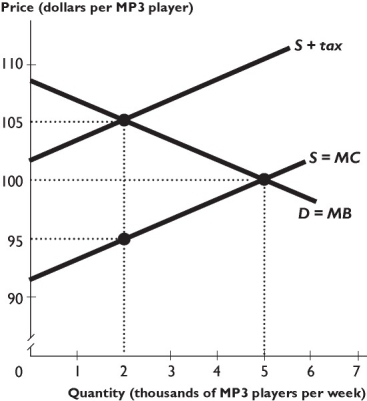 The figure above shows the market for MP3 players, where S is the supply curve and D is the demand curve before any tax is imposed. The government imposes a $10 per unit tax on sellers of MP3 players.
-In the figure above, at the market equilibrium with the tax, marginal benefit ________ marginal cost, and the quantity of MP3 players sold is ________.
The figure above shows the market for MP3 players, where S is the supply curve and D is the demand curve before any tax is imposed. The government imposes a $10 per unit tax on sellers of MP3 players.
-In the figure above, at the market equilibrium with the tax, marginal benefit ________ marginal cost, and the quantity of MP3 players sold is ________. (Multiple Choice)
4.9/5 (83)
(83)
The figure above shows the market for MP3 players, where S is the supply curve and D is the demand curve before any tax is imposed. The government imposes a $10 per unit tax on sellers of MP3 players.
-Based on the figure above, the deadweight loss from the tax is
The figure above shows the market for MP3 players, where S is the supply curve and D is the demand curve before any tax is imposed. The government imposes a $10 per unit tax on sellers of MP3 players.
-Based on the figure above, the deadweight loss from the tax is (Multiple Choice)
4.8/5 (77)
(77) Why are sales taxes, which require that everyone pay the same percentage tax, considered regressive taxes?
(Essay)
4.7/5 (77)
(77) The proposition that taxpayers with the same ability to pay should pay the same taxes is called
(Multiple Choice)
4.8/5 (72)
(72) Suppose the government imposes a $1 per gallon per gallon tax on sellers of gasoline.As a result, the
(Multiple Choice)
4.9/5 (70)
(70) If the average tax rate remains constant as income changes, the tax is
(Multiple Choice)
4.9/5 (87)
(87) If we look at the percentage of total tax revenue collected by different taxes in the United States, we see that
(Multiple Choice)
4.8/5 (70)
(70) To calculate the revenue government receives when a tax is imposed on a good, multiply the
(Multiple Choice)
4.9/5 (83)
(83) 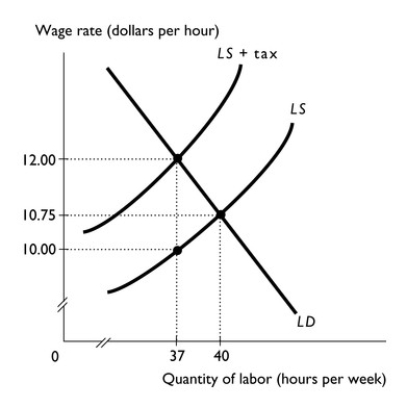 -The figure above shows a labor market in which an income tax has been imposed.
a∙How many hours of labor were employed before the tax was imposed?
b∙How many hours of labor are employed after the tax?
c∙What was the wage rate employers paid and that workers received before the tax?
d∙What is the wage rate employers pay and that workers receive after the tax?
e∙What accounts for the difference between what employers pay and what workers receive?
-The figure above shows a labor market in which an income tax has been imposed.
a∙How many hours of labor were employed before the tax was imposed?
b∙How many hours of labor are employed after the tax?
c∙What was the wage rate employers paid and that workers received before the tax?
d∙What is the wage rate employers pay and that workers receive after the tax?
e∙What accounts for the difference between what employers pay and what workers receive? (Essay)
4.8/5 (71)
(71) Suppose the demand for specialty car license plates is perfectly inelastic and the supply curve for specialty license plates is upward sloping.A tax is imposed on specialty license plates.Which of the following is true?
(Multiple Choice)
4.9/5 (81)
(81) The imposition of a tax on a good enables the government to
(Multiple Choice)
4.8/5 (82)
(82)
-The above figure shows the labor market for land surveyors.Dave is a land surveyor.With the income tax, Dave works ________ hours per year and his after-tax wage rate is ________ per hour.
-The above figure shows the labor market for land surveyors.Dave is a land surveyor.With the income tax, Dave works ________ hours per year and his after-tax wage rate is ________ per hour. (Multiple Choice)
4.8/5 (95)
(95) 
Filters
- Essay(0)
- Multiple Choice(0)
- Short Answer(0)
- True False(0)
- Matching(0)