



 Chat with AI
Exam 14: Oligopoly: Firms in Less Competitive Markets

Exam 1: Economics: Foundations and Models234 Questions
Exam 2: Trade-Offs, Comparative Advantage, and the Market System258 Questions
Exam 3: Where Prices Come From: the Interaction of Demand and Supply242 Questions
Exam 4: Economic Efficiency, Government Price Setting, and Taxes208 Questions
Exam 5: Externalities, Environmental Policy, and Public Goods263 Questions
Exam 6: Elasticity: the Responsiveness of Demand and Supply295 Questions
Exam 7: The Economics of Health Care171 Questions
Exam 8: Firms, the Stock Market, and Corporate Governance264 Questions
Exam 9: Comparative Advantage and the Gains From International Trade188 Questions
Exam 10: Consumer Choice and Behavioral Economics300 Questions
Exam 11: Technology, Production, and Costs328 Questions
Exam 12: Firms in Perfectly Competitive Markets296 Questions
Exam 13: Monopolistic Competition: the Competitive Model in a More Realistic Setting274 Questions
Exam 14: Oligopoly: Firms in Less Competitive Markets259 Questions
Exam 15: Monopoly and Antitrust Policy279 Questions
Exam 16: Pricing Strategy261 Questions
Exam 17: The Markets for Labor and Other Factors of Production281 Questions
Exam 18: Public Choice, Taxes, and the Distribution of Income258 Questions
Select questions type


A situation in which each firm chooses the best strategy given the strategies chosen by other firms is called a
(Multiple Choice)
4.9/5  (69)
(69) Suppose two firms in a duopoly implicitly collude and charge a high price.How might each firm benefit from advertising that it will match the lowest price offered by its competitor?
(Multiple Choice)
4.9/5 (73)
(73) If firms are protected by substantial barriers to entry, short-run profits can turn into long-run profits.
(True/False)
4.7/5 (77)
(77) Table 14-3
 Suppose OPEC has only two producers, Saudi Arabia and Nigeria.Saudi Arabia has far more oil reserves and is the lower-cost producer compared to Nigeria.The payoff matrix in Table 14-3 shows the profits earned per day by each country."Low output" corresponds to producing the OPEC assigned quota and "high output" corresponds to producing the maximum capacity beyond the assigned quota.
-Refer to Table 14-3.What is the Nash equilibrium in this game?
Suppose OPEC has only two producers, Saudi Arabia and Nigeria.Saudi Arabia has far more oil reserves and is the lower-cost producer compared to Nigeria.The payoff matrix in Table 14-3 shows the profits earned per day by each country."Low output" corresponds to producing the OPEC assigned quota and "high output" corresponds to producing the maximum capacity beyond the assigned quota.
-Refer to Table 14-3.What is the Nash equilibrium in this game? (Multiple Choice)
4.9/5 (86)
(86) In Michael Porter's five competitive forces model, what do the competitive forces determine?
(Essay)
4.9/5 (82)
(82) Price leadership is a form of explicit collusion where one firm in an oligopoly announces a price change and expects all other firms to follow suit.
(True/False)
4.9/5 (75)
(75) An example of a supplier that used its bargaining power to charge high prices to its customers is
(Multiple Choice)
4.8/5 (66)
(66) Figure 14-7
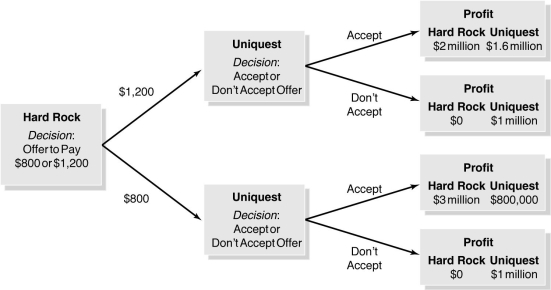 -Refer to Figure 14-7.Uniguest, Inc.is a company that provides PCs with internet access and touch-sensitive screens to hotels.Suppose the Hard Rock Hotel and Casino in Las Vegas informs Uniguest that it is considering installing these systems in its hotel rooms.The Hard Rock expects to be able to charge higher prices for these rooms if it installs Uniguest's systems in its rooms.The two companies begin bargaining over what price the Hard Rock will pay Uniguest for its systems, and the decision tree shown above illustrates this bargaining game.Note that the profit figures listed in the decision tree are additional profits for the Hard Rock and total profits for Uniguest.
a.Suppose the Hard Rock offers Uniguest $1,200 per system.Will Uniguest accept or reject this offer? Why?
b.Suppose the Hard Rock offers Uniguest $800 per system.Will Uniguest accept or reject this offer? Why?
c.Suppose Uniguest attempts to obtain a favorable outcome from the bargaining by telling the Hard Rock it will reject an $800-per-system offer.If the Hard Rock does not believe the threat is credible, what will it do? Why? What will Uniguest do? Why?
d.Is there a subgame-perfect equilibrium in this situation? Explain.
-Refer to Figure 14-7.Uniguest, Inc.is a company that provides PCs with internet access and touch-sensitive screens to hotels.Suppose the Hard Rock Hotel and Casino in Las Vegas informs Uniguest that it is considering installing these systems in its hotel rooms.The Hard Rock expects to be able to charge higher prices for these rooms if it installs Uniguest's systems in its rooms.The two companies begin bargaining over what price the Hard Rock will pay Uniguest for its systems, and the decision tree shown above illustrates this bargaining game.Note that the profit figures listed in the decision tree are additional profits for the Hard Rock and total profits for Uniguest.
a.Suppose the Hard Rock offers Uniguest $1,200 per system.Will Uniguest accept or reject this offer? Why?
b.Suppose the Hard Rock offers Uniguest $800 per system.Will Uniguest accept or reject this offer? Why?
c.Suppose Uniguest attempts to obtain a favorable outcome from the bargaining by telling the Hard Rock it will reject an $800-per-system offer.If the Hard Rock does not believe the threat is credible, what will it do? Why? What will Uniguest do? Why?
d.Is there a subgame-perfect equilibrium in this situation? Explain. (Essay)
4.8/5 (83)
(83) The approach economists use to analyze competition among oligopolists is called
(Multiple Choice)
4.8/5 (74)
(74) Which of the following is not a reason why government officials are willing to impose entry barriers?
(Multiple Choice)
4.9/5 (85)
(85) In many business situations one firm will act first, and then other firms will respond.To help analyze these types of situations economists use
(Multiple Choice)
4.8/5 (74)
(74) In most business situations where firms compete, often they can escape the prisoner's dilemma and reach the most profitable outcome.Which of the following is a reason for this?
(Multiple Choice)
4.8/5 (82)
(82) The fraction of an industry's sales that are accounted for by the largest firms is called
(Multiple Choice)
4.8/5 (65)
(65) Table 14-7
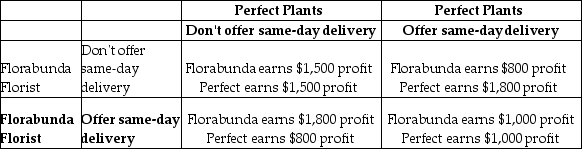 The payoff matrix shown above assumes that Perfect Plants and Florabunda Florist must decide whether to offer same-day delivery for their products.The matrix shows how much profit each firm will earn if it does or does not offer same-day delivery.The amount of profit for one firm depends on whether the other firm offers same-day delivery.
-Refer to Table 14-7.Which of the following statements is true?
The payoff matrix shown above assumes that Perfect Plants and Florabunda Florist must decide whether to offer same-day delivery for their products.The matrix shows how much profit each firm will earn if it does or does not offer same-day delivery.The amount of profit for one firm depends on whether the other firm offers same-day delivery.
-Refer to Table 14-7.Which of the following statements is true? (Multiple Choice)
4.7/5 (95)
(95) A table that shows the possible payoffs each firm earns from every combination of strategies by all firms is called
(Multiple Choice)
4.8/5 (80)
(80) Occupational licensing is an example of an entry barrier that improves a country's standard of living.
(True/False)
4.8/5 (87)
(87) As a measure of competition in an industry, concentration ratios have several flaws.One of these flaws is that concentration ratios
(Multiple Choice)
4.7/5 (79)
(79) 
Filters
- Essay(0)
- Multiple Choice(0)
- Short Answer(0)
- True False(0)
- Matching(0)