



 Chat with AI
Exam 14: Oligopoly: Firms in Less Competitive Markets

Exam 1: Economics: Foundations and Models234 Questions
Exam 2: Trade-Offs, Comparative Advantage, and the Market System258 Questions
Exam 3: Where Prices Come From: the Interaction of Demand and Supply242 Questions
Exam 4: Economic Efficiency, Government Price Setting, and Taxes208 Questions
Exam 5: Externalities, Environmental Policy, and Public Goods263 Questions
Exam 6: Elasticity: the Responsiveness of Demand and Supply295 Questions
Exam 7: The Economics of Health Care171 Questions
Exam 8: Firms, the Stock Market, and Corporate Governance264 Questions
Exam 9: Comparative Advantage and the Gains From International Trade188 Questions
Exam 10: Consumer Choice and Behavioral Economics300 Questions
Exam 11: Technology, Production, and Costs328 Questions
Exam 12: Firms in Perfectly Competitive Markets296 Questions
Exam 13: Monopolistic Competition: the Competitive Model in a More Realistic Setting274 Questions
Exam 14: Oligopoly: Firms in Less Competitive Markets259 Questions
Exam 15: Monopoly and Antitrust Policy279 Questions
Exam 16: Pricing Strategy261 Questions
Exam 17: The Markets for Labor and Other Factors of Production281 Questions
Exam 18: Public Choice, Taxes, and the Distribution of Income258 Questions
Select questions type


Consider two oligopolistic industries selling the same product in different locations.In the first industry, firms always match price changes by any other firm in the industry.In the second industry, firms always ignore price changes by any other firm.Which of the following statements is true about these two industries, holding everything else constant?
(Multiple Choice)
4.8/5  (66)
(66) In a decision tree, the difference between a decision node and a terminal node is that
(Multiple Choice)
4.7/5 (85)
(85) Table 14-8
 Two rival oligopolists in the athletic supplements industry, the Power Fuel Company and the Brawny Juice Company, have to decide on their pricing strategy.Each can choose either a high price or a low price.Table 14-8 shows the payoff matrix with the profits that each firm can expect to earn depending on the pricing strategy it adopts.
-Refer to Table 14-8.Which of the following is true?
Two rival oligopolists in the athletic supplements industry, the Power Fuel Company and the Brawny Juice Company, have to decide on their pricing strategy.Each can choose either a high price or a low price.Table 14-8 shows the payoff matrix with the profits that each firm can expect to earn depending on the pricing strategy it adopts.
-Refer to Table 14-8.Which of the following is true? (Multiple Choice)
4.9/5 (84)
(84) Figure 14-2
 The government of a developing country plans to award two firms, Gigacom and Xenophone, the exclusive rights to share the market for high speed internet service.Gigacom and Xenophone can both provide the service either via television cable lines or via direct subscriber line (DSL).Suppose the government is considering a proposal to delay one firm's entry into the market on the grounds that it wants to prevent "harmful" competition.Figure 14-2 shows the decision tree for this game.
-Refer to Figure 14-2.Now suppose that the government delays Xenophone's entry and Gigacom moves first, what is the likely outcome in the market?
The government of a developing country plans to award two firms, Gigacom and Xenophone, the exclusive rights to share the market for high speed internet service.Gigacom and Xenophone can both provide the service either via television cable lines or via direct subscriber line (DSL).Suppose the government is considering a proposal to delay one firm's entry into the market on the grounds that it wants to prevent "harmful" competition.Figure 14-2 shows the decision tree for this game.
-Refer to Figure 14-2.Now suppose that the government delays Xenophone's entry and Gigacom moves first, what is the likely outcome in the market? (Multiple Choice)
4.8/5 (82)
(82) Suppose we want to use game theory to analyze how an oligopolist selects its optimal price.The cells of the payoff matrix show
(Multiple Choice)
4.8/5 (68)
(68) There is much evidence to suggest that airlines are more likely to match price cuts than price increases.Which of the following best explains this evidence?
(Multiple Choice)
4.9/5 (79)
(79) Decision trees are commonly used to illustrate how firms make business decisions that depend on the actions of rival firms.A decision tree has boxes that contain points that represent when firms must make the decisions contained in the boxes.What are these points called?
(Multiple Choice)
4.9/5 (90)
(90) Because many business situations are repeated games, firms may be able to avoid the prisoner's dilemma and implicitly collude to keep prices high.
(True/False)
4.8/5 (80)
(80) An equilibrium in a game in which players pursue their own self-interest is called
(Multiple Choice)
4.7/5 (69)
(69) Table 14-4
 Alistair Luggage and Baine Baggage are the only firms selling luggage in the upscale town of Montecito.Each firm must decide on whether to increase its advertising budget to compete for customers.If one firm increases its advertising budget but the other does not, then the firm with the higher advertising budget will increase its profit.Table 14-4 shows the payoff matrix for this advertising game.
-Refer to Table 14-4.If Alistair assumes that Baine would increase its advertising budget, what should it do?
Alistair Luggage and Baine Baggage are the only firms selling luggage in the upscale town of Montecito.Each firm must decide on whether to increase its advertising budget to compete for customers.If one firm increases its advertising budget but the other does not, then the firm with the higher advertising budget will increase its profit.Table 14-4 shows the payoff matrix for this advertising game.
-Refer to Table 14-4.If Alistair assumes that Baine would increase its advertising budget, what should it do? (Multiple Choice)
4.9/5 (85)
(85) Collusion makes firms better off because if they act as a single entity (a cartel)they can reduce output and increase their prices and profits.But some cartels have failed and others are unstable.Which of the following is a reason why cartels often break down?
(Multiple Choice)
4.9/5 (80)
(80) Table 14-5
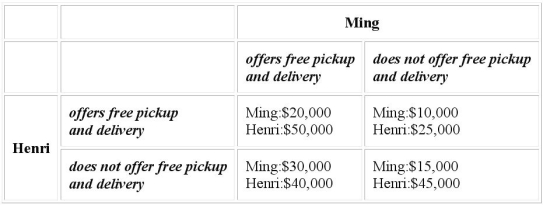 Ming and Henri each run one of the two dry cleaning facilities in the town of Scaraby.Both consider offering free pickup and delivery services.Table 14-5 shows the payoff matrix containing the expected quarterly profits for each firm.
-Refer to Table 14-5.What is the Nash equilibrium in this game?
Ming and Henri each run one of the two dry cleaning facilities in the town of Scaraby.Both consider offering free pickup and delivery services.Table 14-5 shows the payoff matrix containing the expected quarterly profits for each firm.
-Refer to Table 14-5.What is the Nash equilibrium in this game? (Multiple Choice)
4.9/5 (67)
(67) Which of the following statements about the prisoner's dilemma is false?
(Multiple Choice)
4.8/5 (82)
(82) OPEC periodically meets to agree to restrict the cartel's oil output, and yet almost every member of OPEC produces more than its own output quota.This suggests that OPEC has
(Multiple Choice)
5.0/5 (81)
(81) Which of the following economists did not help to develop game theory analysis?
(Multiple Choice)
4.8/5 (65)
(65) According to Porter's Five Competitive Forces Model, which kinds of products are most likely to limit the ability of firms in an industry to raise prices?
(Multiple Choice)
4.8/5 (77)
(77) 
Filters
- Essay(0)
- Multiple Choice(0)
- Short Answer(0)
- True False(0)
- Matching(0)