



 Chat with AI
Exam 14: Oligopoly: Firms in Less Competitive Markets

Exam 1: Economics: Foundations and Models234 Questions
Exam 2: Trade-Offs, Comparative Advantage, and the Market System258 Questions
Exam 3: Where Prices Come From: the Interaction of Demand and Supply242 Questions
Exam 4: Economic Efficiency, Government Price Setting, and Taxes208 Questions
Exam 5: Externalities, Environmental Policy, and Public Goods263 Questions
Exam 6: Elasticity: the Responsiveness of Demand and Supply295 Questions
Exam 7: The Economics of Health Care171 Questions
Exam 8: Firms, the Stock Market, and Corporate Governance264 Questions
Exam 9: Comparative Advantage and the Gains From International Trade188 Questions
Exam 10: Consumer Choice and Behavioral Economics300 Questions
Exam 11: Technology, Production, and Costs328 Questions
Exam 12: Firms in Perfectly Competitive Markets296 Questions
Exam 13: Monopolistic Competition: the Competitive Model in a More Realistic Setting274 Questions
Exam 14: Oligopoly: Firms in Less Competitive Markets259 Questions
Exam 15: Monopoly and Antitrust Policy279 Questions
Exam 16: Pricing Strategy261 Questions
Exam 17: The Markets for Labor and Other Factors of Production281 Questions
Exam 18: Public Choice, Taxes, and the Distribution of Income258 Questions
Select questions type


There are two firms in the residential paint industry, Cool Shades (C)and Warm Hues (W).They collude to share the market equally.They jointly set a monopoly price and split the quantity demanded at that price.Here are their options:
i.They continue to collude (no cheating)and make $12 million each in profits.
ii.One firm cheats and the other does not.The firm that cheats makes a profit
of $14 million whereas the firm that doesn't makes a profit of $9 million.
iii.They both cheat and each firm makes a profit of $7 million.
a.Construct a payoff matrix for these two firms.
b.How does this situation relate to the prisoner's dilemma?
c.If each firm acted noncooperatively, how much profit would each make?
d.Are the firms better off colluding (with no cheating)or competing? Explain.
(Essay)
4.9/5  (77)
(77) Consider two single-malt whiskey distillers, Laphroaig and Knockando.If they advertise, they can both sell more whiskey and increase their revenue.However, the cost of advertising more than offsets the increased revenue so that each distiller ends up with a lower profit than if they do not advertise.On the other hand, if only one advertises, that distiller increases its market share and also its profit.
a.Construct a payoff matrix using the following hypothetical information: If neither distiller advertises: each earns a profit of $35 million per year.If both advertise: each earns a profit of $20 million per year.If one advertises and the other does not: the distiller who advertises earns a profit of $50 million and the distiller who does not advertise earns a profit of $9 million.
b.If the two distillers agree to coordinate their strategies, what is the outcome?
(Essay)
4.8/5 (76)
(76) The prisoner's dilemma is used to analyze business situations in which one firm acts first and then other firms respond.
(True/False)
4.8/5 (82)
(82) The equilibrium in the prisoner's dilemma is a dominant strategy Nash equilibrium.
(True/False)
4.9/5 (85)
(85) In a Nash equilibrium, all players select non-dominant strategies.
(True/False)
4.9/5 (77)
(77) One reason why, in the last four decades, the number of new auto makers in the world has been very small compared to the past is that
(Multiple Choice)
4.8/5 (69)
(69) Table 14-2
 Table 14-2 shows the payoff matrix for Wal-Mart and Target from every combination of pricing strategies for the popular PlayStation 4.At the start of the game each firm charges a low price and each earns a profit of $7,000.
-Refer to Table 14-2.Is the current strategy in which each firm charges the low price and earns a profit of $7,000 a Nash equilibrium? If not, why and what is the Nash equilibrium?
Table 14-2 shows the payoff matrix for Wal-Mart and Target from every combination of pricing strategies for the popular PlayStation 4.At the start of the game each firm charges a low price and each earns a profit of $7,000.
-Refer to Table 14-2.Is the current strategy in which each firm charges the low price and earns a profit of $7,000 a Nash equilibrium? If not, why and what is the Nash equilibrium? (Multiple Choice)
4.8/5 (70)
(70) Table 14-1
 Godrickporter and Star Connections are the only two airport shuttle and limousine rental service companies in the mid-sized town of Godrick Hollow.Each firm must decide on whether to increase its advertising spending to compete for customers.Table 14-1 shows the payoff matrix for this advertising game.
-Refer to Table 14-1.Is there a dominant strategy for Godrickporter and if so, what is it?
Godrickporter and Star Connections are the only two airport shuttle and limousine rental service companies in the mid-sized town of Godrick Hollow.Each firm must decide on whether to increase its advertising spending to compete for customers.Table 14-1 shows the payoff matrix for this advertising game.
-Refer to Table 14-1.Is there a dominant strategy for Godrickporter and if so, what is it? (Multiple Choice)
4.7/5 (72)
(72) An equilibrium in which each player chooses its best strategy given the strategies chosen by the other players is called a Nash equilibrium.
(True/False)
4.7/5 (85)
(85) Who won a Nobel Prize in economics for his work in the development of game theory?
(Multiple Choice)
4.8/5 (96)
(96) Which of the following is not a shortcoming of the concentration ratio as a measure of the extent of competition in an industry?
(Multiple Choice)
4.9/5 (68)
(68) The Organization of Petroleum Exporting Countries (OPEC)controls about 75 percent of the world's proven oil reserves.Economists refer to OPEC as a cartel because
(Multiple Choice)
4.7/5 (82)
(82) Table 14-5
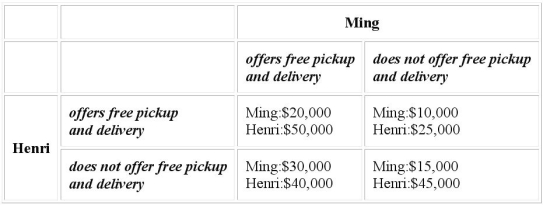 Ming and Henri each run one of the two dry cleaning facilities in the town of Scaraby.Both consider offering free pickup and delivery services.Table 14-5 shows the payoff matrix containing the expected quarterly profits for each firm.
-Refer to Table 14-5.Does Henri have a dominant strategy? If yes, what is it?
Ming and Henri each run one of the two dry cleaning facilities in the town of Scaraby.Both consider offering free pickup and delivery services.Table 14-5 shows the payoff matrix containing the expected quarterly profits for each firm.
-Refer to Table 14-5.Does Henri have a dominant strategy? If yes, what is it? (Multiple Choice)
4.8/5 (67)
(67) Which of the following explains why two firms, Apex and Bongo, would engage in implicit collusion, rather than explicit collusion?
(Multiple Choice)
4.8/5 (91)
(91) According to an article the Wall Street Journal, "The big car makers are pushing a wide
Array of new technology into production, responding to relentless competitive pressure,
Rising energy prices and consumer demand for better safety.
Source: Joseph B.White, "Ford, GM Eye Shift in Buying Habits," Wall Street Journal, May 22, 2006.
Which of Porter's competitive forces does this statement allude to?
(Multiple Choice)
4.8/5 (77)
(77) A member of a cartel earns more profits by producing more than its quota and selling at a price higher than the cartel's price.
(True/False)
4.8/5 (79)
(79) The study of how people make decisions in situations in which attaining their goals depends on their interactions with others is called
(Multiple Choice)
4.9/5 (86)
(86) In a sequential game, one firm will act first and then other firms will respond.
(True/False)
4.9/5 (69)
(69) 
Filters
- Essay(0)
- Multiple Choice(0)
- Short Answer(0)
- True False(0)
- Matching(0)