



 Chat with AI
Exam 10: Consumer Choice and Behavioral Economics

Exam 1: Economics: Foundations and Models234 Questions
Exam 2: Trade-Offs, Comparative Advantage, and the Market System258 Questions
Exam 3: Where Prices Come From: the Interaction of Demand and Supply242 Questions
Exam 4: Economic Efficiency, Government Price Setting, and Taxes208 Questions
Exam 5: Externalities, Environmental Policy, and Public Goods263 Questions
Exam 6: Elasticity: the Responsiveness of Demand and Supply295 Questions
Exam 7: The Economics of Health Care171 Questions
Exam 8: Firms, the Stock Market, and Corporate Governance264 Questions
Exam 9: Comparative Advantage and the Gains From International Trade188 Questions
Exam 10: Consumer Choice and Behavioral Economics300 Questions
Exam 11: Technology, Production, and Costs328 Questions
Exam 12: Firms in Perfectly Competitive Markets296 Questions
Exam 13: Monopolistic Competition: the Competitive Model in a More Realistic Setting274 Questions
Exam 14: Oligopoly: Firms in Less Competitive Markets259 Questions
Exam 15: Monopoly and Antitrust Policy279 Questions
Exam 16: Pricing Strategy261 Questions
Exam 17: The Markets for Labor and Other Factors of Production281 Questions
Exam 18: Public Choice, Taxes, and the Distribution of Income258 Questions
Select questions type


Professor Parallax chooses two students in his economics class, Jasmine and Cassandra, to participate in the ultimatum game.He chooses Jasmine to be the allocator and Cassandra to be the recipient.He gives Jasmine $50 and as the allocator, she gets to decide how to split the money with Cassandra.If Cassandra decides to accept the amount allocated to her by Jasmine, both students get to keep the money.If Cassandra decides to reject her allocation, neither student gets to keep the money.How much will each student end up with if each student acts as if fairness is important? How much will each student end up with if only Cassandra acts as if fairness is important? How much will each student end up with if neither student cares about fairness?
(Essay)
5.0/5  (68)
(68) Music writer Anthony Kuzminski praised rock star Tom Petty in a 2007 article in the online Unrated Magazine.Kuzminski wrote: "Something Petty never can get enough credit for is his fan-friendly attitude.He kept ticket prices for [his concerts] at $50 when other acts this summer are charging upwards of $100 for stadium gigs.Petty could charge more, but he doesn't see the point.He has stated time and time again he still makes millions when he's on the road, regardless of his ticket prices.He is the last of the fan friendly rock stars out there." Use economic reasoning to write a rationale for Tom Petty's decision to charge prices for his band's ("Tom Petty and the Heartbreakers")concerts that are less than market clearing prices.
Source: Anthony Kuzminski, "Tom Petty & The Heartbreakers at the Vic Theater" http://www.unratedmagazine.com/
(Essay)
4.9/5 (71)
(71) There are two conditions necessary for a consumer to maximize her utility.One is that the marginal utilities per dollar spent on each good and service consumed are equal.What is the other condition?
(Multiple Choice)
4.9/5 (70)
(70) Grant has $200 to spend each month on restaurant meals and jazz performances at his
neighborhood jazz club.The price of a typical restaurant meal is $20 and the price of a jazz performance ticket is $10.Grant is maximizing his utility by consuming 6 restaurant meals and attending 8 jazz performances.Suppose Grant still has $200 to spend, but the price of restaurant meal rises to $25, while the price of jazz performance ticket drops to $8.Is Grant better off or worse off than he was before the price change? Use a budget constraint/indifference curve graph to illustrate your answer.
(Essay)
4.9/5 (95)
(95) Costs that have already been incurred, and which cannot be recovered, are known as
(Multiple Choice)
4.9/5 (82)
(82) Which of the following statements about utility and preferences is false?
(Multiple Choice)
4.7/5 (83)
(83) Under J.C.Penney's everyday low pricing policy, the everyday low prices
(Multiple Choice)
4.9/5 (72)
(72) Arnie Ziffel has $20 per week to spend on any combination of pineapples and green tea.The price of a pineapple is $4 and the price of a bottle of green tea is $2.The table below shows Arnie's utility values.Use the table to answer the questions that follow the table.
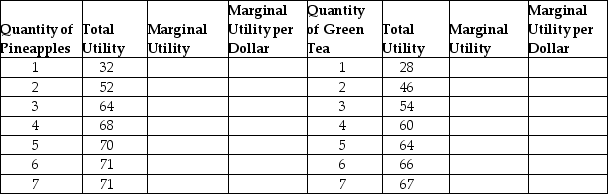 a.Complete the table by filling in the blank spaces.
b.Suppose Arnold purchases 4 pineapples and 2 bottles of green tea.Is he consuming the optimal consumption bundle? If so, explain why.If not, what combination should he buy and why?
a.Complete the table by filling in the blank spaces.
b.Suppose Arnold purchases 4 pineapples and 2 bottles of green tea.Is he consuming the optimal consumption bundle? If so, explain why.If not, what combination should he buy and why? (Essay)
4.8/5 (71)
(71) Consider the following factors:
A.culture
B.religion
C.customs
D.prices
E.income
Which of the factors above are likely to influence the choices consumers make?
(Multiple Choice)
4.8/5 (73)
(73) Suppose the consumer's income increases while the prices of the goods remain constant.Then the
(Multiple Choice)
4.9/5 (74)
(74) The additional utility that George receives from consuming one more slice of pizza is called
(Multiple Choice)
4.7/5 (78)
(78) In their surveys of consumers, Daniel Kaheman, Jack Knetsch and Richard Thaler found that
(Multiple Choice)
4.8/5 (83)
(83) The amount of income a consumer has to spend on goods and services is known as
(Multiple Choice)
4.8/5 (85)
(85) A curve that shows combinations of consumption bundles that give a consumer the same utility is called
(Multiple Choice)
4.9/5 (88)
(88) Figure 10-5
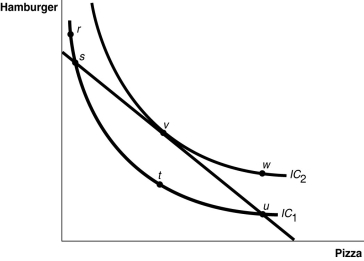 -Refer to Figure 10-5.Which of the following statements is true?
 (Multiple Choice)
4.9/5 (83)
(83) If total utility increases at a decreasing rate as a consumer consumes more coffee, then marginal utility must
(Multiple Choice)
4.9/5 (87)
(87) 
Filters
- Essay(0)
- Multiple Choice(0)
- Short Answer(0)
- True False(0)
- Matching(0)