



 Chat with AI
Exam 10: Consumer Choice and Behavioral Economics

Exam 1: Economics: Foundations and Models234 Questions
Exam 2: Trade-Offs, Comparative Advantage, and the Market System258 Questions
Exam 3: Where Prices Come From: the Interaction of Demand and Supply242 Questions
Exam 4: Economic Efficiency, Government Price Setting, and Taxes208 Questions
Exam 5: Externalities, Environmental Policy, and Public Goods263 Questions
Exam 6: Elasticity: the Responsiveness of Demand and Supply295 Questions
Exam 7: The Economics of Health Care171 Questions
Exam 8: Firms, the Stock Market, and Corporate Governance264 Questions
Exam 9: Comparative Advantage and the Gains From International Trade188 Questions
Exam 10: Consumer Choice and Behavioral Economics300 Questions
Exam 11: Technology, Production, and Costs328 Questions
Exam 12: Firms in Perfectly Competitive Markets296 Questions
Exam 13: Monopolistic Competition: the Competitive Model in a More Realistic Setting274 Questions
Exam 14: Oligopoly: Firms in Less Competitive Markets259 Questions
Exam 15: Monopoly and Antitrust Policy279 Questions
Exam 16: Pricing Strategy261 Questions
Exam 17: The Markets for Labor and Other Factors of Production281 Questions
Exam 18: Public Choice, Taxes, and the Distribution of Income258 Questions
Select questions type


Carolyn spends her income on popular magazines and music CDs.If the price of a CD is four times the price of a magazine and if Carolyn is maximizing her utility, she buys
(Multiple Choice)
4.8/5  (87)
(87) Behavioral economists examine choices that consumers make that are not economically rational.Economists generally assume that people are rational; that is, they weigh the benefits and costs of an action and choose an action only if the benefits outweigh the costs.Why do consumers not act rationally when the result is that they make themselves worse off?
(Essay)
4.8/5 (82)
(82) A new area of economics studies situations in which people appear to be making choices that do not appear to be economically rational.This area is called
(Multiple Choice)
5.0/5 (81)
(81) Identify the one statement that does not demonstrate how social effects influence consumer choice.
(Multiple Choice)
4.9/5 (82)
(82) Table 10-2
 Table 10-2 above shows Keira's utility from soup and sandwiches.The price of soup is $2 per cup and the price of a sandwich is $3.Keira has $18 to spend on these two goods.
-Refer to Table 10-2.If Keira maximizes her utility, how many units of each good should she buy?
Table 10-2 above shows Keira's utility from soup and sandwiches.The price of soup is $2 per cup and the price of a sandwich is $3.Keira has $18 to spend on these two goods.
-Refer to Table 10-2.If Keira maximizes her utility, how many units of each good should she buy? (Multiple Choice)
4.9/5 (80)
(80) A network externality refers to a situation in which the usefulness of a product decreases with the number of consumers who use it.
(True/False)
4.9/5 (89)
(89) For a demand curve to be upward sloping, the good would have to be an inferior good, and
(Multiple Choice)
4.9/5 (71)
(71) Which of the following is a common mistake made by consumers?
(Multiple Choice)
4.8/5 (85)
(85) If, when you consume another piece of candy, your marginal utility is zero, then
(Multiple Choice)
4.7/5 (90)
(90) Figure 10-8
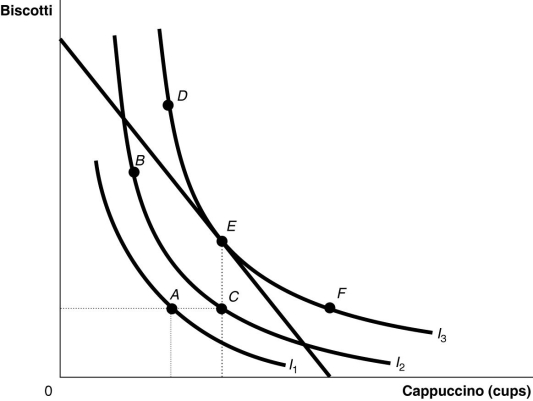 -Refer to Figure 10-8.Given the budget constraint in the diagram, which of the following statements is false?
 (Multiple Choice)
4.8/5 (70)
(70) Table 10-5
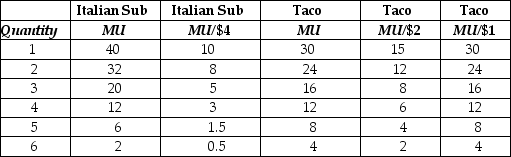 -Refer to Table 10-5, which lists the values of Harry Taber's marginal utility and marginal utility per dollar for Italian submarine (sub)sandwiches and tacos.Assume that the price of a sub sandwich is $4 and the price of a taco is $2.When Harry's income is $14, he buys two Italian sub sandwiches and three tacos.The last column lists the values of the marginal utility per dollar for tacos when the price of a taco decreases to $1.Complete this statement: As a result of the change in price, the marginal utility of each taco Harry consumes increases and
 (Multiple Choice)
4.8/5 (90)
(90) Standard economic theory asserts that sunk costs are irrelevant in making economic decisions, yet studies conducted by behavioral economists reveal that sunk costs often affect economic decisions.Which of the following could explain this observation?
(Multiple Choice)
4.8/5 (79)
(79) 
Filters
- Essay(0)
- Multiple Choice(0)
- Short Answer(0)
- True False(0)
- Matching(0)