



 Chat with AI
Exam 10: Consumer Choice and Behavioral Economics

Exam 1: Economics: Foundations and Models234 Questions
Exam 2: Trade-Offs, Comparative Advantage, and the Market System258 Questions
Exam 3: Where Prices Come From: the Interaction of Demand and Supply242 Questions
Exam 4: Economic Efficiency, Government Price Setting, and Taxes208 Questions
Exam 5: Externalities, Environmental Policy, and Public Goods263 Questions
Exam 6: Elasticity: the Responsiveness of Demand and Supply295 Questions
Exam 7: The Economics of Health Care171 Questions
Exam 8: Firms, the Stock Market, and Corporate Governance264 Questions
Exam 9: Comparative Advantage and the Gains From International Trade188 Questions
Exam 10: Consumer Choice and Behavioral Economics300 Questions
Exam 11: Technology, Production, and Costs328 Questions
Exam 12: Firms in Perfectly Competitive Markets296 Questions
Exam 13: Monopolistic Competition: the Competitive Model in a More Realistic Setting274 Questions
Exam 14: Oligopoly: Firms in Less Competitive Markets259 Questions
Exam 15: Monopoly and Antitrust Policy279 Questions
Exam 16: Pricing Strategy261 Questions
Exam 17: The Markets for Labor and Other Factors of Production281 Questions
Exam 18: Public Choice, Taxes, and the Distribution of Income258 Questions
Select questions type


Alan Krueger conducted a survey of fans at the 2001 Super Bowl who purchased tickets to the game for $325 or $400.Krueger found that (a)94 percent of those surveyed would not have paid $3,000 for their tickets, and (b)92 percent of those surveyed would not have sold their tickets for $3,000.These results are an example of
(Multiple Choice)
5.0/5  (87)
(87) Table 10-6
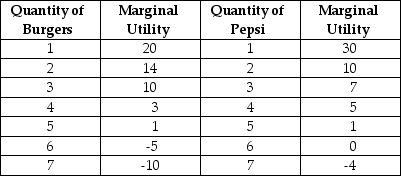 Table 10-6 lists Jay's marginal utilities for burgers and Pepsi.Jay has $7 to spend on these two goods.The price of a burger is $2 and the price of a can of Pepsi is $1.
-Refer to Table 10-6.What is Jay's optimal consumption bundle?
Table 10-6 lists Jay's marginal utilities for burgers and Pepsi.Jay has $7 to spend on these two goods.The price of a burger is $2 and the price of a can of Pepsi is $1.
-Refer to Table 10-6.What is Jay's optimal consumption bundle? (Multiple Choice)
4.7/5 (71)
(71) Which of the following describes the substitution effect of a price change?
(Multiple Choice)
4.9/5 (95)
(95) A common mistake made by consumers is the failure to take into account the monetary costs of their actions.
(True/False)
4.9/5 (90)
(90) All but one of the following economists were awarded a Nobel prize for their contributions to experimental economics and their explorations of the influence fairness has on consumer decision-making.Which economist did not receive a Nobel Prize for this work?
(Multiple Choice)
4.8/5 (82)
(82) Consumers maximize total utility within their budget constraint by
(Multiple Choice)
4.8/5 (80)
(80) The demand curve for an inferior good can never be downward sloping.
(True/False)
4.9/5 (80)
(80) The limitation that a consumer's total expenditure on goods and services purchased cannot exceed the income available is referred to as
(Multiple Choice)
4.9/5 (77)
(77) Suppose you pre-ordered a non-refundable movie ticket to X-Men: Apocalypse.On the day of the movie you decide that you would rather not go to the movie.According to economists, what is the rational thing to do?
(Multiple Choice)
4.8/5 (84)
(84) The average price of gasoline in your neighborhood is $2.15 per gallon.Your neighbor, Diana tells you that you can "save a lot" by frequenting a gas station 20 miles outside your neighborhood where the price of gasoline is $2.06 per gallon However, she cautions you that there are usually long lines at that station.Is her suggestion beneficial to you?
(Multiple Choice)
4.8/5 (72)
(72) If Paul decides to buy a $60 ticket to a Cirque du Soleil show rather than a $45 ticket for a Blue Man Group performance, we can conclude that
(Multiple Choice)
4.8/5 (79)
(79) Figure 10-1
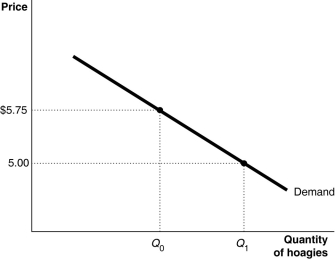 -Refer to Figure 10-1.Which of the following statements is true?
 (Multiple Choice)
5.0/5 (85)
(85) Figure 10-3
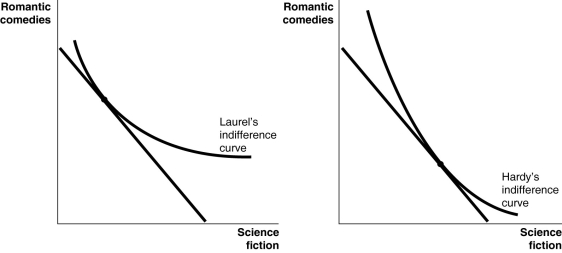 -Refer to Figure 10-3.Best friends Laurel and Hardy both enjoy watching romantic comedies and science fiction movies.Based on the diagrams above what can you conclude about their movie preferences?
 (Multiple Choice)
4.9/5 (85)
(85) Figure 10-2
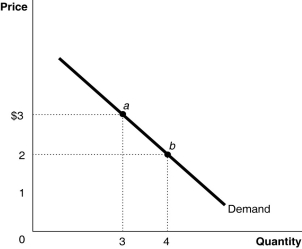 Figure 10-2 represents the demand for ice cream cones.
-Refer to Figure 10-2.Which of the following statements is true?
Figure 10-2 represents the demand for ice cream cones.
-Refer to Figure 10-2.Which of the following statements is true? (Multiple Choice)
4.8/5 (73)
(73) In a survey of consumers, Daniel Kaheman, Jack Knetsch and Richard Thaler asked their opinion of a hardware store's decision to
(Multiple Choice)
4.9/5 (81)
(81) Behavioral economics helps explain why customers ________ at J.C.Penney.
(Multiple Choice)
4.8/5 (78)
(78) The iPod is a product without any significant network externalities.
(True/False)
4.9/5 (90)
(90) 
Filters
- Essay(0)
- Multiple Choice(0)
- Short Answer(0)
- True False(0)
- Matching(0)