



 Chat with AI
Exam 13: Monopoly

Exam 1: What Is Economics212 Questions
Exam 2: The Economic Problem159 Questions
Exam 3: Demand and Supply198 Questions
Exam 4: Elasticity186 Questions
Exam 5: Efficiency and Equity121 Questions
Exam 6: Government Actions in Markets130 Questions
Exam 7: Global Markets in Action138 Questions
Exam 8: Utility and Demand120 Questions
Exam 9: Possibilities, Preferences, and Choices124 Questions
Exam 10: Organizing Production111 Questions
Exam 11: Output and Costs142 Questions
Exam 12: Perfect Competition117 Questions
Exam 13: Monopoly118 Questions
Exam 14: Monopolistic Competition122 Questions
Exam 15: Oligopoly106 Questions
Exam 16: Externalities116 Questions
Exam 17: Public Goods and Common Resources98 Questions
Exam 18: Markets for Factors of Production252 Questions
Select questions type


Use the figure below to answer the following questions.
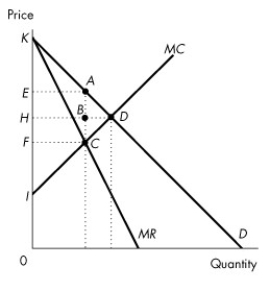 Figure 13.4.5
-Refer to Figure 13.4.5.What is the redistribution of surplus from consumers to the producer with a perfect price-discriminating monopoly, as compared to a perfectly competitive market?
Figure 13.4.5
-Refer to Figure 13.4.5.What is the redistribution of surplus from consumers to the producer with a perfect price-discriminating monopoly, as compared to a perfectly competitive market? (Multiple Choice)
4.7/5  (91)
(91) Which of the following quotes by a store manager describes price discrimination in action?
(Multiple Choice)
4.9/5 (82)
(82) Use the figure below to answer the following questions.
 Figure 13.4.2
-Refer to Figure 13.4.2.Assume this monopolist practises perfect price discrimination.What is the lowest price charged for tickets?
Figure 13.4.2
-Refer to Figure 13.4.2.Assume this monopolist practises perfect price discrimination.What is the lowest price charged for tickets? (Multiple Choice)
4.9/5 (91)
(91) Use the figure below to answer the following questions.
 Figure 13.4.6
-Prime Pharmaceuticals has developed a new asthma medicine, for which it has a patent.An inhaler can be produced at a constant marginal cost of $2 per inhaler.The demand curve, marginal revenue curve, and marginal cost curve for this new asthma inhaler are shown in Figure 13.4.6.The patent gives Prime Pharmaceuticals a monopoly for its new inhaler.If Prime Pharmaceuticals can perfectly price discriminate, then it
Figure 13.4.6
-Prime Pharmaceuticals has developed a new asthma medicine, for which it has a patent.An inhaler can be produced at a constant marginal cost of $2 per inhaler.The demand curve, marginal revenue curve, and marginal cost curve for this new asthma inhaler are shown in Figure 13.4.6.The patent gives Prime Pharmaceuticals a monopoly for its new inhaler.If Prime Pharmaceuticals can perfectly price discriminate, then it (Multiple Choice)
4.8/5 (74)
(74) Use the figure below to answer the following questions.
 Figure 13.3.3
-Consider the market demand curve in Figure 13.3.3.If the market is perfectly competitive, which area indicates consumer surplus?
Figure 13.3.3
-Consider the market demand curve in Figure 13.3.3.If the market is perfectly competitive, which area indicates consumer surplus? (Multiple Choice)
4.8/5 (87)
(87) Use the figure below to answer the following question.
 Figure 13.2.4
-Refer to Figure 13.2.4.Grannie's is the only cake bakery on Coastal Island.The graph shows Grannie's demand curve, marginal revenue curve, and marginal cost curve.Grannie's profit-maximizing price is ________ a cake and its profit-maximizing output is ________ cakes a week.
Figure 13.2.4
-Refer to Figure 13.2.4.Grannie's is the only cake bakery on Coastal Island.The graph shows Grannie's demand curve, marginal revenue curve, and marginal cost curve.Grannie's profit-maximizing price is ________ a cake and its profit-maximizing output is ________ cakes a week. (Multiple Choice)
4.9/5 (102)
(102) A monopolist under rate of return regulation has an incentive to
(Multiple Choice)
4.9/5 (69)
(69) A monopoly ________ make positive economic profit in the long run because ________.
(Multiple Choice)
4.9/5 (78)
(78) If a profit-maximizing monopoly is producing an output at which marginal cost exceeds marginal revenue, it
(Multiple Choice)
4.7/5 (83)
(83) Use the figure below to answer the following questions.
Figure 13.4.2
-Refer to Figure 13.4.2.Assume this monopolist practises perfect price discrimination.What is total revenue?
Figure 13.4.2
-Refer to Figure 13.4.2.Assume this monopolist practises perfect price discrimination.What is total revenue? (Multiple Choice)
4.9/5 (70)
(70) Use the figure below to answer the following questions.
Figure 13.3.3
-Consider the revenue and cost curves in Figure 13.3.3.If this is a single-price monopoly, what is consumer surplus?
Figure 13.3.3
-Consider the revenue and cost curves in Figure 13.3.3.If this is a single-price monopoly, what is consumer surplus? (Multiple Choice)
4.8/5 (73)
(73) Use the figure below to answer the following questions.
 Figure 13.2.2
-For the single-price monopoly shown in Figure 13.2.2, when profit is maximized, quantity is
Figure 13.2.2
-For the single-price monopoly shown in Figure 13.2.2, when profit is maximized, quantity is (Multiple Choice)
4.8/5 (64)
(64) Use the figure below to answer the following questions.
 Figure 13.3.1
-Refer to Figure 13.3.1.The efficient quantity is
Figure 13.3.1
-Refer to Figure 13.3.1.The efficient quantity is (Multiple Choice)
5.0/5 (68)
(68) Use the figure below to answer the following questions.
 Figure 13.5.2
-Consider the natural monopoly depicted in Figure 13.5.2.What area in the graph represents the deadweight loss arising from an average cost pricing rule?
Figure 13.5.2
-Consider the natural monopoly depicted in Figure 13.5.2.What area in the graph represents the deadweight loss arising from an average cost pricing rule? (Multiple Choice)
4.8/5 (87)
(87) Use the figure below to answer the following question.
 Figure 13.2.1
-Refer to Figure 13.2.1.This single-price monopoly produces ________ units per day and charges a price of $________ per unit.
Figure 13.2.1
-Refer to Figure 13.2.1.This single-price monopoly produces ________ units per day and charges a price of $________ per unit. (Multiple Choice)
4.9/5 (82)
(82) Use the figure below to answer the following questions.
Figure 13.3.3
-Consider the market demand curve in Figure 13.3.3.If the market is perfectly competitive, which area indicates the deadweight loss?
Figure 13.3.3
-Consider the market demand curve in Figure 13.3.3.If the market is perfectly competitive, which area indicates the deadweight loss? (Multiple Choice)
4.8/5 (78)
(78) Use the figure below to answer the following questions.
 Figure 13.3.2
-Consider Figure 13.3.2.Consider a single-price monopoly.If the light grey area shows the consumer surplus, and the dark grey area shows the producer surplus, which graph correctly represents this firm?
Figure 13.3.2
-Consider Figure 13.3.2.Consider a single-price monopoly.If the light grey area shows the consumer surplus, and the dark grey area shows the producer surplus, which graph correctly represents this firm? (Multiple Choice)
4.8/5 (84)
(84) Suppose in an industry a firm realizes economies of scale over the entire length of its LRAC curve.In this situation, the firm is
(Multiple Choice)
4.8/5 (72)
(72) 
Filters
- Essay(0)
- Multiple Choice(0)
- Short Answer(0)
- True False(0)
- Matching(0)