



 Chat with AI
Exam 13: Monopoly

Exam 1: What Is Economics212 Questions
Exam 2: The Economic Problem159 Questions
Exam 3: Demand and Supply198 Questions
Exam 4: Elasticity186 Questions
Exam 5: Efficiency and Equity121 Questions
Exam 6: Government Actions in Markets130 Questions
Exam 7: Global Markets in Action138 Questions
Exam 8: Utility and Demand120 Questions
Exam 9: Possibilities, Preferences, and Choices124 Questions
Exam 10: Organizing Production111 Questions
Exam 11: Output and Costs142 Questions
Exam 12: Perfect Competition117 Questions
Exam 13: Monopoly118 Questions
Exam 14: Monopolistic Competition122 Questions
Exam 15: Oligopoly106 Questions
Exam 16: Externalities116 Questions
Exam 17: Public Goods and Common Resources98 Questions
Exam 18: Markets for Factors of Production252 Questions
Select questions type


Use the figure below to answer the following questions.
 Figure 13.3.1
-Refer to Figure 13.3.1.If this market is a single-price monopoly, then
Figure 13.3.1
-Refer to Figure 13.3.1.If this market is a single-price monopoly, then (Multiple Choice)
4.9/5  (89)
(89) Use the figure below to answer the following question.
 Figure 13.4.1
-Which area in Figure 13.4.1 indicates the deadweight loss from a perfect price-discriminating monopoly?
Figure 13.4.1
-Which area in Figure 13.4.1 indicates the deadweight loss from a perfect price-discriminating monopoly? (Multiple Choice)
4.9/5 (72)
(72) Use the figure below to answer the following questions.
 Figure 13.3.3
-Consider the revenue and cost curves in Figure 13.3.3.What is the difference in consumer surplus between a single-price monopoly and a perfectly competitive market?
Figure 13.3.3
-Consider the revenue and cost curves in Figure 13.3.3.What is the difference in consumer surplus between a single-price monopoly and a perfectly competitive market? (Multiple Choice)
4.9/5 (79)
(79) Firms that can price discriminate between customers do so to
(Multiple Choice)
4.8/5 (73)
(73) If marginal revenue equals zero, then demand at this level of output is
(Multiple Choice)
4.9/5 (71)
(71) Use the figure below to answer the following questions.
 Figure 13.4.6
-Prime Pharmaceuticals has developed a new asthma medicine, for which it has a patent.An inhaler can be produced at a constant marginal cost of $2 per inhaler.The demand curve, marginal revenue curve, and marginal cost curve for this new asthma inhaler are shown in Figure 13.4.6.The patent gives Prime Pharmaceuticals a monopoly for its new inhaler.If Prime Pharmaceuticals can perfectly price discriminate, then consumer surplus is
Figure 13.4.6
-Prime Pharmaceuticals has developed a new asthma medicine, for which it has a patent.An inhaler can be produced at a constant marginal cost of $2 per inhaler.The demand curve, marginal revenue curve, and marginal cost curve for this new asthma inhaler are shown in Figure 13.4.6.The patent gives Prime Pharmaceuticals a monopoly for its new inhaler.If Prime Pharmaceuticals can perfectly price discriminate, then consumer surplus is (Multiple Choice)
4.8/5 (75)
(75) Use the information below to answer the following questions.
Fact 13.1.1
The following statements give some information about seven markets.
1. Coca-Cola cuts its price below that of Pepsi-Cola in an attempt to increase its market share.
2. A single firm, protected by a barrier to entry, produces a personal service that has no close substitutes.
3. A barrier to entry exists, but the good has some close substitutes.
4. A firm offers discounts to students and seniors.
5. A firm can sell any quantity it chooses at the going price.
6. The government issues Nike an exclusive licence to produce golf balls.
7. A firm experiences economies of scale even when it produces the quantity that meets the entire market demand.
-Refer to Fact 13.1.1.A monopoly might arise in the market described in
(Multiple Choice)
4.9/5 (74)
(74) One difference between perfectly competitive markets and a single-price monopoly is that
(Multiple Choice)
4.8/5 (80)
(80) A price cap is a price ________.A price cap might be a more effective way of regulating monopoly than rate of return regulation because under rate of return regulation, ________.
(Multiple Choice)
4.8/5 (84)
(84) Use the figure below to answer the following questions.
Figure 13.3.3
-Consider the revenue and cost curves in Figure 13.3.3.What is the difference in producer surplus between a single-price monopoly and a perfectly competitive market?
Figure 13.3.3
-Consider the revenue and cost curves in Figure 13.3.3.What is the difference in producer surplus between a single-price monopoly and a perfectly competitive market? (Multiple Choice)
4.7/5 (74)
(74) An exclusive right granted to a firm to supply a good or service is
(Multiple Choice)
4.8/5 (72)
(72) Use the information below to answer the following questions.
Fact 13.5.1
Cascade Springs Inc. is a natural monopoly that bottles water from a spring high in the Rocky Mountains. The total fixed cost it incurs is $80,000, and its marginal cost is 10 cents a bottle. The demand curve for Cascade Springs bottled water is shown in the following figure:
 Figure 13.5.1
-Refer to Figure 13.5.1.Suppose the government regulates the firm with average cost pricing.What is the price?
Figure 13.5.1
-Refer to Figure 13.5.1.Suppose the government regulates the firm with average cost pricing.What is the price? (Multiple Choice)
4.8/5 (77)
(77) Use the figure below to answer the following questions.
 Figure 13.5.2
-Consider the natural monopoly depicted in Figure 13.5.2.If a regulator uses a marginal cost pricing rule to set price, what is the quantity produced?
Figure 13.5.2
-Consider the natural monopoly depicted in Figure 13.5.2.If a regulator uses a marginal cost pricing rule to set price, what is the quantity produced? (Multiple Choice)
4.8/5 (84)
(84) An average cost pricing rule sets ________ equal to average total cost.An average cost pricing rule is not an efficient way of regulating monopoly because at the quantity produced, ________.
(Multiple Choice)
4.8/5 (82)
(82) Use the figure below to answer the following questions.
Figure 13.5.2
-Consider the natural monopoly depicted in Figure 13.5.2.If a regulatory agency sets a price just sufficient for the firm to make zero economic profit, what output will it produce?
Figure 13.5.2
-Consider the natural monopoly depicted in Figure 13.5.2.If a regulatory agency sets a price just sufficient for the firm to make zero economic profit, what output will it produce? (Multiple Choice)
4.8/5 (99)
(99) Use the figure below to answer the following question.
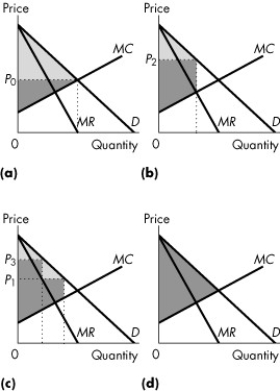 Figure 13.4.4
-Refer to Figure 13.4.4.Consider a market with a perfect price-discriminating monopolist.If the light grey area shows the consumer surplus and the dark grey area shows the producer surplus, which graph correctly represents this firm?
Figure 13.4.4
-Refer to Figure 13.4.4.Consider a market with a perfect price-discriminating monopolist.If the light grey area shows the consumer surplus and the dark grey area shows the producer surplus, which graph correctly represents this firm? (Multiple Choice)
4.8/5 (74)
(74) Use the figure below to answer the following question.
 Figure 13.1.1
-Refer to Figure 13.1.1.The quantity demanded by the market is 8 million cubic metres a month.This market is
Figure 13.1.1
-Refer to Figure 13.1.1.The quantity demanded by the market is 8 million cubic metres a month.This market is (Multiple Choice)
4.7/5 (86)
(86) 
Filters
- Essay(0)
- Multiple Choice(0)
- Short Answer(0)
- True False(0)
- Matching(0)