



 Chat with AI
Exam 13: Monopoly

Exam 1: What Is Economics212 Questions
Exam 2: The Economic Problem159 Questions
Exam 3: Demand and Supply198 Questions
Exam 4: Elasticity186 Questions
Exam 5: Efficiency and Equity121 Questions
Exam 6: Government Actions in Markets130 Questions
Exam 7: Global Markets in Action138 Questions
Exam 8: Utility and Demand120 Questions
Exam 9: Possibilities, Preferences, and Choices124 Questions
Exam 10: Organizing Production111 Questions
Exam 11: Output and Costs142 Questions
Exam 12: Perfect Competition117 Questions
Exam 13: Monopoly118 Questions
Exam 14: Monopolistic Competition122 Questions
Exam 15: Oligopoly106 Questions
Exam 16: Externalities116 Questions
Exam 17: Public Goods and Common Resources98 Questions
Exam 18: Markets for Factors of Production252 Questions
Select questions type


Which one of the following is most likely to be a natural monopoly?

Free
(Multiple Choice)
4.7/5  (100)
(100) Correct Answer: Verified
E
An efficient use of resources occurs when
Free
(Multiple Choice)
4.9/5 (63)
(63) Correct Answer:Verified
VerifiedD
Rate of return regulation can end up serving the self-interest of the firm if
Free
(Multiple Choice)
4.9/5 (84)
(84) Correct Answer:Verified
VerifiedC
Use the figure below to answer the following questions.
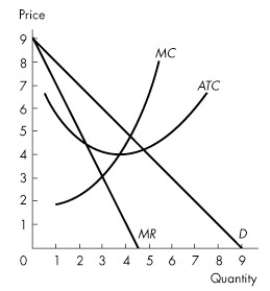 Figure 13.2.2
-Refer to Figure 13.2.2.If the single-price monopoly shown in Figure 13.2.2 is maximizing profit, what is total economic profit?
Figure 13.2.2
-Refer to Figure 13.2.2.If the single-price monopoly shown in Figure 13.2.2 is maximizing profit, what is total economic profit? (Multiple Choice)
4.9/5 (87)
(87) Use the figure below to answer the following questions.
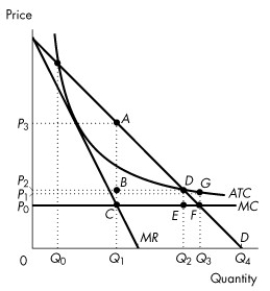 Figure 13.3.4
-Consider the natural monopoly depicted in Figure 13.3.4.Total surplus is at a maximum when quantity is
Figure 13.3.4
-Consider the natural monopoly depicted in Figure 13.3.4.Total surplus is at a maximum when quantity is (Multiple Choice)
4.8/5 (100)
(100) Use the information below to answer the following questions.
Fact 13.1.1
The following statements give some information about seven markets.
1. Coca-Cola cuts its price below that of Pepsi-Cola in an attempt to increase its market share.
2. A single firm, protected by a barrier to entry, produces a personal service that has no close substitutes.
3. A barrier to entry exists, but the good has some close substitutes.
4. A firm offers discounts to students and seniors.
5. A firm can sell any quantity it chooses at the going price.
6. The government issues Nike an exclusive licence to produce golf balls.
7. A firm experiences economies of scale even when it produces the quantity that meets the entire market demand.
-Refer to Fact 13.1.1.The firm described in statement ________ is a natural monopoly.The firm described in statement ________ is a legal monopoly.
(Multiple Choice)
4.9/5 (82)
(82) For the regulated natural monopoly, an average cost pricing rule sets price equal to
(Multiple Choice)
4.9/5 (87)
(87) For a monopoly able to practice perfect price discrimination, the market
(Multiple Choice)
4.7/5 (77)
(77) Which of the following is least likely to be a natural monopoly?
(Multiple Choice)
4.8/5 (72)
(72) Canada Post has a monopoly on residential mail delivery.Pfizer Inc.makes LIPITOR, a prescription drug that lowers cholesterol.Rogers Communications is the sole provider of cable television service in some parts of Ontario.The monopolies which are legal monopolies are
(Multiple Choice)
4.7/5 (77)
(77) Use the figure below to answer the following questions.
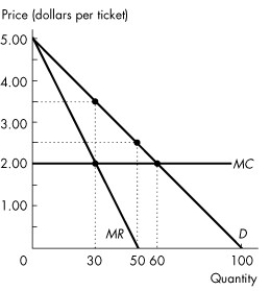 Figure 13.2.3
-Refer to Figure 13.2.3.Assume this firm is a single-price monopoly.How many tickets does this monopolist sell to maximize economic profit?
Figure 13.2.3
-Refer to Figure 13.2.3.Assume this firm is a single-price monopoly.How many tickets does this monopolist sell to maximize economic profit? (Multiple Choice)
4.8/5 (80)
(80) Which of the following markets will have the largest deadweight loss?
(Multiple Choice)
4.8/5 (75)
(75) A monopolist under marginal cost pricing has an incentive to
(Multiple Choice)
4.9/5 (86)
(86) 
Filters
- Essay(0)
- Multiple Choice(0)
- Short Answer(0)
- True False(0)
- Matching(0)