



 Chat with AI
Exam 22: Scheduling

Exam 1: Introduction to Operations Management74 Questions
Exam 2: Competitiveness70 Questions
Exam 3: Forecasting139 Questions
Exam 4: Product and Service Design78 Questions
Exam 4: RELIABILITY – Static12 Questions
Exam 6: Strategic Capacity Planning for Products and Services85 Questions
Exam 7: Decision Theory– Static114 Questions
Exam 8: Process Selection and Facility Layout132 Questions
Exam 9: Work Design and Measurement129 Questions
Exam 10: learning curve– Static61 Questions
Exam 11: Location Planning and Analysis62 Questions
Exam 12: The Transportation Model– Static20 Questions
Exam 13: Management of Quality97 Questions
Exam 14: Quality Control112 Questions
Exam 15: Acceptance Sampling– Static51 Questions
Exam 16: Aggregate Planning and Master Scheduling74 Questions
Exam 17: MRP and ERP81 Questions
Exam 18: Inventory Management128 Questions
Exam 19: JIT and Lean Operations79 Questions
Exam 20: Maintenance– Static36 Questions
Exam 21: Supply Chain Management87 Questions
Exam 22: Scheduling98 Questions
Exam 23: Project Management113 Questions
Exam 24: Management of Waiting Lines64 Questions
Exam 25: Linear Programming93 Questions
Select questions type


To facilitate utilization of bottleneck operations, in theory of constraints scheduling ________ can be split into __________ to reduce waiting times.
(Multiple Choice)
4.9/5  (71)
(71) A Gantt chart is a basic scheduling tool that is most useful in low-volume systems.
(True/False)
4.9/5 (78)
(78) Scheduling in service systems often takes the form of:
(I) appointment systems.
(II) reservation systems.
(III) makespan systems.
(Multiple Choice)
4.8/5 (93)
(93) Job X, which has a duration of four days, is due by the close of business on Friday, December 23. Without looking at the work already scheduled on X's required resource, the scheduler schedules X to be begun on the morning of Tuesday, December 20. This is an example of:
(Multiple Choice)
4.9/5 (83)
(83) The owner/operator of the local franchise of Handyman, Inc., has four jobs to do today, shown in the order they were received: Job Processing Time (hrs) Due (hrs from now) W 4 4 3 5 2 2 1 1
If he uses the shortest processing time first priority rule to schedule these jobs, what will be the average number of jobs in his shop today?
(Multiple Choice)
4.8/5 (68)
(68) Which of the following is the last step in the capacity/scheduling chain?
(Multiple Choice)
4.8/5 (79)
(79) Scheduling in service systems may involve scheduling:
(I) the workforce.
(II) the equipment.
(III) customers.
(Multiple Choice)
4.8/5 (83)
(83) The owner/operator of the local franchise of Handyman, Inc., has four jobs to do today, shown in the order they were received: Job Processing Time (hrs) Due (hrs from now) W 4 4 X 3 5 Y 2 2 Z 1 1
If he uses the earliest due date first priority rule to schedule these jobs, what will be the average job tardiness?
(Multiple Choice)
4.9/5 (84)
(84) Splitting a large lot after one operation beyond a bottleneck operation would reduce the overall waiting time of the bottleneck operation.
(True/False)
4.8/5 (79)
(79) The output of the system cannot exceed the output of the bottleneck operation(s).
(True/False)
4.9/5 (83)
(83) Bottlenecks in service systems may shift with the passage of time, so that different operations become bottleneck operations at different times.
(True/False)
4.9/5 (76)
(76) In the decision-making hierarchy, scheduling decisions are the final step in the transformation process before actual output occurs.
(True/False)
4.9/5 (68)
(68) The priority rule which will sequence jobs in the order they are received is:
(Multiple Choice)
5.0/5 (79)
(79) For the jobs listed below, which processing sequence would result using Johnson's rule? 
(Multiple Choice)
4.9/5 (86)
(86) Eva, the owner of Eva's Second Time Around Wedding Dresses, currently has five dresses to be altered, shown in the order in which they arrived: 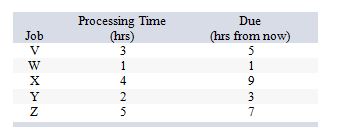 If Eva uses the earliest due date first (EDD) priority rule to schedule these jobs, what will be the average job tardiness?
 (Multiple Choice)
5.0/5 (81)
(81) There are four resources and four jobs to be done. Assume there must be one-to-one matching between jobs and resources. The time required for each resource to do each job is as follows: Job (Hours) Resource A B C D 1 5 8 7 7 2 4 9 5 9 3 6 9 8 7 4 7 6 6 9
For the optimal schedule, what is the total number of hours required to complete these jobs?
(Multiple Choice)
4.9/5 (84)
(84) The two different approaches to load work centers in job-shop scheduling are:
(Multiple Choice)
4.8/5 (66)
(66) The elimination of idle time on both bottleneck and non-bottleneck operations must be accomplished to optimize output.
(True/False)
4.7/5 (81)
(81) Sequencing is concerned with the order in which jobs are done, while loading is concerned with assigning jobs to work centers or workstations.
(True/False)
4.8/5 (83)
(83) 
Filters
- Essay(0)
- Multiple Choice(0)
- Short Answer(0)
- True False(0)
- Matching(0)