



 Chat with AI
Exam 30: Monetary Policy

Exam 1: What Is Economics212 Questions
Exam 2: The Economic Problem159 Questions
Exam 3: Demand and Supply197 Questions
Exam 4: Elasticity186 Questions
Exam 5: Efficiency and Equity119 Questions
Exam 6: Governments Actions in Markets130 Questions
Exam 7: Global Markets in Action138 Questions
Exam 8: Utility and Demand120 Questions
Exam 9: Possibilities, Preferences, and Choices124 Questions
Exam 10: Organizing Production111 Questions
Exam 11: Output and Costs142 Questions
Exam 12: Perfect Competition117 Questions
Exam 13: Monopoly118 Questions
Exam 14: Monopolistic Competition122 Questions
Exam 15: Oligopoly106 Questions
Exam 16: Externalities116 Questions
Exam 17: Public Goods and Common Resources98 Questions
Exam 18: Markets for Factors of Production128 Questions
Exam 19: Economic Inequality124 Questions
Exam 20: Measuring Gdp and Economic Growth133 Questions
Exam 21: Monitoring Jobs and Inflation121 Questions
Exam 22: Economic Growth98 Questions
Exam 23: Finance, Saving, and Investment141 Questions
Exam 24: Money, the Price Level, and Inflation126 Questions
Exam 25: The Exchange Rate and the Balance of Payments126 Questions
Exam 26: Aggregate Supply and Aggregate Demand136 Questions
Exam 27: Expenditure Multipliers171 Questions
Exam 28: The Business Cycle, Inflation, and Deflation110 Questions
Exam 29: Fiscal Policy97 Questions
Exam 30: Monetary Policy97 Questions
Exam 31: Macro Only: International Trade Policy126 Questions
Select questions type


Suppose the inflation rate is 3 percent and the output gap is -1 percent. Using the Taylor rule, the Bank of Canada sets the overnight loans rate equal to
(Multiple Choice)
4.7/5  (84)
(84) When the Bank of Canada fights inflation by implementing an open market operation, the supply of reserves curve shifts ________ and the supply of money curve shifts ________.
(Multiple Choice)
4.8/5 (77)
(77) Why does the Bank of Canada pay close attention to the core inflation rate in addition to the overall CPI inflation rate?
(Multiple Choice)
4.9/5 (68)
(68) To combat a recession, the Bank of Canada ________ the overnight loans rate, which ________ the quantity of money.
(Multiple Choice)
4.7/5 (92)
(92) The Bank of Canada raises the overnight loans rate. In the foreign exchange market people ________ dollars and the price of the dollar ________ because the Canadian interest rate differential ________.
(Multiple Choice)
4.9/5 (80)
(80) If the Bank of Canada is concerned with inflation it will ________ the overnight loans rate to ________.
(Multiple Choice)
4.9/5 (69)
(69) When the Bank of Canada fights recession by lowering the overnight loan rate, the supply of loanable funds curve shifts ________, and the aggregate demand curve shifts ________.
(Multiple Choice)
4.7/5 (89)
(89) The overnight rate is determined by equilibrium in the market for ________. The overnight rate ________.
(Multiple Choice)
4.8/5 (76)
(76) The current overnight loans rate is 3 percent, with the Bank of Canada's operating band set at 2.75 to 3.25 percent. If the Bank of Canada lowers their operating band to 2.25 to 2.75 percent, which of the following is one of the reasons the overnight rate will fall to within this new range?
(Multiple Choice)
5.0/5 (91)
(91) How is responsibility for monetary policy set forth in Canada?
(Multiple Choice)
4.9/5 (74)
(74) When the Bank of Canada fights inflation by implementing open market operations, the supply of loanable funds curve shifts ________ and the aggregate demand curve shifts ________.
(Multiple Choice)
4.9/5 (76)
(76) Which of the following does not occur as a result of the Bank of Canada lowering the overnight loans rate?
(Multiple Choice)
4.8/5 (90)
(90) Use the figure below to answer the following question.
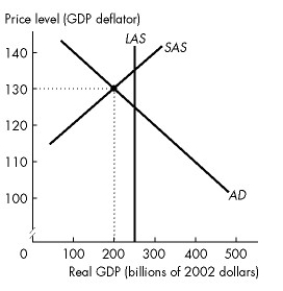 Figure 30.3.2
-Refer to Figure 30.3.2. The figure shows the economy of Freezone. Potential GDP is $250 billion. To return the economy to full employment, the central bank can ________ the overnight rate and ________ securities.
Figure 30.3.2
-Refer to Figure 30.3.2. The figure shows the economy of Freezone. Potential GDP is $250 billion. To return the economy to full employment, the central bank can ________ the overnight rate and ________ securities. (Multiple Choice)
4.8/5 (62)
(62) 
Filters
- Essay(0)
- Multiple Choice(0)
- Short Answer(0)
- True False(0)
- Matching(0)