



 Chat with AI
Exam 3: Demand and Supply

Exam 1: What Is Economics212 Questions
Exam 2: The Economic Problem159 Questions
Exam 3: Demand and Supply197 Questions
Exam 4: Elasticity186 Questions
Exam 5: Efficiency and Equity119 Questions
Exam 6: Governments Actions in Markets130 Questions
Exam 7: Global Markets in Action138 Questions
Exam 8: Utility and Demand120 Questions
Exam 9: Possibilities, Preferences, and Choices124 Questions
Exam 10: Organizing Production111 Questions
Exam 11: Output and Costs142 Questions
Exam 12: Perfect Competition117 Questions
Exam 13: Monopoly118 Questions
Exam 14: Monopolistic Competition122 Questions
Exam 15: Oligopoly106 Questions
Exam 16: Externalities116 Questions
Exam 17: Public Goods and Common Resources98 Questions
Exam 18: Markets for Factors of Production128 Questions
Exam 19: Economic Inequality124 Questions
Exam 20: Measuring Gdp and Economic Growth133 Questions
Exam 21: Monitoring Jobs and Inflation121 Questions
Exam 22: Economic Growth98 Questions
Exam 23: Finance, Saving, and Investment141 Questions
Exam 24: Money, the Price Level, and Inflation126 Questions
Exam 25: The Exchange Rate and the Balance of Payments126 Questions
Exam 26: Aggregate Supply and Aggregate Demand136 Questions
Exam 27: Expenditure Multipliers171 Questions
Exam 28: The Business Cycle, Inflation, and Deflation110 Questions
Exam 29: Fiscal Policy97 Questions
Exam 30: Monetary Policy97 Questions
Exam 31: Macro Only: International Trade Policy126 Questions
Select questions type


Use the figure below to answer the following questions.
 Figure 3.5.2
Original equilibrium at 1.
-Refer to Figure 3.5.2, which represents the market for cow manure. If the price of milk, a complement in production of manure, rises, what is the new manure equilibrium, ceteris paribus?
Figure 3.5.2
Original equilibrium at 1.
-Refer to Figure 3.5.2, which represents the market for cow manure. If the price of milk, a complement in production of manure, rises, what is the new manure equilibrium, ceteris paribus? (Multiple Choice)
4.8/5  (59)
(59) Use the table below to answer the following questions.
Table 3.4.1
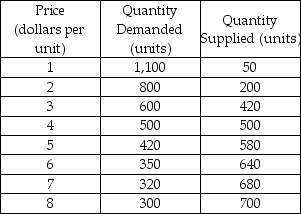 -Refer to Table 3.4.1. A surplus occurs if
 (Multiple Choice)
4.8/5 (91)
(91) A market where no single buyer or seller can influence the price is
(Multiple Choice)
4.7/5 (81)
(81) Use the table below to answer the following questions.
Table 3.1.1
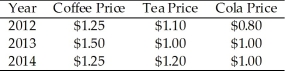 -Refer to Table 3.1.1. Between 2013 and 2014, the price of coffee relative to the price of tea ________, while the price of coffee relative to the price of cola ________.
 (Multiple Choice)
4.7/5 (93)
(93) The law of demand applies to food because when the price of food rises, there is
(Multiple Choice)
4.8/5 (79)
(79) Use the figure below to answer the following questions.
Figure 3.5.2
Original equilibrium at 1.
-Refer to Figure 3.5.2, which represents the market for beans. If the price of peas, a substitute for beans and a substitute in production, rises, what is the new beans equilibrium, ceteris paribus?
Figure 3.5.2
Original equilibrium at 1.
-Refer to Figure 3.5.2, which represents the market for beans. If the price of peas, a substitute for beans and a substitute in production, rises, what is the new beans equilibrium, ceteris paribus? (Multiple Choice)
4.8/5 (80)
(80) Use the information below to answer the following questions.
Fact 3.5.1
The market for coffee is initially in equilibrium. Pepsi is a substitute for coffee; cream is a complement of coffee. Consider the market for coffee. Assume that all ceteris paribus assumptions continue to hold except for the event listed.
-Refer to Fact 3.5.1. A new study comes out, revealing that drinking Pepsi increases your ability to study. The equilibrium quantity of coffee
(Multiple Choice)
4.8/5 (86)
(86) The opportunity cost of good A in terms of good B is equal to the
(Multiple Choice)
4.8/5 (105)
(105) Which of the following will shift the supply curve of good X rightward?
(Multiple Choice)
4.8/5 (91)
(91) The y- axis intercept of the supply curve is 40 and the slope is 6. The equation of the supply curve is
(Multiple Choice)
4.9/5 (79)
(79) If the quantity of textbooks supplied is 10,000 per year and the quantity of textbooks demanded is 8,000 per year, there is a ________ in the market and the price will ________.
(Multiple Choice)
4.8/5 (83)
(83) Use the figure below to answer the following questions.
Table 3.5.2
Demand and Supply Schedules for Cups of Coffee each day at CoolU
 -Refer to Table 3.5.2. A premature frost destroys half the coffee trees and the supply of coffee is cut in half. The new equilibrium price is $________ and the new equilibrium quantity is ________ cups a day.
 (Multiple Choice)
4.7/5 (65)
(65) Networks increase the price they charge cable television firms for programming. As a result, the price of cable television rises. Choose the correct statement.
(Multiple Choice)
4.9/5 (81)
(81) Use the table below to answer the following questions.
Table 3.4.1
-Refer to Table 3.4.1. A shortage occurs if
-Refer to Table 3.4.1. A shortage occurs if (Multiple Choice)
4.8/5 (91)
(91) Today, the price of peanuts increases. Peanut butter producers and peanut butter consumers expect that the price of peanut butter will rise in the future. In the current market for peanut butter, the equilibrium price rises and the equilibrium quantity increases. It must be the case that
(Multiple Choice)
4.9/5 (81)
(81) 
Filters
- Essay(0)
- Multiple Choice(0)
- Short Answer(0)
- True False(0)
- Matching(0)