



 Chat with AI
Exam 24: Money, the Price Level, and Inflation

Exam 1: What Is Economics212 Questions
Exam 2: The Economic Problem159 Questions
Exam 3: Demand and Supply197 Questions
Exam 4: Elasticity186 Questions
Exam 5: Efficiency and Equity119 Questions
Exam 6: Governments Actions in Markets130 Questions
Exam 7: Global Markets in Action138 Questions
Exam 8: Utility and Demand120 Questions
Exam 9: Possibilities, Preferences, and Choices124 Questions
Exam 10: Organizing Production111 Questions
Exam 11: Output and Costs142 Questions
Exam 12: Perfect Competition117 Questions
Exam 13: Monopoly118 Questions
Exam 14: Monopolistic Competition122 Questions
Exam 15: Oligopoly106 Questions
Exam 16: Externalities116 Questions
Exam 17: Public Goods and Common Resources98 Questions
Exam 18: Markets for Factors of Production128 Questions
Exam 19: Economic Inequality124 Questions
Exam 20: Measuring Gdp and Economic Growth133 Questions
Exam 21: Monitoring Jobs and Inflation121 Questions
Exam 22: Economic Growth98 Questions
Exam 23: Finance, Saving, and Investment141 Questions
Exam 24: Money, the Price Level, and Inflation126 Questions
Exam 25: The Exchange Rate and the Balance of Payments126 Questions
Exam 26: Aggregate Supply and Aggregate Demand136 Questions
Exam 27: Expenditure Multipliers171 Questions
Exam 28: The Business Cycle, Inflation, and Deflation110 Questions
Exam 29: Fiscal Policy97 Questions
Exam 30: Monetary Policy97 Questions
Exam 31: Macro Only: International Trade Policy126 Questions
Select questions type


If the desired reserve ratio is 3 percent and deposits totaled $5.75 billion, banks hold
(Multiple Choice)
4.8/5  (81)
(81) Use the information below to answer the following question.
Fact 24.7.1
The Bank of Speedy Creek has chosen the following initial balance sheet:
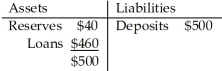 -Refer to Fact 24.7.1. Suppose all the banks in the banking system have the same desired reserve ratio as the Bank of Speedy Creek. If the currency drain ratio is 32 percent, what is the size of the money multiplier?
 (Multiple Choice)
4.9/5 (66)
(66) ________ is the interest rate that the Bank of Canada charges on short-term loans that it makes to major depository institutions when the banking system is temporarily short of reserves.
(Multiple Choice)
4.8/5 (83)
(83) Suppose that a country has $50 billion in bank reserves, $100 billion in currency held by the public, and $500 billion in bank deposits. The currency drain ratio is
(Multiple Choice)
4.9/5 (78)
(78) During a period of severe inflation, which function of money is most seriously affected?
(Multiple Choice)
4.7/5 (68)
(68) Which one of the following is not a service of depository institutions?
(Multiple Choice)
4.8/5 (77)
(77) The Bank of Canada is the lender of last resort. This means banks may borrow money from the Bank of Canada
(Multiple Choice)
4.9/5 (82)
(82) Suppose that the interest rate is greater than the equilibrium interest rate. Which of the following statements is true?
I. There is an excess quantity of money.
II. The quantity of money automatically increases.
III. The interest rate falls.
(Multiple Choice)
4.8/5 (86)
(86) GDP is $2,000 billion, the GDP deflator is 100 (a price level of 1), and the velocity of circulation is 5. The quantity of money is
(Multiple Choice)
4.7/5 (73)
(73) If Wolfgang transfers $1,000 out of his chequable deposit account and places it in his non-chequable deposit account,
(Multiple Choice)
4.9/5 (69)
(69) Use the figure below to answer the following questions.
 Figure 24.5.2
-Refer to Figure 24.5.2. Which one of the following best describes the response to a decrease in the market price of bonds?
Figure 24.5.2
-Refer to Figure 24.5.2. Which one of the following best describes the response to a decrease in the market price of bonds? (Multiple Choice)
4.8/5 (82)
(82) 
Filters
- Essay(0)
- Multiple Choice(0)
- Short Answer(0)
- True False(0)
- Matching(0)