



 Chat with AI
Exam 19: Economic Inequality

Exam 1: What Is Economics212 Questions
Exam 2: The Economic Problem159 Questions
Exam 3: Demand and Supply197 Questions
Exam 4: Elasticity186 Questions
Exam 5: Efficiency and Equity119 Questions
Exam 6: Governments Actions in Markets130 Questions
Exam 7: Global Markets in Action138 Questions
Exam 8: Utility and Demand120 Questions
Exam 9: Possibilities, Preferences, and Choices124 Questions
Exam 10: Organizing Production111 Questions
Exam 11: Output and Costs142 Questions
Exam 12: Perfect Competition117 Questions
Exam 13: Monopoly118 Questions
Exam 14: Monopolistic Competition122 Questions
Exam 15: Oligopoly106 Questions
Exam 16: Externalities116 Questions
Exam 17: Public Goods and Common Resources98 Questions
Exam 18: Markets for Factors of Production128 Questions
Exam 19: Economic Inequality124 Questions
Exam 20: Measuring Gdp and Economic Growth133 Questions
Exam 21: Monitoring Jobs and Inflation121 Questions
Exam 22: Economic Growth98 Questions
Exam 23: Finance, Saving, and Investment141 Questions
Exam 24: Money, the Price Level, and Inflation126 Questions
Exam 25: The Exchange Rate and the Balance of Payments126 Questions
Exam 26: Aggregate Supply and Aggregate Demand136 Questions
Exam 27: Expenditure Multipliers171 Questions
Exam 28: The Business Cycle, Inflation, and Deflation110 Questions
Exam 29: Fiscal Policy97 Questions
Exam 30: Monetary Policy97 Questions
Exam 31: Macro Only: International Trade Policy126 Questions
Select questions type


Use the figure below to answer the following questions.
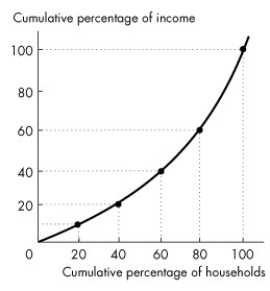 Figure 19.1.3
-In Figure 19.1.3, the second richest 20 percent of all families receive what share of income?
Figure 19.1.3
-In Figure 19.1.3, the second richest 20 percent of all families receive what share of income? (Multiple Choice)
4.7/5  (80)
(80) Measured wealth distributions that do not consider the distribution of human capital
(Multiple Choice)
4.9/5 (76)
(76) In an economy in 2011, 3 million people had full-time managerial and professional jobs that paid an average of $800 a week. At the same time, 1 million people had full-time sales positions that paid an average of $530 a week. Managers and professionals are paid more than salespeople because
(Multiple Choice)
4.9/5 (73)
(73) In Canada, the low-income cut-off level for a family is when ________ or more of income is spent on food, shelter, and clothing.
(Multiple Choice)
4.7/5 (75)
(75) If the average tax rate increases as income increases, the income tax is
(Multiple Choice)
4.9/5 (82)
(82) Among Canada, Finland, and South Africa, income is distributed most equally in ________ and least equally in ________.
(Multiple Choice)
4.7/5 (76)
(76) Comparing the distribution of income after taxes and benefits to the distribution of market income, it is true that the distribution of income after taxes and benefits is ________ the distribution of market income.
(Multiple Choice)
4.8/5 (78)
(78) Use the figure below to answer the following questions.
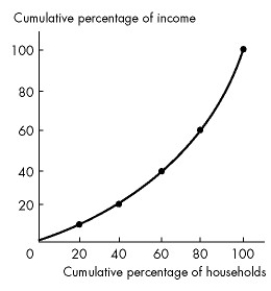 Figure 19.1.1
-Refer to Figure 19.1.1. The richest 20 percent of households receive what share of total income?
Figure 19.1.1
-Refer to Figure 19.1.1. The richest 20 percent of households receive what share of total income? (Multiple Choice)
4.9/5 (80)
(80) Use the figure below to answer the following questions.
Figure 19.1.3
-In Figure 19.1.3, the second poorest 20 percent of all families receive what share of income?
Figure 19.1.3
-In Figure 19.1.3, the second poorest 20 percent of all families receive what share of income? (Multiple Choice)
4.8/5 (85)
(85) Complete the following sentence. Passing on wealth from one generation to another
(Multiple Choice)
4.9/5 (85)
(85) Which one of the following reduces the inequality of income or wealth relative to the market distribution?
(Multiple Choice)
4.9/5 (74)
(74) Use the figure below to answer the following questions.
 Figure 19.3.6
-Refer to Figure 19.3.6. This is the market for a group of workers. If point A represents the equilibrium for workers with higher human capital, which point represents the equilibrium for the workers with less human capital?
Figure 19.3.6
-Refer to Figure 19.3.6. This is the market for a group of workers. If point A represents the equilibrium for workers with higher human capital, which point represents the equilibrium for the workers with less human capital? (Multiple Choice)
4.9/5 (82)
(82) Use the figure below to answer the following questions.
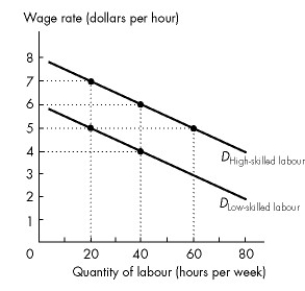 Figure 19.3.2
-Refer to Figure 19.3.2. At a wage rate of $5, an employer would hire
Figure 19.3.2
-Refer to Figure 19.3.2. At a wage rate of $5, an employer would hire (Multiple Choice)
5.0/5 (69)
(69) 
Filters
- Essay(0)
- Multiple Choice(0)
- Short Answer(0)
- True False(0)
- Matching(0)