



 Chat with AI
Exam 7: Consumer Choice and Elasticity

Exam 1: The Economic Approach210 Questions
Exam 2: A: Some Tools of the Economist224 Questions
Exam 2: B: Some Tools of the Economist33 Questions
Exam 3: A: Supply, Demand, and the Market Process225 Questions
Exam 3: B: Supply, Demand, and the Market Process180 Questions
Exam 4: A: Supply and Demand: Applications and Extensions233 Questions
Exam 4: B: Supply and Demand: Applications and Extensions98 Questions
Exam 5: Difficult Cases for the Market and the Role of Government168 Questions
Exam 6: The Economics of Collective Decision-Making180 Questions
Exam 7: Consumer Choice and Elasticity223 Questions
Exam 8: A: Costs and the Supply of Goods223 Questions
Exam 8: B: Costs and the Supply of Goods8 Questions
Exam 9: A: Price Takers and the Competitive Process237 Questions
Exam 9: B: Price Takers and the Competitive Process23 Questions
Exam 10: Price-Searcher Markets With Low Entry Barriers216 Questions
Exam 11: A: Price-Searcher Markets With High Entry Barriers229 Questions
Exam 11: B: Price-Searcher Markets With High Entry Barriers25 Questions
Exam 12: The Supply of and Demand for Productive Resources200 Questions
Exam 13: Earnings, Productivity, and the Job Market109 Questions
Exam 14: Investment, the Capital Market, and the Wealth of Nations129 Questions
Exam 15: Income Inequality and Poverty136 Questions
Exam 16: Appendix: Government Spending and Taxation79 Questions
Exam 17: Appendix: the Economics of Social Security54 Questions
Exam 18: Appendix: the Stock Market: Its Function, Performance, and Potential As an Investment Opportunity70 Questions
Exam 19: Appendix: Great Debates in Economics: Keynes Versus Hayek8 Questions
Exam 20: Appendix: the Crisis of 2008: Causes and Lessons for the Future64 Questions
Exam 21: Appendix: Lessons From the Great Depression60 Questions
Exam 22: Appendix: the Economics of Healthcare68 Questions
Exam 23: Appendix:education: Problems and Performance60 Questions
Exam 24: Appendix: Earnings Differences Between Men and Women47 Questions
Exam 26: Appendix: the Question of Resource Exhaustion61 Questions
Exam 25: Appendix: Do Labor Unions Increase the Wages of Workers74 Questions
Exam 27: Appendix: Difficult Environmental Cases and the Role of Government63 Questions
Select questions type


A 10 percent increase in the price of sugar reduces sugar consumption by about 5 percent. The increase causes households to
(Multiple Choice)
4.9/5  (76)
(76) Rebel Records announces it is cutting the prices of its bluegrass album titles by 25 percent. If Rebel is seeking to increase revenues, it must believe that the elasticity of demand for bluegrass albums is
(Multiple Choice)
4.7/5 (63)
(63) Which of the following is not a fundamental that underlies consumer behavior?
(Multiple Choice)
4.8/5 (83)
(83) The exhibit illustrates two possible demand curves for a product, D₁ and D₂. Which of the following is true regarding these demand curves? 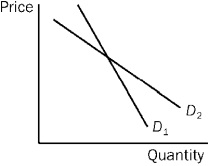
(Multiple Choice)
4.8/5 (84)
(84) For a particular good, a 3 percent increase in price causes a 10 percent decrease in quantity demanded. Which of the following statements is most likely applicable to this good?
(Multiple Choice)
4.8/5 (79)
(79) Suppose the Pleasant Corporation cuts the price of its American Girl dolls by 10 percent, and as a result, the quantity of the dolls sold increases by 25 percent. This indicates that the price elasticity of demand for the dolls over this range is
(Multiple Choice)
4.8/5 (88)
(88) The difference between the amount consumers would be willing to pay and the amount they actually pay for a good is called
(Multiple Choice)
4.9/5 (74)
(74) Muriel's income elasticity of demand for football tickets is 1.5. All else equal, this means that if her income increases by 20 percent, she will buy
(Multiple Choice)
4.9/5 (96)
(96) A question on an economics exam asks: What happens in the market for margarine when income rises? Allison, an excellent student, shows the demand for margarine decreasing. Is she necessarily wrong? Why or why not?
(Essay)
4.7/5 (73)
(73) Scenario 7-1
Use the information below to answer the following question(s).
JoAnn considers cola and plain sparkling water to be good substitutes. Suppose the price of sugar, a key ingredient used to produce cola, falls.
-Refer to Scenario 7-1. According to the substitution effect, which of the following is most likely to occur?
(Multiple Choice)
4.8/5 (74)
(74) If people buy less chewing gum at every price when their incomes fall, then
(Multiple Choice)
4.8/5 (86)
(86) "Because of the unseasonably cold weather, Florida orange growers expect (1) fewer bushels of oranges to be harvested, (2) a higher market price for oranges, and (3) larger total revenues from this year's crop." This statement would most likely be correct if the
(Multiple Choice)
4.8/5 (81)
(81) If Jane's marginal benefit as a consumer in the jeans market is larger than the price of a pair of jeans,
(Multiple Choice)
4.8/5 (75)
(75) If an increase in the excise tax imposed on cigarettes pushes the price per pack up by 20 percent, and the quantity sold declines by 8 percent as a result, the price elasticity of demand for cigarettes is equal to
(Multiple Choice)
4.9/5 (82)
(82) If the demand for a product increases as the result of a decline in income, it can be concluded that the
(Multiple Choice)
4.7/5 (73)
(73) Table 7-1
 -Refer to Table 7-1. When the price of the good is $1.00, the quantity demanded in this market would be
 (Multiple Choice)
4.9/5 (75)
(75) 
Filters
- Essay(0)
- Multiple Choice(0)
- Short Answer(0)
- True False(0)
- Matching(0)