



 Chat with AI
Exam 5: Difficult Cases for the Market and the Role of Government

Exam 1: The Economic Approach210 Questions
Exam 2: A: Some Tools of the Economist224 Questions
Exam 2: B: Some Tools of the Economist33 Questions
Exam 3: A: Supply, Demand, and the Market Process225 Questions
Exam 3: B: Supply, Demand, and the Market Process180 Questions
Exam 4: A: Supply and Demand: Applications and Extensions233 Questions
Exam 4: B: Supply and Demand: Applications and Extensions98 Questions
Exam 5: Difficult Cases for the Market and the Role of Government168 Questions
Exam 6: The Economics of Collective Decision-Making180 Questions
Exam 7: Consumer Choice and Elasticity223 Questions
Exam 8: A: Costs and the Supply of Goods223 Questions
Exam 8: B: Costs and the Supply of Goods8 Questions
Exam 9: A: Price Takers and the Competitive Process237 Questions
Exam 9: B: Price Takers and the Competitive Process23 Questions
Exam 10: Price-Searcher Markets With Low Entry Barriers216 Questions
Exam 11: A: Price-Searcher Markets With High Entry Barriers229 Questions
Exam 11: B: Price-Searcher Markets With High Entry Barriers25 Questions
Exam 12: The Supply of and Demand for Productive Resources200 Questions
Exam 13: Earnings, Productivity, and the Job Market109 Questions
Exam 14: Investment, the Capital Market, and the Wealth of Nations129 Questions
Exam 15: Income Inequality and Poverty136 Questions
Exam 16: Appendix: Government Spending and Taxation79 Questions
Exam 17: Appendix: the Economics of Social Security54 Questions
Exam 18: Appendix: the Stock Market: Its Function, Performance, and Potential As an Investment Opportunity70 Questions
Exam 19: Appendix: Great Debates in Economics: Keynes Versus Hayek8 Questions
Exam 20: Appendix: the Crisis of 2008: Causes and Lessons for the Future64 Questions
Exam 21: Appendix: Lessons From the Great Depression60 Questions
Exam 22: Appendix: the Economics of Healthcare68 Questions
Exam 23: Appendix:education: Problems and Performance60 Questions
Exam 24: Appendix: Earnings Differences Between Men and Women47 Questions
Exam 26: Appendix: the Question of Resource Exhaustion61 Questions
Exam 25: Appendix: Do Labor Unions Increase the Wages of Workers74 Questions
Exam 27: Appendix: Difficult Environmental Cases and the Role of Government63 Questions
Select questions type


A government passes a new law allowing only 1,000 tons of pollution per day to be generated and simultaneously sells 1,000 transferable rights to emit one ton each of pollution per day. Which of the following is true?
(Multiple Choice)
4.9/5  (92)
(92) Relative to a competitive situation, if a market lacks competition, economic theory suggests that
(Multiple Choice)
4.9/5 (80)
(80) People who receive the benefit of a good without contributing to its costs of production are called
(Multiple Choice)
4.9/5 (85)
(85) Which of the following is most consistent with the idea that if it's worth doing, it's worth doing imperfectly?
(Multiple Choice)
4.9/5 (73)
(73) Which of the following is the best example of a public good?
(Multiple Choice)
4.8/5 (71)
(71) Consider two goods - one that generates external benefits and another that generates external costs. The actual market outcome would
(Multiple Choice)
4.9/5 (84)
(84) Which of the following would be a protective function of government?
(Multiple Choice)
4.9/5 (85)
(85) Which of the following would be a protective function of government?
(Multiple Choice)
4.9/5 (70)
(70) Suppose external benefits are present in a market which results in the actual market price of $62 and market output of 3,000 units. How does this outcome compare to the efficient, ideal equilibrium?
(Multiple Choice)
4.8/5 (91)
(91) Consider two goods--one that generates external costs and another that generates external benefits. The actual market outcome would
(Multiple Choice)
4.8/5 (81)
(81) Figure 5-1
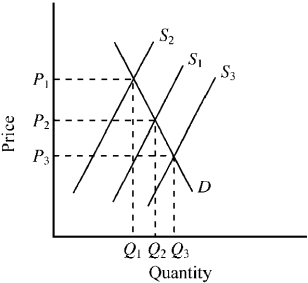 -In Figure 5-1, S₁ and D illustrate the demand and supply for a product if it were produced in a normal competitive market. Which of the following would be true if the firms in the industry were instead able to get government licensing restrictions to limit competition in the market?
 (Multiple Choice)
4.9/5 (69)
(69) Suppose external costs are present in a market which results in the actual market price of $84 and market output of 320 units. How does this outcome compare to the efficient, ideal equilibrium?
(Multiple Choice)
4.9/5 (88)
(88) Suppose external benefits are present in a market which results in the actual market price of $34 and market output of 126 units. How does this outcome compare to the efficient, ideal equilibrium?
(Multiple Choice)
4.8/5 (79)
(79) Figure 5-4
 -Refer to Figure 5-4. The efficient price and quantity are
 (Multiple Choice)
4.8/5 (88)
(88) In which of the following markets are information problems likely to be most serious?
(Multiple Choice)
4.8/5 (81)
(81) The maintenance of a framework of security and order through the establishment and enforcement of rules under which people can interact peacefully with one another and be secure in their person and property is known as the
(Multiple Choice)
4.9/5 (82)
(82) Does economic efficiency indicate that all pollution should be eliminated?
(Multiple Choice)
4.8/5 (93)
(93) A public good is defined as a good with which of the following characteristics?
(Multiple Choice)
4.9/5 (60)
(60) A good that is both nonexcludable and nonrival-in-consumption is called a
(Multiple Choice)
4.9/5 (85)
(85) 
Filters
- Essay(0)
- Multiple Choice(0)
- Short Answer(0)
- True False(0)
- Matching(0)