



 Chat with AI
Exam 3: A: Supply, Demand, and the Market Process

Exam 1: The Economic Approach210 Questions
Exam 2: A: Some Tools of the Economist224 Questions
Exam 2: B: Some Tools of the Economist33 Questions
Exam 3: A: Supply, Demand, and the Market Process225 Questions
Exam 3: B: Supply, Demand, and the Market Process180 Questions
Exam 4: A: Supply and Demand: Applications and Extensions233 Questions
Exam 4: B: Supply and Demand: Applications and Extensions98 Questions
Exam 5: Difficult Cases for the Market and the Role of Government168 Questions
Exam 6: The Economics of Collective Decision-Making180 Questions
Exam 7: Consumer Choice and Elasticity223 Questions
Exam 8: A: Costs and the Supply of Goods223 Questions
Exam 8: B: Costs and the Supply of Goods8 Questions
Exam 9: A: Price Takers and the Competitive Process237 Questions
Exam 9: B: Price Takers and the Competitive Process23 Questions
Exam 10: Price-Searcher Markets With Low Entry Barriers216 Questions
Exam 11: A: Price-Searcher Markets With High Entry Barriers229 Questions
Exam 11: B: Price-Searcher Markets With High Entry Barriers25 Questions
Exam 12: The Supply of and Demand for Productive Resources200 Questions
Exam 13: Earnings, Productivity, and the Job Market109 Questions
Exam 14: Investment, the Capital Market, and the Wealth of Nations129 Questions
Exam 15: Income Inequality and Poverty136 Questions
Exam 16: Appendix: Government Spending and Taxation79 Questions
Exam 17: Appendix: the Economics of Social Security54 Questions
Exam 18: Appendix: the Stock Market: Its Function, Performance, and Potential As an Investment Opportunity70 Questions
Exam 19: Appendix: Great Debates in Economics: Keynes Versus Hayek8 Questions
Exam 20: Appendix: the Crisis of 2008: Causes and Lessons for the Future64 Questions
Exam 21: Appendix: Lessons From the Great Depression60 Questions
Exam 22: Appendix: the Economics of Healthcare68 Questions
Exam 23: Appendix:education: Problems and Performance60 Questions
Exam 24: Appendix: Earnings Differences Between Men and Women47 Questions
Exam 26: Appendix: the Question of Resource Exhaustion61 Questions
Exam 25: Appendix: Do Labor Unions Increase the Wages of Workers74 Questions
Exam 27: Appendix: Difficult Environmental Cases and the Role of Government63 Questions
Select questions type


An important assumption that is made when constructing a demand schedule is that
(Multiple Choice)
4.9/5  (70)
(70) Which of the following will decrease the demand for coffee?
(Multiple Choice)
4.8/5 (59)
(59) Bill is willing to cut lawns for a minimum of $200 a week. He is, however, paid $250 for the same service by a lawn maintenance company. This is an example of
(Multiple Choice)
4.8/5 (88)
(88) Suppliers recognize there is a shortage in the market for their product when they notice that
(Multiple Choice)
4.9/5 (74)
(74) If price falls, what happens to the quantity demanded for a product?
(Multiple Choice)
4.9/5 (81)
(81) When economists say the quantity supplied of a product has decreased, they mean the
(Multiple Choice)
5.0/5 (80)
(80) If Harry is paid $25,000 to sell his crop of tomatoes even though he would have been willing to have sold the crop for as little as $20,000, this indicates that
(Multiple Choice)
4.9/5 (75)
(75) If a large percentage increase in the price of a good results in a small percentage increase in the quantity supplied of the good, supply is said to be
(Multiple Choice)
4.8/5 (72)
(72) Use the table below to choose the correct answer. The table is a schedule of the supply and demand for ground hamburger meat (both given in thousands of pounds per month). 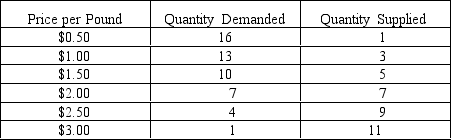 The equilibrium market price of ground hamburger meat would be
 (Multiple Choice)
4.8/5 (82)
(82) Ceteris paribus, a decrease in the price of a good will cause the
(Multiple Choice)
4.8/5 (81)
(81) If the quantity of a good supplied is highly sensitive to the price of the good, economists say the supply of the good is relatively
(Multiple Choice)
4.9/5 (84)
(84) The invisible hand principle indicates that competitive markets can help promote the efficient use of resources
(Multiple Choice)
4.8/5 (84)
(84) Assuming Chinese food and Thai food are substitutes, if Lucy Ho's Chinese restaurant reduces its prices,
(Multiple Choice)
4.8/5 (80)
(80) When economists say the supply of a product has decreased, they mean that
(Multiple Choice)
4.7/5 (79)
(79) 
Filters
- Essay(0)
- Multiple Choice(0)
- Short Answer(0)
- True False(0)
- Matching(0)