



 Chat with AI
Exam 15: Monopoly

Exam 1: Ten Principles of Economics218 Questions
Exam 2: Thinking Like an Economist239 Questions
Exam 3: Interdependence and the Gains From Trade207 Questions
Exam 4: The Market Forces of Supply and Demand351 Questions
Exam 5: Elasticity and Its Application230 Questions
Exam 6: Supply, demand, and Government Policies248 Questions
Exam 7: Consumers, producers, and the Efficiency of Markets216 Questions
Exam 8: Application: the Costs of Taxation222 Questions
Exam 9: Application: International Trade182 Questions
Exam 10: Externalities210 Questions
Exam 11: Public Goods and Common Resources173 Questions
Exam 12: The Design of the Tax System200 Questions
Exam 13: The Costs of Production209 Questions
Exam 14: Firms in Competitive Markets261 Questions
Exam 15: Monopoly239 Questions
Exam 16: Monopolistic Competition191 Questions
Exam 17: Oligopoly198 Questions
Exam 18: The Markets for the Factors of Production180 Questions
Exam 19: Earnings and Discrimination167 Questions
Exam 20: Income Inequality and Poverty163 Questions
Exam 21: The Theory of Consumer Choice191 Questions
Exam 22: Frontiers of Microeconomics141 Questions
Select questions type


Table 15-3
A monopolist faces the following demand curve:
 -Refer to Table 15-3.Consider that the monopolist has total fixed costs of $40 and a constant marginal cost of $5.At the profit-maximizing level of output,what is the monopolist's average total cost
 (Multiple Choice)
4.9/5  (62)
(62) In a competitive market,a firm's supply curve dictates the amount it will supply.How does a monopoly market compare
(Multiple Choice)
5.0/5 (75)
(75) Why are drug companies allowed to be monopolists in the drugs they discover
(Multiple Choice)
4.8/5 (88)
(88) Scenario 15-1
Consider the market for water in a small town in the Old West.Assume that the only source of water is the underground aquifer that lies directly below the town.Wells are used to supply water to the entire town.
-Refer to Scenario 15-1.If dozens of residents have their own wells,which statement most adequately describes the behaviour of sellers of water
(Multiple Choice)
4.8/5 (81)
(81) A monopolist faces market demand given by P = 300 - 2Q.For this market,MR = 300 - 4Q and MC = 40.What price will the monopolist charge in order to maximize profits
(Multiple Choice)
4.8/5 (81)
(81) Figure 15-7
The figure depicts the demand, marginal-revenue, and marginal-cost curves of a profit-maximizing monopolist.
 -Refer to Figure 15-7.If the monopoly firm is NOT allowed to price discriminate,what is the deadweight loss
 (Multiple Choice)
4.8/5 (85)
(85) A monopolist faces market demand given by P = 220 - 5Q.For this market,MR = 200 - 10Q and MC = 10Q.What quantity of output will the monopolist produce in order to maximize profits
(Multiple Choice)
4.7/5 (88)
(88) When is price discrimination a rational strategy for a profit-maximizing monopolist
(Multiple Choice)
4.9/5 (74)
(74) Table 15-2
A monopolist faces the following demand curve:
 -Refer to the table.If the monopolist has total fixed costs of $60 and has a constant marginal cost of $18,what is the profit-maximizing level of production
 (Multiple Choice)
4.9/5 (76)
(76) When a monopolist increases the number of units it sells,there are two effects on revenue.What are they
(Multiple Choice)
4.9/5 (87)
(87) Why do economists usually prefer private ownership to public ownership of natural monopolies?
(Essay)
4.8/5 (80)
(80) Figure 15-5
The figure depicts the demand, marginal-revenue, and marginal-cost curves of a profit-maximizing monopolist.
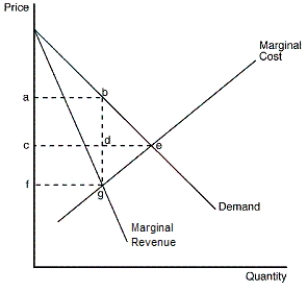 -Refer to Figure 15-5.Which area represents the deadweight loss due to monopoly pricing
 (Multiple Choice)
4.7/5 (81)
(81) Which of the following feats is impossible for a monopolist to accomplish
(Multiple Choice)
4.7/5 (78)
(78) Consider the following: The profit-maximizing price charged for goods produced is $13.The intersection of the marginal-revenue and marginal-cost curves occurs where output is 10 units,marginal cost is $8,and average total cost is $7.What is the monopolist's profit under these conditions
(Multiple Choice)
4.9/5 (65)
(65) Why might economists prefer private ownership of monopolies over public ownership of monopolies?
(Essay)
4.9/5 (92)
(92) Scenario 15-2
A monopoly firm maximizes its profit by producing 500 units output (so Q = 500).At that level of output, its marginal revenue is $32, its average revenue is $42, and its average total cost is $36.
-Refer to Scenario 15-2.What is the firm's maximum profit
(Multiple Choice)
4.9/5 (93)
(93) Which solution to the problem of monopolies does the debate concerning the tradeoffs between "market failure" and "political failure" in the Canadian economy provide support for
(Multiple Choice)
4.9/5 (90)
(90) 
Filters
- Essay(0)
- Multiple Choice(0)
- Short Answer(0)
- True False(0)
- Matching(0)