



 Chat with AI
Exam 9: Application: International Trade

Exam 1: Ten Principles of Economics218 Questions
Exam 2: Thinking Like an Economist239 Questions
Exam 3: Interdependence and the Gains From Trade207 Questions
Exam 4: The Market Forces of Supply and Demand351 Questions
Exam 5: Elasticity and Its Application230 Questions
Exam 6: Supply, demand, and Government Policies248 Questions
Exam 7: Consumers, producers, and the Efficiency of Markets216 Questions
Exam 8: Application: the Costs of Taxation222 Questions
Exam 9: Application: International Trade182 Questions
Exam 10: Externalities210 Questions
Exam 11: Public Goods and Common Resources173 Questions
Exam 12: The Design of the Tax System200 Questions
Exam 13: The Costs of Production209 Questions
Exam 14: Firms in Competitive Markets261 Questions
Exam 15: Monopoly239 Questions
Exam 16: Monopolistic Competition191 Questions
Exam 17: Oligopoly198 Questions
Exam 18: The Markets for the Factors of Production180 Questions
Exam 19: Earnings and Discrimination167 Questions
Exam 20: Income Inequality and Poverty163 Questions
Exam 21: The Theory of Consumer Choice191 Questions
Exam 22: Frontiers of Microeconomics141 Questions
Select questions type


Figure 9-7
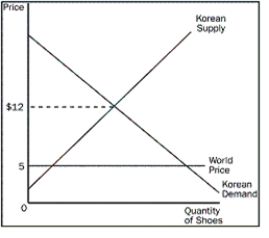 -Refer to Figure 9-7.If trade in shoes is allowed,what will happen to Korean shoe consumers and producers
Free
(Multiple Choice)
4.7/5  (74)
(74) Correct Answer: Verified
C
What can be said if Canada exports cars to France and imports cheese from Switzerland
Free
(Multiple Choice)
4.9/5 (91)
(91) Correct Answer:Verified
VerifiedA
Figure 9-11
 -Refer to Figure 9-11.Before the tariff is imposed,how many carnations will this country import/export
Free
(Multiple Choice)
4.9/5 (72)
(72) Correct Answer:Verified
VerifiedB
A multilateral approach to free trade has more potential to increase the gains from trade than a unilateral approach because the multilateral approach can reduce trade restrictions abroad as well as at home.
(True/False)
4.8/5 (76)
(76) Figure 9-2
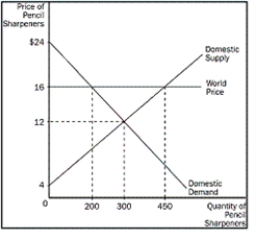 -Refer to Figure 9-2.Without trade,what would consumer surplus in China be
 (Multiple Choice)
4.9/5 (76)
(76) Canada has imposed taxes on some imported goods that have been sold here by foreign countries at below their cost of production.What do these taxes do to Canada as a whole
(Multiple Choice)
4.7/5 (80)
(80) When a country allows trade and becomes an importer of a good,what is the result
(Multiple Choice)
4.7/5 (75)
(75) Without free trade,the domestic price of a good must be equal to the world price of a good.
(True/False)
4.9/5 (79)
(79) According to the principle of comparative advantage,all countries can benefit from trading with one another because trade allows each country to specialize in doing what it does best.
(True/False)
4.9/5 (81)
(81) When does a country have a comparative advantage in a product
(Multiple Choice)
4.8/5 (76)
(76) Figure 9-12
 -Refer to Figure 9-12.What would be the domestic price and domestic quantity demanded after the tariff
 (Multiple Choice)
4.8/5 (70)
(70) Suppose the Ivory Coast,a small country,imports wheat at the world price of $4 per bushel.If the Ivory Coast imposes a tariff of $1 per bushel on imported wheat,the price of wheat in Ivory Coast will increase,but by less than $1,all else equal.
(True/False)
5.0/5 (67)
(67) Figure 9-6
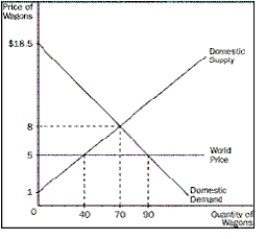 -Refer to Figure 9-6.What does the world price for wagons represent
 (Multiple Choice)
4.9/5 (72)
(72) Figure 9-11
-Refer to Figure 9-11.What is the amount of deadweight loss caused by the tariff
-Refer to Figure 9-11.What is the amount of deadweight loss caused by the tariff (Multiple Choice)
4.9/5 (88)
(88) Figure 9-11
-Refer to Figure 9-11.What will happen in this market with free trade
-Refer to Figure 9-11.What will happen in this market with free trade (Multiple Choice)
5.0/5 (91)
(91) Figure 9-5
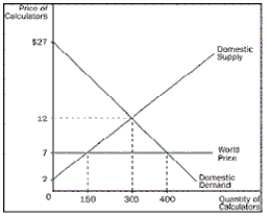 -Figure 9-5 shows the domestic market for calculators in Haiti.What is the change in total surplus in Haiti because of trade
 (Multiple Choice)
4.9/5 (92)
(92) Figure 9-10
 -Refer to Figure 9-10.What would be producer surplus before trade
 (Multiple Choice)
4.9/5 (70)
(70) In principle,trade can make everyone better off,since the gains to the winners exceed the losses to the losers.
(True/False)
4.8/5 (76)
(76) 
Filters
- Essay(0)
- Multiple Choice(0)
- Short Answer(0)
- True False(0)
- Matching(0)