



 Chat with AI
Exam 9: Application: International Trade

Exam 1: Ten Principles of Economics218 Questions
Exam 2: Thinking Like an Economist239 Questions
Exam 3: Interdependence and the Gains From Trade207 Questions
Exam 4: The Market Forces of Supply and Demand351 Questions
Exam 5: Elasticity and Its Application230 Questions
Exam 6: Supply, demand, and Government Policies248 Questions
Exam 7: Consumers, producers, and the Efficiency of Markets216 Questions
Exam 8: Application: the Costs of Taxation222 Questions
Exam 9: Application: International Trade182 Questions
Exam 10: Externalities210 Questions
Exam 11: Public Goods and Common Resources173 Questions
Exam 12: The Design of the Tax System200 Questions
Exam 13: The Costs of Production209 Questions
Exam 14: Firms in Competitive Markets261 Questions
Exam 15: Monopoly239 Questions
Exam 16: Monopolistic Competition191 Questions
Exam 17: Oligopoly198 Questions
Exam 18: The Markets for the Factors of Production180 Questions
Exam 19: Earnings and Discrimination167 Questions
Exam 20: Income Inequality and Poverty163 Questions
Exam 21: The Theory of Consumer Choice191 Questions
Exam 22: Frontiers of Microeconomics141 Questions
Select questions type


Figure 9-10
 -Refer to Figure 9-10.What would be producer surplus after trade
 (Multiple Choice)
4.8/5  (86)
(86) Figure 9-6
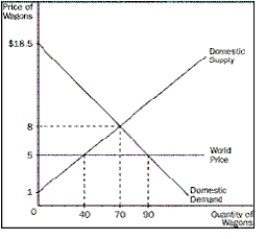 -Refer to Figure 9-6.With free trade,what would producer surplus be
 (Multiple Choice)
4.8/5 (75)
(75) Figure 9-6
-Refer to Figure 9-6.Without trade,what would total surplus be
-Refer to Figure 9-6.Without trade,what would total surplus be (Multiple Choice)
4.8/5 (79)
(79) If Brazil has a comparative advantage in producing sugar,and trade in sugar is allowed,what can be said about Brazil
(Multiple Choice)
4.8/5 (87)
(87) Where will workers displaced by trade eventually find jobs
(Multiple Choice)
5.0/5 (76)
(76) Figure 9-6
-Refer to Figure 9-6.If this country allows free trade in wagons,how much will producers gain or lose
-Refer to Figure 9-6.If this country allows free trade in wagons,how much will producers gain or lose (Multiple Choice)
4.9/5 (80)
(80) Figure 9-12
 -Refer to Figure 9-12.What would consumer surplus be with free trade
 (Multiple Choice)
4.8/5 (84)
(84) The finance minister of a province that has many textile firms wants to impose tariffs on all imported textiles.Which of the following is NOT a likely consequence of such tariffs
(Multiple Choice)
4.7/5 (92)
(92) If a country allows trade and the domestic price of a good is different from the world price,will the country become an exporter
(Multiple Choice)
4.9/5 (73)
(73) In a two-country world,the opening of free trade does not make everyone in the two countries better off.Why should we promote international trade
(Essay)
4.8/5 (67)
(67) Tariffs cause deadweight loss because they move the price of an imported product closer to the equilibrium without trade,thus reducing the gains from trade.
(True/False)
4.9/5 (71)
(71) Figure 9-6
-Refer to Figure 9-6.If this country allows free trade in wagons,who will gain or lose
-Refer to Figure 9-6.If this country allows free trade in wagons,who will gain or lose (Multiple Choice)
4.8/5 (72)
(72) Figure 9-6
-Refer to Figure 9-6.Without trade,what would consumer surplus be
-Refer to Figure 9-6.Without trade,what would consumer surplus be (Multiple Choice)
4.9/5 (82)
(82) When a country allows free trade,how will the domestic price of a product compare with the world price
(Multiple Choice)
4.8/5 (82)
(82) If the world price of a good is greater than the domestic price in a country that can engage in international trade,that country would become an importer of that good.
(True/False)
5.0/5 (89)
(89) Trade decisions are based on the concept of absolute advantage.
(True/False)
4.9/5 (80)
(80) When a country allows trade and becomes an exporter of a good,what happens to consumer surplus and producer surplus
(Multiple Choice)
4.7/5 (73)
(73) Sweden is an importer of goose down parkas.The world price of these parkas is $500.Sweden imposes a $17 tariff on parkas.Sweden is a price taker in the parka market.As a result of the tariff,who will gain
(Multiple Choice)
4.9/5 (74)
(74) Figure 9-7
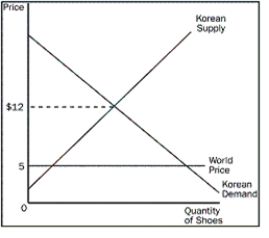 -Refer to Figure 9-7.If trade in shoes is allowed,what action will Korea take
 (Multiple Choice)
4.9/5 (79)
(79) 
Filters
- Essay(0)
- Multiple Choice(0)
- Short Answer(0)
- True False(0)
- Matching(0)