



 Chat with AI
Exam 15: Monopoly

Exam 1: Ten Principles of Economics218 Questions
Exam 2: Thinking Like an Economist239 Questions
Exam 3: Interdependence and the Gains From Trade207 Questions
Exam 4: The Market Forces of Supply and Demand351 Questions
Exam 5: Elasticity and Its Application230 Questions
Exam 6: Supply, demand, and Government Policies248 Questions
Exam 7: Consumers, producers, and the Efficiency of Markets216 Questions
Exam 8: Application: the Costs of Taxation222 Questions
Exam 9: Application: International Trade182 Questions
Exam 10: Externalities210 Questions
Exam 11: Public Goods and Common Resources173 Questions
Exam 12: The Design of the Tax System200 Questions
Exam 13: The Costs of Production209 Questions
Exam 14: Firms in Competitive Markets261 Questions
Exam 15: Monopoly239 Questions
Exam 16: Monopolistic Competition191 Questions
Exam 17: Oligopoly198 Questions
Exam 18: The Markets for the Factors of Production180 Questions
Exam 19: Earnings and Discrimination167 Questions
Exam 20: Income Inequality and Poverty163 Questions
Exam 21: The Theory of Consumer Choice191 Questions
Exam 22: Frontiers of Microeconomics141 Questions
Select questions type


For a profit-maximizing monopolist,when should output be increased to enhance economic well-being
(Multiple Choice)
4.9/5  (65)
(65) How is a monopolist's profit-maximizing quantity of output determined
(Multiple Choice)
5.0/5 (80)
(80) What shape of demand curves do competitive firms have,and how much output can they sell
(Multiple Choice)
4.9/5 (82)
(82) Figure 15-3
The figure below reflects the cost and revenue structure for a monopoly firm.
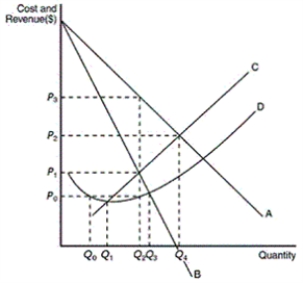 -Refer to Figure 15-3.What would profit be on a typical unit sold for a profit-maximizing monopoly
 (Multiple Choice)
4.7/5 (79)
(79) A monopoly firm can sell 200 units of output for $36.00 per unit.Alternatively,it can sell 201 units of output for $35.50 per unit.What is the marginal revenue of the 201st unit of output
(Multiple Choice)
4.9/5 (77)
(77) Price discrimination explains why many universities often set rules that determine prices of admission (or financial aid).What characteristic of students is this based on
(Multiple Choice)
4.8/5 (74)
(74) What shape of demand curves do monopoly firms have,and how much output can they sell
(Multiple Choice)
4.9/5 (84)
(84) Assume that a monopolist decides to maximize revenue rather than profit. How does this operating objective change the size of the deadweight loss? If you are a “benevolent” manager of a monopoly firm and are interested in reducing the deadweight loss of monopoly, should you maximize profits or maximize revenue? Carefully explain your answer.
(Essay)
4.8/5 (79)
(79) Figure 15-2
The figure below reflects the cost and revenue structure for a monopoly firm.
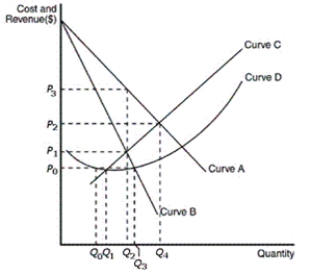 -Refer to Figure 15-2.Which curve depicts the marginal-revenue curve for a monopoly firm
 (Multiple Choice)
4.7/5 (89)
(89) In theory,which outcome occurs with perfect price discrimination
(Multiple Choice)
4.8/5 (83)
(83) Scenario 15-1
Consider the market for water in a small town in the Old West.Assume that the only source of water is the underground aquifer that lies directly below the town.Wells are used to supply water to the entire town.
-Refer to Scenario 15-1.Assume that Jack is the sole owner of all the wells in town.He decides to move to a more suitable climate and sells the wells to a couple of dozen different town residents.What will be the result
(Multiple Choice)
4.9/5 (69)
(69) For which item is it sometimes meaningful for a monopoly to consider negative values
(Multiple Choice)
4.8/5 (73)
(73) Table 15-1
 -Refer to Table 15-1.What is the marginal revenue for the monopolist for the sixth unit sold
 (Multiple Choice)
4.8/5 (74)
(74) Which of the following is NOT an example of price discrimination
(Multiple Choice)
4.7/5 (62)
(62) Under which circumstance can a firm that has a monopoly on water (which is a necessity) charge a high price for water
(Multiple Choice)
4.8/5 (83)
(83) 
Filters
- Essay(0)
- Multiple Choice(0)
- Short Answer(0)
- True False(0)
- Matching(0)