



 Chat with AI
Exam 10: Externalities

Exam 1: Ten Principles of Economics218 Questions
Exam 2: Thinking Like an Economist239 Questions
Exam 3: Interdependence and the Gains From Trade207 Questions
Exam 4: The Market Forces of Supply and Demand351 Questions
Exam 5: Elasticity and Its Application230 Questions
Exam 6: Supply, demand, and Government Policies248 Questions
Exam 7: Consumers, producers, and the Efficiency of Markets216 Questions
Exam 8: Application: the Costs of Taxation222 Questions
Exam 9: Application: International Trade182 Questions
Exam 10: Externalities210 Questions
Exam 11: Public Goods and Common Resources173 Questions
Exam 12: The Design of the Tax System200 Questions
Exam 13: The Costs of Production209 Questions
Exam 14: Firms in Competitive Markets261 Questions
Exam 15: Monopoly239 Questions
Exam 16: Monopolistic Competition191 Questions
Exam 17: Oligopoly198 Questions
Exam 18: The Markets for the Factors of Production180 Questions
Exam 19: Earnings and Discrimination167 Questions
Exam 20: Income Inequality and Poverty163 Questions
Exam 21: The Theory of Consumer Choice191 Questions
Exam 22: Frontiers of Microeconomics141 Questions
Select questions type


Private parties may choose to leave an externality problem unsolved if the transaction costs are large enough.
(True/False)
4.9/5  (81)
(81) If making computer chips yields greater spillovers than making potato chips,what do some economists argue that government should do
(Multiple Choice)
4.8/5 (74)
(74) In which case is the Coase theorem most likely to work to solve an externality
(Multiple Choice)
4.9/5 (76)
(76) What effect are corrective taxes typically advocated to correct
(Multiple Choice)
4.8/5 (98)
(98) When dealing with externalities,how can we correct market failure
(Multiple Choice)
5.0/5 (70)
(70) When externalities cause markets to be inefficient,what can solve the problem
(Multiple Choice)
5.0/5 (79)
(79) What result could private contracts between parties with mutual interests lead to
(Multiple Choice)
4.9/5 (73)
(73) Why do private markets fail to reach a socially optimal level when positive externalities are present
(Multiple Choice)
4.8/5 (76)
(76) What is one reason that some firms are involved in multiple types of businesses
(Multiple Choice)
4.9/5 (77)
(77) Despite the appealing logic of the Coase theorem,private actors often fail to resolve the problems caused by externalities on their own.
(True/False)
4.7/5 (80)
(80) If the government were to impose a fee of $10,000 for each unit of air pollution released by a steel mill,what term would be used for this policy
(Multiple Choice)
4.8/5 (73)
(73) Suppose that a steel factory emits a certain amount of air pollution.If this market is NOT required to internalize this externality,what will happen
(Multiple Choice)
4.9/5 (85)
(85) Figure 10-1
This figure reflects the market for outdoor concerts in a public park surrounded by residential neighbourhoods.
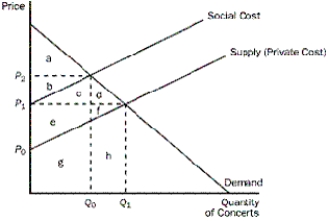 -Refer to Figure 10-1.At the private market outcome,what will the equilibrium price be
 (Multiple Choice)
5.0/5 (81)
(81) A fertilizer plant emits a very foul odour during the production process.If the government forces the plant to internalize this negative externality,what would result
(Multiple Choice)
4.9/5 (91)
(91) When producers operate in a market characterized by negative externalities,what will a tax do that forces them to internalize the externality
(Multiple Choice)
4.9/5 (79)
(79) To ensure the market reaches the social optimum in presence of a technology spillover,how should the government subsidize producers
(Multiple Choice)
5.0/5 (82)
(82) Brennan owns a dog whose barking annoys Brennan's neighbour Emily.Brennan receives personal benefit from owning the dog,and Emily bears a cost of Brennan's ownership of the dog.Assuming Brennan has the legal right to keep the dog,when can a private solution be arranged
(Multiple Choice)
5.0/5 (78)
(78) Figure 10-2
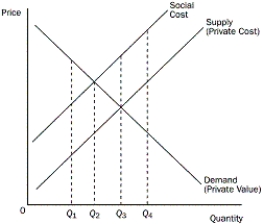 -Refer to Figure 10-2.If this market currently produces Q₃,how would total economic well-being be increased
 (Multiple Choice)
4.7/5 (65)
(65) Two firms,A and B,each currently dump 50 tonnes of chemicals into the local river.From now on both firms will require a pollution permit for each tonne of pollution dumped into the river.The government gives each firm 20 tonnes' worth of pollution permits,which it can either use or sell to the other firm.It costs Firm A $100 for each tonne of pollution that it eliminates before it reaches the river,and it costs Firm B $50 for each tonne of pollution that it eliminates before it reaches the river.What is likely to happen
(Multiple Choice)
4.8/5 (81)
(81) 
Filters
- Essay(0)
- Multiple Choice(0)
- Short Answer(0)
- True False(0)
- Matching(0)