



 Chat with AI
Exam 10: Externalities

Exam 1: Ten Principles of Economics218 Questions
Exam 2: Thinking Like an Economist239 Questions
Exam 3: Interdependence and the Gains From Trade207 Questions
Exam 4: The Market Forces of Supply and Demand351 Questions
Exam 5: Elasticity and Its Application230 Questions
Exam 6: Supply, demand, and Government Policies248 Questions
Exam 7: Consumers, producers, and the Efficiency of Markets216 Questions
Exam 8: Application: the Costs of Taxation222 Questions
Exam 9: Application: International Trade182 Questions
Exam 10: Externalities210 Questions
Exam 11: Public Goods and Common Resources173 Questions
Exam 12: The Design of the Tax System200 Questions
Exam 13: The Costs of Production209 Questions
Exam 14: Firms in Competitive Markets261 Questions
Exam 15: Monopoly239 Questions
Exam 16: Monopolistic Competition191 Questions
Exam 17: Oligopoly198 Questions
Exam 18: The Markets for the Factors of Production180 Questions
Exam 19: Earnings and Discrimination167 Questions
Exam 20: Income Inequality and Poverty163 Questions
Exam 21: The Theory of Consumer Choice191 Questions
Exam 22: Frontiers of Microeconomics141 Questions
Select questions type


Figure 10-2
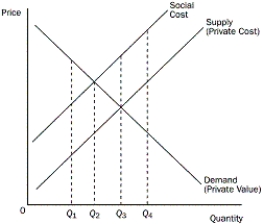 -Refer to Figure 10-2.If this market currently produces Q₂,how could total economic well-being be maximized
 (Multiple Choice)
4.8/5  (84)
(84) Why would corrective taxes NOT be preferred over regulations in order to reduce pollution
(Multiple Choice)
5.0/5 (94)
(94) Imagine you are a nonsmoker sharing a house with a smoker. According to the Coase theorem, what determines whether your roommate smokes in the house? Is this outcome efficient? How do you and your roommate reach this solution?
(Essay)
4.7/5 (83)
(83) When a transaction between a buyer and seller directly affects a third party,the effect is called an externality.
(True/False)
4.7/5 (77)
(77) Using a supply and demand diagram, demonstrate how a positive externality leads to market inefficiency. How might the government help to eliminate this inefficiency?
(Essay)
4.9/5 (80)
(80) Assume that your roommate,Vanessa,is very messy,and according to campus policy,you have a right to live in an uncluttered apartment.Suppose she gets a $200 benefit from being messy but imposes a $100 cost on you.What would the Coase theorem suggest would be an efficient solution for your roommate
(Multiple Choice)
4.9/5 (82)
(82) A market for pollution permits can efficiently allocate the right to pollute by the forces of supply and demand.
(True/False)
4.9/5 (84)
(84) Social welfare can be enhanced by allowing firms to trade their rights to pollute.
(True/False)
4.7/5 (91)
(91) What are two types of private solutions to the problem of externalities
(Multiple Choice)
4.7/5 (80)
(80) Figure 10-3
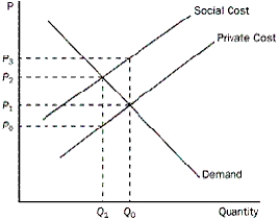 -Refer to Figure 10-3.How is the negative externality measured
 (Multiple Choice)
5.0/5 (91)
(91) Figure 10-1
This figure reflects the market for outdoor concerts in a public park surrounded by residential neighbourhoods.
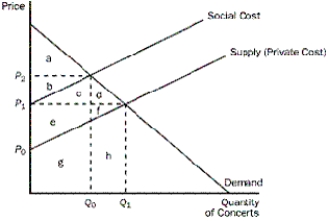 -Refer to Figure 10-1.What price and quantity combination best represents the optimum price and number of concerts that should be organized
 (Multiple Choice)
4.8/5 (76)
(76) What does the height of the supply curve at any given quantity of coal show
(Multiple Choice)
4.9/5 (83)
(83) If the government wanted to ensure that the market reaches the social optimum in the presence of a technology spillover,what should it do
(Multiple Choice)
4.8/5 (73)
(73) The social cost of pollution includes the private costs of the producers plus the costs to those bystanders affected adversely by the pollution.
(True/False)
4.8/5 (84)
(84) Using a supply and demand diagram,demonstrate how a negative externality leads to market inefficiency.How might the government help to eliminate this inefficiency
(Essay)
4.9/5 (85)
(85) Two firms,A and B,each currently dump 20 tonnes of chemicals into the local river.From now on both firms will require a pollution permit for each tonne of pollution dumped into the river.The government gives each firm 10 pollution permits,which it can either use or sell to the other firm.It costs Firm A $100 for each tonne of pollution that it eliminates before it reaches the river,and it costs Firm B $50 for each tonne of pollution that it eliminates before it reaches the river.After the two firms buy or sell pollution permits from each other,what would we expect
(Multiple Choice)
4.9/5 (88)
(88) 
Filters
- Essay(0)
- Multiple Choice(0)
- Short Answer(0)
- True False(0)
- Matching(0)