



 Chat with AI
Exam 8: Application: the Costs of Taxation

Exam 1: Ten Principles of Economics218 Questions
Exam 2: Thinking Like an Economist239 Questions
Exam 3: Interdependence and the Gains From Trade207 Questions
Exam 4: The Market Forces of Supply and Demand351 Questions
Exam 5: Elasticity and Its Application230 Questions
Exam 6: Supply, demand, and Government Policies248 Questions
Exam 7: Consumers, producers, and the Efficiency of Markets216 Questions
Exam 8: Application: the Costs of Taxation222 Questions
Exam 9: Application: International Trade182 Questions
Exam 10: Externalities210 Questions
Exam 11: Public Goods and Common Resources173 Questions
Exam 12: The Design of the Tax System200 Questions
Exam 13: The Costs of Production209 Questions
Exam 14: Firms in Competitive Markets261 Questions
Exam 15: Monopoly239 Questions
Exam 16: Monopolistic Competition191 Questions
Exam 17: Oligopoly198 Questions
Exam 18: The Markets for the Factors of Production180 Questions
Exam 19: Earnings and Discrimination167 Questions
Exam 20: Income Inequality and Poverty163 Questions
Exam 21: The Theory of Consumer Choice191 Questions
Exam 22: Frontiers of Microeconomics141 Questions
Select questions type


Using demand and supply diagrams,show the difference in deadweight loss between a market with inelastic demand and supply curves and a market with elastic demand and supply curves.
(Essay)
4.9/5  (74)
(74) Figure 8-5
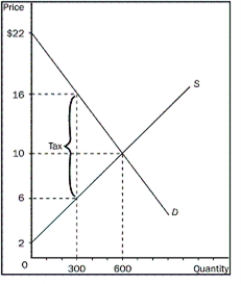 -Refer to Figure 8-5.What would happen to consumer surplus if the tax were imposed in this market
 (Multiple Choice)
4.9/5 (82)
(82) A tax of $20 per unit is imposed on a certain market.The tax reduces the equilibrium quantity in the market by 200 units.What is the deadweight loss from the tax
(Multiple Choice)
4.8/5 (92)
(92) As the size of a tax increases,the government's tax revenue rises then falls.
(True/False)
4.7/5 (83)
(83) What happens if the deadweight loss of taxation grows larger
(Multiple Choice)
4.9/5 (86)
(86) Figure 8-5
-Refer to Figure 8-5.If the tax is imposed on the seller,what price would the buyers pay for the good
-Refer to Figure 8-5.If the tax is imposed on the seller,what price would the buyers pay for the good (Multiple Choice)
5.0/5 (86)
(86) Figure 8-6
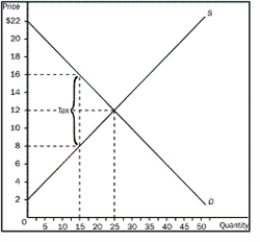 -Refer to Figure 8-6.What is the price sellers receive after the tax
 (Multiple Choice)
4.9/5 (77)
(77) Economists disagree on whether labour taxes have a small or a large deadweight loss.
(True/False)
4.8/5 (77)
(77) Which term refers to the loss in total surplus resulting from a tax
(Multiple Choice)
4.9/5 (79)
(79) Figure 8-4
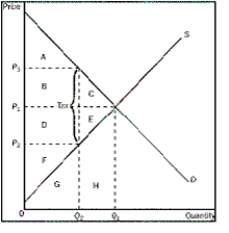 -Refer to Figure 8-4.Assume the tax was levied on the consumer.Which area represents the reduction in consumer surplus
 (Multiple Choice)
4.8/5 (74)
(74) How is the benefit received by buyers in the market measured
(Multiple Choice)
4.8/5 (63)
(63) Figure 8-3
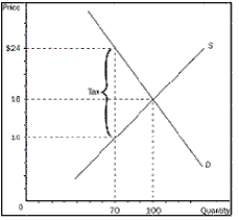 -Refer to Figure 8-3.What is the per-unit burden of the tax on the sellers
 (Multiple Choice)
4.9/5 (86)
(86) Figure 8-4
-Refer to Figure 8-4.What is the price sellers receive after the tax and the quantity sold
-Refer to Figure 8-4.What is the price sellers receive after the tax and the quantity sold (Multiple Choice)
4.9/5 (83)
(83) Economist Arthur Laffer made the argument that tax rates in the United States were so high that reducing the rates would increase tax revenue.
(True/False)
4.9/5 (76)
(76) How are the size of the tax and the deadweight loss of a tax related
(Multiple Choice)
4.8/5 (89)
(89) Figure 8-6
-Refer to Figure 8-6.What would consumer surplus be after the tax is levied on the buyer
-Refer to Figure 8-6.What would consumer surplus be after the tax is levied on the buyer (Multiple Choice)
4.8/5 (88)
(88) What will a tax placed on coffee do to the equilibrium price and quantity
(Multiple Choice)
5.0/5 (82)
(82) The Laffer curve is the curve showing how tax revenue varies as tax rates vary.
(True/False)
4.7/5 (68)
(68) 
Filters
- Essay(0)
- Multiple Choice(0)
- Short Answer(0)
- True False(0)
- Matching(0)