



 Chat with AI
Exam 8: Application: the Costs of Taxation

Exam 1: Ten Principles of Economics218 Questions
Exam 2: Thinking Like an Economist239 Questions
Exam 3: Interdependence and the Gains From Trade207 Questions
Exam 4: The Market Forces of Supply and Demand351 Questions
Exam 5: Elasticity and Its Application230 Questions
Exam 6: Supply, demand, and Government Policies248 Questions
Exam 7: Consumers, producers, and the Efficiency of Markets216 Questions
Exam 8: Application: the Costs of Taxation222 Questions
Exam 9: Application: International Trade182 Questions
Exam 10: Externalities210 Questions
Exam 11: Public Goods and Common Resources173 Questions
Exam 12: The Design of the Tax System200 Questions
Exam 13: The Costs of Production209 Questions
Exam 14: Firms in Competitive Markets261 Questions
Exam 15: Monopoly239 Questions
Exam 16: Monopolistic Competition191 Questions
Exam 17: Oligopoly198 Questions
Exam 18: The Markets for the Factors of Production180 Questions
Exam 19: Earnings and Discrimination167 Questions
Exam 20: Income Inequality and Poverty163 Questions
Exam 21: The Theory of Consumer Choice191 Questions
Exam 22: Frontiers of Microeconomics141 Questions
Select questions type


Assume that a tax is levied on a good and the government uses the funds to build statues of the premiers of each of the provinces and territories.In this case,which of the following would NOT occur
(Multiple Choice)
4.8/5  (71)
(71) Which effect on income tax collections is NOT indicated by the Laffer curve
(Multiple Choice)
4.8/5 (88)
(88) Assume that the supply of gasoline is relatively inelastic and the supply of wheat is relatively elastic.What happens to the producer surplus if a tax is levied on gasoline
(Multiple Choice)
4.8/5 (81)
(81) Figure 8-6
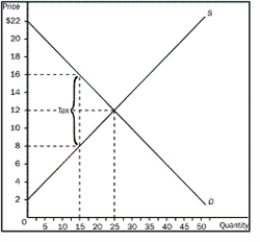 -Refer to Figure 8-6.What would the total surplus with the tax levied on the seller be
 (Multiple Choice)
4.8/5 (60)
(60) What happens as elasticities of supply and demand increase
(Multiple Choice)
4.8/5 (85)
(85) Figure 8-6
-Refer to Figure 8-6.What would the benefits to the government (total tax revenue) be
-Refer to Figure 8-6.What would the benefits to the government (total tax revenue) be (Multiple Choice)
4.8/5 (73)
(73) Which tax is the most important tax in the Canadian economy,according to economists
(Multiple Choice)
4.8/5 (79)
(79) Figure 8-3
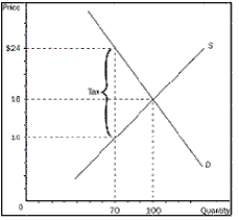 -Refer to Figure 8-3.What is the price that will be paid after the tax
 (Multiple Choice)
4.9/5 (76)
(76) Which of the following effects is NOT encouraged by taxes on labour
(Multiple Choice)
4.9/5 (61)
(61) What result did Ronald Reagan believe would come from reducing income tax rates
(Multiple Choice)
4.9/5 (89)
(89) Figure 8-5
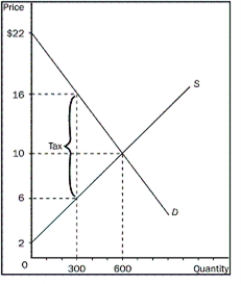 -Refer to Figure 8-5.What would happen to total surplus in this market if the tax were imposed on the buyer
 (Multiple Choice)
4.9/5 (84)
(84) When a tax is levied on a good,what is the effect on buyers and sellers and who is worse off
(Multiple Choice)
4.8/5 (86)
(86) Consider a (per unit) tax on two different goods,X and Y.Good X has very elastic supply,while good Y has very inelastic supply.Assume the demand curve for each good is the same.If the government wants to minimize deadweight loss,which good should they tax
(Essay)
5.0/5 (79)
(79) A tax on insulin is likely to cause a tremendous deadweight loss to society.
(True/False)
4.8/5 (79)
(79) Figure 8-4
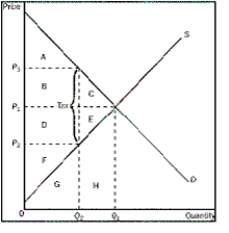 -Refer to Figure 8-4.Which area represents consumer surplus before the tax was levied
 (Multiple Choice)
4.8/5 (78)
(78) What name was given to the views held by Arthur Laffer and Ronald Reagan that cuts in tax rates would encourage people to increase the quantity of labour they supplied
(Multiple Choice)
4.7/5 (67)
(67) Figure 8-4
-Refer to Figure 8-4.Which area represents producer surplus before the tax
-Refer to Figure 8-4.Which area represents producer surplus before the tax (Multiple Choice)
4.9/5 (83)
(83) The demand for bread is less elastic than the demand for donuts; hence,a tax on bread will create a larger deadweight loss than will the same tax on donuts,all else equal.
(True/False)
4.7/5 (80)
(80) 
Filters
- Essay(0)
- Multiple Choice(0)
- Short Answer(0)
- True False(0)
- Matching(0)