



 Chat with AI
Exam 6: Supply, demand, and Government Policies

Exam 1: Ten Principles of Economics218 Questions
Exam 2: Thinking Like an Economist239 Questions
Exam 3: Interdependence and the Gains From Trade207 Questions
Exam 4: The Market Forces of Supply and Demand351 Questions
Exam 5: Elasticity and Its Application230 Questions
Exam 6: Supply, demand, and Government Policies248 Questions
Exam 7: Consumers, producers, and the Efficiency of Markets216 Questions
Exam 8: Application: the Costs of Taxation222 Questions
Exam 9: Application: International Trade182 Questions
Exam 10: Externalities210 Questions
Exam 11: Public Goods and Common Resources173 Questions
Exam 12: The Design of the Tax System200 Questions
Exam 13: The Costs of Production209 Questions
Exam 14: Firms in Competitive Markets261 Questions
Exam 15: Monopoly239 Questions
Exam 16: Monopolistic Competition191 Questions
Exam 17: Oligopoly198 Questions
Exam 18: The Markets for the Factors of Production180 Questions
Exam 19: Earnings and Discrimination167 Questions
Exam 20: Income Inequality and Poverty163 Questions
Exam 21: The Theory of Consumer Choice191 Questions
Exam 22: Frontiers of Microeconomics141 Questions
Select questions type


Figure 6-12
 -Refer to Figure 6-12.What is the per-unit burden of the tax on the sellers
 (Multiple Choice)
4.7/5  (71)
(71) Figure 6-13
 -Refer to Figure 6-13.What is the per-unit burden of the tax on the sellers
 (Multiple Choice)
4.9/5 (82)
(82) Market demand is given as QD = 280 - 4P.Market supply is given as QS = 2P + 40.Which legally imposed price would constitute a binding price floor
(Multiple Choice)
4.9/5 (83)
(83) Although lawmakers designed the burden of the EI payroll tax to be split evenly between workers and firms,what do labour economists believe
(Multiple Choice)
4.8/5 (92)
(92) If buyers of a product are required to pay a tax,the demand curve for the product will shift downward by exactly the size of the tax.
(True/False)
4.9/5 (81)
(81) Lawmakers can decide whether the buyer or the seller must send a tax to the government,but they cannot legislate the true burden of a tax.
(True/False)
4.8/5 (74)
(74) Which statement is the best explanation for the imposition of a price floor in the market for corn
(Multiple Choice)
4.8/5 (85)
(85) Market demand is given as QD = 210 - 5P.Market supply is given as QS = 2P.Which legally imposed price would constitute a binding price ceiling
(Multiple Choice)
4.9/5 (78)
(78) Market demand is given as QD = 280 - 4P.Market supply is given as QS = 2P + 40.Which legally imposed price would constitute a binding price floor
(Multiple Choice)
4.7/5 (67)
(67) Suppose that a tax is placed on music concerts.If the buyer ends up paying the majority of the tax,what do we know
(Multiple Choice)
4.8/5 (74)
(74) Figure 6-7
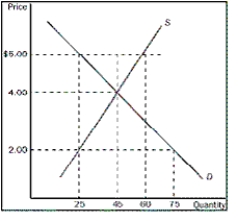 -Refer to Figure 6-7.If the government imposes a binding price floor of $5.00 in this market,what is the result
 (Multiple Choice)
4.9/5 (77)
(77) Figure 6-1
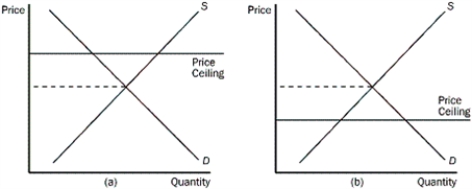
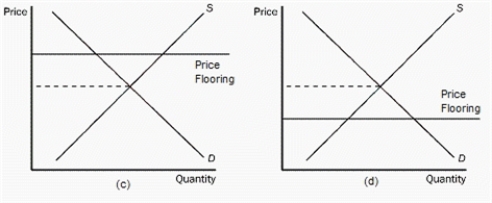 -Refer to Figure 6-1.Which of the above figures represent price control correctly
 (Multiple Choice)
4.8/5 (77)
(77) Market demand is given as QD = 45 - P.Market supply is given as QS = P + 15.Which legally imposed price would constitute a binding price ceiling
(Multiple Choice)
4.8/5 (78)
(78) If a tax is imposed on a market with inelastic supply,how is the burden of the tax distributed
(Multiple Choice)
4.8/5 (73)
(73) What is the most likely result of the imposition of a price floor in the market for rental cars
(Multiple Choice)
4.9/5 (71)
(71) What do we know about price controls imposed by policymakers
(Multiple Choice)
5.0/5 (74)
(74) One economist has argued that rent control is "the best way to destroy a city,other than bombing." Why would an economist agree with this
(Multiple Choice)
4.9/5 (86)
(86) When binding price ceilings are imposed to benefit buyers,what happens
(Multiple Choice)
5.0/5 (81)
(81) If a tax is imposed on the buyer of a product,the tax incidence will fall entirely on the buyer,causing the buyer to pay more.
(True/False)
4.7/5 (76)
(76) 
Filters
- Essay(0)
- Multiple Choice(0)
- Short Answer(0)
- True False(0)
- Matching(0)