



 Chat with AI
Exam 6: Supply, demand, and Government Policies

Exam 1: Ten Principles of Economics218 Questions
Exam 2: Thinking Like an Economist239 Questions
Exam 3: Interdependence and the Gains From Trade207 Questions
Exam 4: The Market Forces of Supply and Demand351 Questions
Exam 5: Elasticity and Its Application230 Questions
Exam 6: Supply, demand, and Government Policies248 Questions
Exam 7: Consumers, producers, and the Efficiency of Markets216 Questions
Exam 8: Application: the Costs of Taxation222 Questions
Exam 9: Application: International Trade182 Questions
Exam 10: Externalities210 Questions
Exam 11: Public Goods and Common Resources173 Questions
Exam 12: The Design of the Tax System200 Questions
Exam 13: The Costs of Production209 Questions
Exam 14: Firms in Competitive Markets261 Questions
Exam 15: Monopoly239 Questions
Exam 16: Monopolistic Competition191 Questions
Exam 17: Oligopoly198 Questions
Exam 18: The Markets for the Factors of Production180 Questions
Exam 19: Earnings and Discrimination167 Questions
Exam 20: Income Inequality and Poverty163 Questions
Exam 21: The Theory of Consumer Choice191 Questions
Exam 22: Frontiers of Microeconomics141 Questions
Select questions type


The demand for salt is price inelastic and the supply of salt is price elastic.The demand for caviar is price elastic and the supply of caviar is price inelastic.Suppose that a tax of $1 per kilogram is levied on the sellers of salt and a tax of $1 per kilogram is levied on the buyers of caviar.Who would we expect to have to pay most of these taxes
(Multiple Choice)
4.8/5  (84)
(84) Figure 6-11
 -Refer to Figure 6-11.In which market will the majority of a tax be paid by the buyer
 (Multiple Choice)
4.9/5 (82)
(82) If the equilibrium wage rate is $4 per hour,and the minimum wage is $5.15 per hour,a shortage of labour will exist.
(True/False)
4.8/5 (92)
(92) Market demand is given as QD = 400 - 2P.Market supply is given as QS = 2P.Which legally imposed price would constitute a binding price ceiling
(Multiple Choice)
4.8/5 (79)
(79) Figure 6-13
 -Refer to Figure 6-13.What is the equilibrium price before the tax is imposed
 (Multiple Choice)
4.7/5 (84)
(84) Market demand is given as QD = 45 - P.Market supply is given as QS = P + 15.Which legally imposed price would constitute a binding price ceiling
(Multiple Choice)
4.8/5 (83)
(83) When is the tax incidence the same as who ultimately bears the tax
(Multiple Choice)
4.9/5 (67)
(67) What happens when government imposes price ceilings and floors in a market
(Multiple Choice)
4.9/5 (89)
(89) In order to raise tax revenue and reduce cigarette sales,the government decided to impose a new alcohol tax on all beer sales.One year after introducing the tax,the government found that the tax was most effective in reducing beer sales among young people but did not have a significant effect on others.What can this information tell you about the demand curves
(Essay)
4.9/5 (72)
(72) Which parties determine the supply and the demand for labour
(Multiple Choice)
4.8/5 (63)
(63) Figure 6-13
-Refer to Figure 6-13.What is the per-unit burden of the tax on buyers
-Refer to Figure 6-13.What is the per-unit burden of the tax on buyers (Multiple Choice)
5.0/5 (84)
(84) What effect will a tax on sellers of cellphones have on the cell phone market
(Multiple Choice)
4.8/5 (86)
(86) Under rent control,landlords cease to be responsive to tenants' concerns about the quality of the housing.Why is this
(Multiple Choice)
4.8/5 (68)
(68) Using the graph shown below,answer the following questions.
a.What was the equilibrium price in this market before the tax
b.What is the amount of the tax
c.How much of the tax will the buyers pay
d.How much of the tax will the sellers pay
e.How much will the buyer pay for the product after the tax is imposed
f.How much will the seller receive after the tax is imposed
g.As a result of the tax,what has happened to the level of market activity
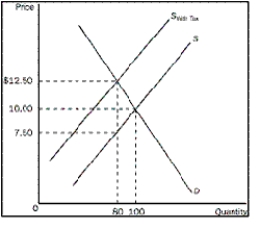
(Essay)
4.8/5 (95)
(95) Figure 6-5

 -Refer to Figure 6-5.Which panel best represents a binding rent control in the short run
 (Multiple Choice)
4.7/5 (84)
(84) Using the equations shown below,answer the following questions.
QD = 100 - 2P
QS = -20 + 2P
a.What is the equilibrium price and quantity in this market
b.Assuming a tax of $10 is imposed on the buyer side,what is the equilibrium price and quantity after the tax
c.How much of the tax will the buyers pay
d.How much of the tax will the sellers pay
e.What is the effective price the buyers pay
(Essay)
4.9/5 (84)
(84) 
Filters
- Essay(0)
- Multiple Choice(0)
- Short Answer(0)
- True False(0)
- Matching(0)