



 Chat with AI
Exam 5: Externalities, Environmental Policy, and Public Goods

Exam 1: Economics: Foundations and Models240 Questions
Exam 2: Trade-Offs, Comparative Advantage, and the Market System258 Questions
Exam 3: Where Prices Come From: the Interaction of Demand and Supply242 Questions
Exam 4: Economic Efficiency, Government Price Setting, and Taxes208 Questions
Exam 5: Externalities, Environmental Policy, and Public Goods262 Questions
Exam 6: Elasticity: the Responsiveness of Demand and Supply293 Questions
Exam 7: The Economics of Health Care171 Questions
Exam 8: Firms, the Stock Market, and Corporate Governance261 Questions
Exam 9: Comparative Advantage and the Gains From International Trade188 Questions
Exam 10: Consumer Choice and Behavioral Economics304 Questions
Exam 11: Technology, Production, and Costs327 Questions
Exam 12: Firms in Perfectly Competitive Markets297 Questions
Exam 13: Monopolistic Competition: the Competitive Model in a272 Questions
Exam 14: Oligopoly: Firms in Less Competitive Markets257 Questions
Exam 15: Monopoly and Antitrust Policy279 Questions
Exam 16: Pricing Strategy258 Questions
Exam 17: The Markets for Labor and Other Factors of Production279 Questions
Exam 18: Public Choice, Taxes, and the Distribution of Income258 Questions
Select questions type


When negative externalities exist, the competitive market supply curve does not include all of the costs borne by members of society.
(True/False)
4.9/5  (70)
(70) In economics, the optimal level of pollution is the level for which the net benefit from reducing the pollution is the greatest.
(True/False)
4.8/5 (84)
(84) An important difference between the demand for a private good and the demand for a public good is that
(Multiple Choice)
4.8/5 (77)
(77) Figure 5-10
 Chicken pox vaccinations for toddlers benefit society by protecting young children and by preventing an epidemic of the disease. Thus, the marginal social benefits of chicken pox vaccinations exceed the marginal private benefit for any quantity of vaccinations as illustrated in Figure 5-10.
-Refer to Figure 5-10.One way to obtain the economically efficient amount of chicken pox vaccinations is for governments to subsidize these vaccinations.What is the size of the per-vaccination Pigovian subsidy that the government must provide to internalize the external benefits?
Chicken pox vaccinations for toddlers benefit society by protecting young children and by preventing an epidemic of the disease. Thus, the marginal social benefits of chicken pox vaccinations exceed the marginal private benefit for any quantity of vaccinations as illustrated in Figure 5-10.
-Refer to Figure 5-10.One way to obtain the economically efficient amount of chicken pox vaccinations is for governments to subsidize these vaccinations.What is the size of the per-vaccination Pigovian subsidy that the government must provide to internalize the external benefits? (Multiple Choice)
4.9/5 (74)
(74) Sefronia and Bella share an apartment and they are deciding whether or not to purchase a weekly housecleaning service.The value of the service to each of them is $50 and it costs $80 to hire a housecleaner.Suppose Bella is lazy and a spendthrift and Sefronia suspects that Bella will be willing to pay $80.What is Sefronia likely to do, given that she is as rational as any other person?
(Multiple Choice)
4.8/5 (72)
(72) Figure 5-14
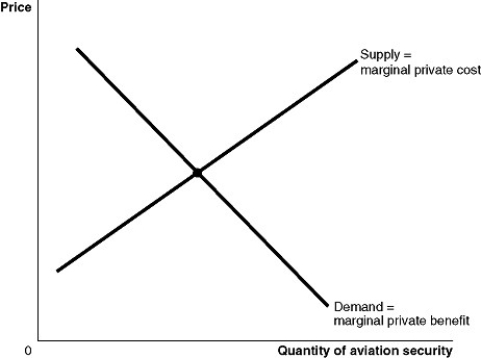 Figure 5-14 shows the market for aviation security. Aviation security generates a positive externality because people who are not airline passengers benefit from aviation security.
-Refer to Figure 5-14 to answer the following questions.
a.In the absence of any government intervention what is the equilibrium level of security that airlines will supply? Using the diagram, denote this level, Q*.Briefly explain why this quantity is not the economically efficient level of aviation security.
b.In the diagram, illustrate the presence of positive externalities in the aviation security market.Label any new curve that you draw.
c.On your diagram identify the economically efficient level of aviation security.Denote this level Qe.
d.Explain how a government subsidy for the airlines can bring about the economically efficient aviation security level.Be sure to identify the size of the subsidy.
Figure 5-14 shows the market for aviation security. Aviation security generates a positive externality because people who are not airline passengers benefit from aviation security.
-Refer to Figure 5-14 to answer the following questions.
a.In the absence of any government intervention what is the equilibrium level of security that airlines will supply? Using the diagram, denote this level, Q*.Briefly explain why this quantity is not the economically efficient level of aviation security.
b.In the diagram, illustrate the presence of positive externalities in the aviation security market.Label any new curve that you draw.
c.On your diagram identify the economically efficient level of aviation security.Denote this level Qe.
d.Explain how a government subsidy for the airlines can bring about the economically efficient aviation security level.Be sure to identify the size of the subsidy. (Essay)
4.8/5 (88)
(88) Which of the following is a possible solution when a scarce resource is subject to the tragedy of the commons?
(Multiple Choice)
4.9/5 (89)
(89) Congressman Murphy made the following proposal: "We should establish policies that completely eliminate air pollution.This is the only way to ensure that none of our citizens suffer the negative effects of air pollution." If Congressman Murphy's proposal was adopted and all forms of air pollution were eliminated, which of the following would be true?
(Multiple Choice)
4.8/5 (91)
(91) A quasi-public good is similar to a public good in that one person's consumption of the quasi-public good does not reduce the amount available for everyone else.
(True/False)
4.8/5 (74)
(74) Which of the following statements about the economically efficient level of air pollution is correct?
(Multiple Choice)
4.9/5 (85)
(85) Assume that production from an electric utility caused acid rain and that the government imposed a tax on the utility equal to the cost of the acid rain.This is an example of
(Multiple Choice)
4.8/5 (79)
(79) Figure 5-4
 Suppose there are several paper mills producing paper for a market. These mills, located upstream from a fishing village, discharge a large amount of wastewater into the river. The waste material affects the number of fish in the river and the use of the river for recreation and as a public water supply source. Figure 5-4 shows the paper market. Use this Figure to answer the following question(s).
-Refer to Figure 5-4.What is the deadweight loss from producing at the market equilibrium?
Suppose there are several paper mills producing paper for a market. These mills, located upstream from a fishing village, discharge a large amount of wastewater into the river. The waste material affects the number of fish in the river and the use of the river for recreation and as a public water supply source. Figure 5-4 shows the paper market. Use this Figure to answer the following question(s).
-Refer to Figure 5-4.What is the deadweight loss from producing at the market equilibrium? (Multiple Choice)
4.8/5 (78)
(78) Some policymakers have argued that products like cigarettes, alcohol, and sweetened soda generate negative externalities in consumption.If the government decided to impose a tax on soda, the government will cause
(Multiple Choice)
4.7/5 (85)
(85) "When it comes to public goods, individuals do not reveal their true preferences because it is not in their self-interest to do so." Evaluate this statement.
(Essay)
4.8/5 (85)
(85) Figure 5-2
 Figure 5-2 shows a market with a negative externality.
-Refer to Figure 5-2.The deadweight loss due to the externality is represented by the area
Figure 5-2 shows a market with a negative externality.
-Refer to Figure 5-2.The deadweight loss due to the externality is represented by the area (Multiple Choice)
4.9/5 (78)
(78) 
Filters
- Essay(0)
- Multiple Choice(0)
- Short Answer(0)
- True False(0)
- Matching(0)