



 Chat with AI
Exam 5: Externalities, Environmental Policy, and Public Goods

Exam 1: Economics: Foundations and Models240 Questions
Exam 2: Trade-Offs, Comparative Advantage, and the Market System258 Questions
Exam 3: Where Prices Come From: the Interaction of Demand and Supply242 Questions
Exam 4: Economic Efficiency, Government Price Setting, and Taxes208 Questions
Exam 5: Externalities, Environmental Policy, and Public Goods262 Questions
Exam 6: Elasticity: the Responsiveness of Demand and Supply293 Questions
Exam 7: The Economics of Health Care171 Questions
Exam 8: Firms, the Stock Market, and Corporate Governance261 Questions
Exam 9: Comparative Advantage and the Gains From International Trade188 Questions
Exam 10: Consumer Choice and Behavioral Economics304 Questions
Exam 11: Technology, Production, and Costs327 Questions
Exam 12: Firms in Perfectly Competitive Markets297 Questions
Exam 13: Monopolistic Competition: the Competitive Model in a272 Questions
Exam 14: Oligopoly: Firms in Less Competitive Markets257 Questions
Exam 15: Monopoly and Antitrust Policy279 Questions
Exam 16: Pricing Strategy258 Questions
Exam 17: The Markets for Labor and Other Factors of Production279 Questions
Exam 18: Public Choice, Taxes, and the Distribution of Income258 Questions
Select questions type


Figure 5-7
 -Refer to Figure 5-7.What is the incremental cost of increasing the quantity of pollution reduction from QB to QE units?
 (Multiple Choice)
4.8/5  (79)
(79) The marginal social cost of a good or service is the cost borne by the producer.
(True/False)
4.8/5 (73)
(73) Briefly explain the command-and-control approach in dealing with an externality such as pollution.Give an example of the U.S.government using the command-and-control approach to deal with the pollution problem.
(Essay)
4.9/5 (80)
(80) The first economist to systematically analyze market failure was
(Multiple Choice)
4.8/5 (77)
(77) Some policymakers have argued that products like cigarettes, alcohol, and sweetened soda generate negative externalities in consumption.All else equal, if the government decided to impose a tax on soda, the equilibrium quantity of soda would ________ and the equilibrium price of soda would ________.
(Multiple Choice)
4.9/5 (94)
(94) Figure 5-1
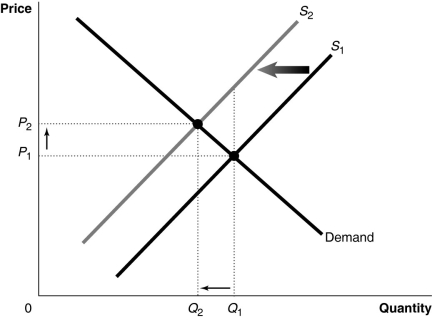 Figure 5-1 shows a market with an externality. The current market equilibrium output of Q₁ is not the economically efficient output. The economically efficient output is Q₂.
-Refer to Figure 5-1.If, because of an externality, the economically efficient output is Q₂ and not the current equilibrium output of Q₁, what does S₂ represent?
Figure 5-1 shows a market with an externality. The current market equilibrium output of Q₁ is not the economically efficient output. The economically efficient output is Q₂.
-Refer to Figure 5-1.If, because of an externality, the economically efficient output is Q₂ and not the current equilibrium output of Q₁, what does S₂ represent? (Multiple Choice)
4.9/5 (70)
(70) Which of the following is an example of a quasi-public good?
(Multiple Choice)
4.9/5 (79)
(79) Figure 5-3
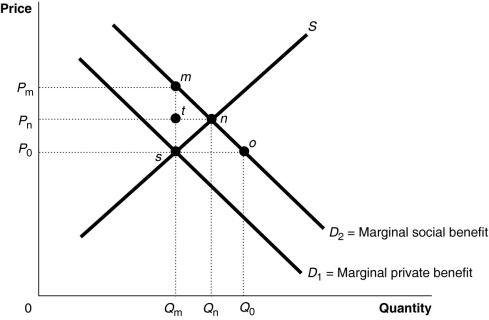 -Refer to Figure 5-3.The deadweight loss due to the externality is represented by the area
 (Multiple Choice)
4.9/5 (72)
(72) The social benefit of a given level of a public good is the vertical sum of all private benefits for that level.
(True/False)
5.0/5 (86)
(86) Article Summary
According to the online real estate database company Zillow, homes located near a Whole Foods or Trader Joe's location have appreciated in value at double the rate of homes in other areas. From 1997 to 2014, the median U.S. home had appreciated 71 percent, while a median home near a Whole Foods or Trader Joe's appreciated 140 percent and 148 percent, respectively. Although some analysts believe this is due to these retailers often opening stores in high-income neighborhoods, Zillow researchers found that before a Whole Foods or Trader Joe's opened, homes near where the stores would eventually be appreciated at the same pace of comparable homes across the city, but after the stores opened the appreciation rate of homes in close proximity increased at a faster rate.
Source: Marian McPherson, "Living near these 2 stores boosts a home's value," inman.com, June 19, 2017.
-Refer to the Article Summary.Assuming the findings are correct and all else equal, higher increases in home values which result from close proximity to a Whole Foods or Trader Joe's are an example of a ________ due to the location of these stores.
(Multiple Choice)
4.7/5 (82)
(82) When production generates a negative externality, the true cost of production is the
(Multiple Choice)
4.9/5 (87)
(87) Explain how the decision by parents to not immunize their children, hoping that their children will not get sick because other parents have had their children immunized, is an example of free riding.How is this behavior dangerous to the public?
(Essay)
4.7/5 (76)
(76) Consider the following characteristics:
A.low transactions costs
B.small levels of pollution
C.high levels of pollution
D.clear assignment of property rights
Which of the above are assumptions behind the Coase Theorem?
(Multiple Choice)
4.9/5 (77)
(77) An external benefit is created when you pursue a college education.
(True/False)
4.8/5 (83)
(83) Figure 5-15
 Figure 5-15 shows the market for Atlantic salmon, a common resource. The current market equilibrium output of Q₁ is not the economically efficient output. The economically efficient output is Q₂.
-Refer to Figure 5-15.The current market equilibrium output is partly the result of overfishing.In that case, what does S₂ represent?
Figure 5-15 shows the market for Atlantic salmon, a common resource. The current market equilibrium output of Q₁ is not the economically efficient output. The economically efficient output is Q₂.
-Refer to Figure 5-15.The current market equilibrium output is partly the result of overfishing.In that case, what does S₂ represent? (Multiple Choice)
4.8/5 (80)
(80) The efficient output level of a public good occurs where the
(Multiple Choice)
4.7/5 (74)
(74) If transactions costs are low, private bargaining will always result in an efficient solution to the problem of externalities.
(True/False)
4.9/5 (78)
(78) Private solutions to the problem of externalities are most likely when
(Multiple Choice)
4.9/5 (74)
(74) 
Filters
- Essay(0)
- Multiple Choice(0)
- Short Answer(0)
- True False(0)
- Matching(0)