



 Chat with AI
Exam 5: Externalities, Environmental Policy, and Public Goods

Exam 1: Economics: Foundations and Models240 Questions
Exam 2: Trade-Offs, Comparative Advantage, and the Market System258 Questions
Exam 3: Where Prices Come From: the Interaction of Demand and Supply242 Questions
Exam 4: Economic Efficiency, Government Price Setting, and Taxes208 Questions
Exam 5: Externalities, Environmental Policy, and Public Goods262 Questions
Exam 6: Elasticity: the Responsiveness of Demand and Supply293 Questions
Exam 7: The Economics of Health Care171 Questions
Exam 8: Firms, the Stock Market, and Corporate Governance261 Questions
Exam 9: Comparative Advantage and the Gains From International Trade188 Questions
Exam 10: Consumer Choice and Behavioral Economics304 Questions
Exam 11: Technology, Production, and Costs327 Questions
Exam 12: Firms in Perfectly Competitive Markets297 Questions
Exam 13: Monopolistic Competition: the Competitive Model in a272 Questions
Exam 14: Oligopoly: Firms in Less Competitive Markets257 Questions
Exam 15: Monopoly and Antitrust Policy279 Questions
Exam 16: Pricing Strategy258 Questions
Exam 17: The Markets for Labor and Other Factors of Production279 Questions
Exam 18: Public Choice, Taxes, and the Distribution of Income258 Questions
Select questions type


The social cost of cutting trees for firewood in a government forest is
(Multiple Choice)
4.8/5  (84)
(84) Which of the following describes how a negative externality affects a competitive market?
(Multiple Choice)
4.9/5 (74)
(74) What is meant by the term "internalizing an externality"? How does a Pigovian tax or subsidy internalize an externality?
(Essay)
4.9/5 (84)
(84) If the marginal social benefit of consuming a good or a service exceeds the marginal private benefit
(Multiple Choice)
4.8/5 (83)
(83) If policymakers use a pollution tax to control pollution, the tax per unit of pollution should be set
(Multiple Choice)
4.8/5 (80)
(80) For the Coase theorem to work there must be clear assignment of property rights.
(True/False)
4.9/5 (84)
(84) Define the tragedy of the commons.Give three examples of common resources.Briefly explain why common property resources are subject to overuse.
(Essay)
4.9/5 (82)
(82) Figure 5-15
 Figure 5-15 shows the market for Atlantic salmon, a common resource. The current market equilibrium output of Q₁ is not the economically efficient output. The economically efficient output is Q₂.
-Refer to Figure 5-15.Identify the area that shows the deadweight loss from overfishing.
Figure 5-15 shows the market for Atlantic salmon, a common resource. The current market equilibrium output of Q₁ is not the economically efficient output. The economically efficient output is Q₂.
-Refer to Figure 5-15.Identify the area that shows the deadweight loss from overfishing. (Multiple Choice)
4.8/5 (78)
(78) Figure 5-5
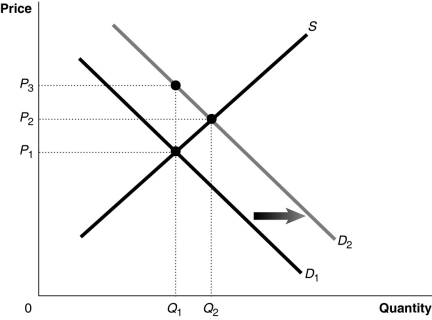 Figure 5-5 shows a market with an externality. The current market equilibrium output of Q₁ is not the economically efficient output. The economically efficient output is Q₂.
-Refer to Figure 5-5.If, because of an externality, the economically efficient output is Q₂ and not the current equilibrium output of Q₁, what does D₂ represent?
Figure 5-5 shows a market with an externality. The current market equilibrium output of Q₁ is not the economically efficient output. The economically efficient output is Q₂.
-Refer to Figure 5-5.If, because of an externality, the economically efficient output is Q₂ and not the current equilibrium output of Q₁, what does D₂ represent? (Multiple Choice)
4.8/5 (71)
(71) Figure 5-13
 Figure 5-13 illustrates the market for gasoline before the government imposes a tax to bring about the efficient level of gasoline production.
-Refer to Figure 5-13.If the government wanted to bring about the efficient level of gasoline production by imposing a tax, the amount of the gasoline tax would be ________ per gallon.
Figure 5-13 illustrates the market for gasoline before the government imposes a tax to bring about the efficient level of gasoline production.
-Refer to Figure 5-13.If the government wanted to bring about the efficient level of gasoline production by imposing a tax, the amount of the gasoline tax would be ________ per gallon. (Multiple Choice)
5.0/5 (83)
(83) Figure 5-13
Figure 5-13 illustrates the market for gasoline before the government imposes a tax to bring about the efficient level of gasoline production.
-Refer to Figure 5-13.If the government wanted to bring about the efficient level of gasoline production by imposing a tax, the actual price of gasoline paid by consumers after the tax is implemented is ________ per gallon.
Figure 5-13 illustrates the market for gasoline before the government imposes a tax to bring about the efficient level of gasoline production.
-Refer to Figure 5-13.If the government wanted to bring about the efficient level of gasoline production by imposing a tax, the actual price of gasoline paid by consumers after the tax is implemented is ________ per gallon. (Multiple Choice)
4.8/5 (73)
(73) One difference between the demand for a private good and that for a public good is that
(Multiple Choice)
4.9/5 (83)
(83) If the social cost of producing a good or service exceeds the private cost
(Multiple Choice)
4.9/5 (93)
(93) Which of the following must be present to reach a private solution to an externality problem?
(Multiple Choice)
4.7/5 (79)
(79) Figure 5-6
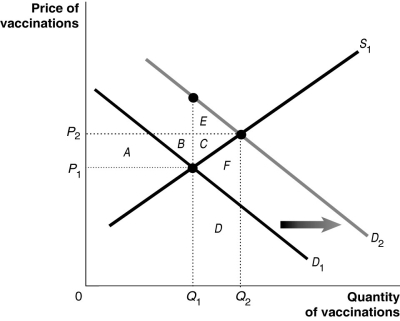 Figure 5-6 shows the market for measles vaccinations, a product whose use generates positive externalities.
-Refer to Figure 5-6.What does D₁ represent?
Figure 5-6 shows the market for measles vaccinations, a product whose use generates positive externalities.
-Refer to Figure 5-6.What does D₁ represent? (Multiple Choice)
4.8/5 (69)
(69) What are transactions costs? Why do transactions costs create difficulties in finding a private solution to the problem of pollution?
(Essay)
5.0/5 (78)
(78) 
Filters
- Essay(0)
- Multiple Choice(0)
- Short Answer(0)
- True False(0)
- Matching(0)