



 Chat with AI
Exam 15: The International Financial System

Exam 1: Economics: Foundations and Models160 Questions
Exam 2: Choices and Trade Offs in the Market192 Questions
Exam 3: Where Prices Come From: the Interaction of Demand and Supply201 Questions
Exam 4: Gdp: Measuring Total Production, Income and Economic Growth123 Questions
Exam 5: Economic Growth, the Financial System and Business Cycles132 Questions
Exam 6: Long-Run Economic Growth: Sources and Policies118 Questions
Exam 7: Unemployment120 Questions
Exam 8: Inflation110 Questions
Exam 9: Aggregate Expenditure and Output in the Short Run138 Questions
Exam 10: Aggregate Demand and Aggregate Supply Analysis134 Questions
Exam 11: Money, Banks and the Reserve Bank of Australia123 Questions
Exam 12: Monetary Policy116 Questions
Exam 13: Fiscal Policy163 Questions
Exam 14: Macroeconomics in an Open Economy141 Questions
Exam 15: The International Financial System145 Questions
Select questions type


Exchange rates will equalise purchasing power parity in the long run unless:
(Multiple Choice)
4.9/5  (74)
(74) Has the adoption of the euro by many countries in the European Union enhanced economic growth in those countries?
_____________________________________________________________________________________________
_____________________________________________________________________________________________
(Essay)
4.7/5 (83)
(83) Would we expect that purchasing power parity will hold in the long run for haircut prices between Australia and Singapore? Why or why not?
_____________________________________________________________________________________________
_____________________________________________________________________________________________
(Essay)
4.9/5 (80)
(80) The three most important financial centres in the world today are New York, Beijing and Frankfurt.
(True/False)
4.9/5 (78)
(78) Refer to Figure 15.2 for the following questions.
Figure 15.2
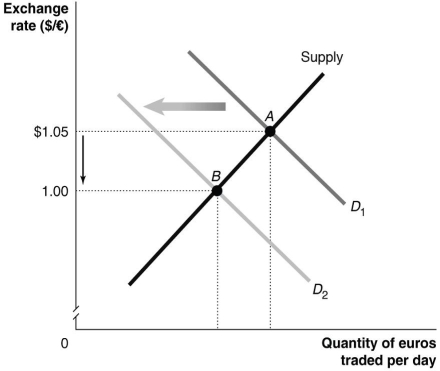 -Which of the following would cause the change depicted in Figure 15.2? Note that the figure depicts the quantity of euros traded.
 (Multiple Choice)
4.9/5 (84)
(84) A currency exchange rate system under which the currency is determined by demand and supply, and occasional government intervention is a:
(Multiple Choice)
4.9/5 (76)
(76) In a pegged exchange rate system, a country will peg the value of its currency to:
(Multiple Choice)
4.8/5 (81)
(81) Soon after the Australia dollar was floated, it ________ against the United States dollar and ________ against other major currencies.
(Multiple Choice)
4.8/5 (73)
(73) If the Thai baht is pegged above the equilibrium exchange rate as expressed in United States (US)dollars per baht:
(Multiple Choice)
4.9/5 (70)
(70) Both countries involved in an exchange rate peg must agree to the peg.
(True/False)
4.9/5 (91)
(91) Describe how the 'Bretton Woods System' operated.
_____________________________________________________________________________________________
_____________________________________________________________________________________________
(Essay)
4.8/5 (74)
(74) Exchange rates under the Bretton Woods System were determined by relative supplies of gold held by countries within the system.
(True/False)
4.8/5 (81)
(81) If inflation in Australia is higher than inflation in Japan, what will happen to the exchange rate between the Australian dollar and the Japanese yen in the long run, ceteris paribus?
(Multiple Choice)
4.9/5 (77)
(77) What is a 'pegged exchange rate' and what are the advantages to a country of having a pegged exchange rate system?
_____________________________________________________________________________________________
_____________________________________________________________________________________________
(Essay)
4.7/5 (75)
(75) Investors who sell a country's currency in anticipation of a devaluation are engaging in:
(Multiple Choice)
4.9/5 (77)
(77) The Bretton Woods System was a system of ________ exchange rates against the United States dollar.
(Multiple Choice)
4.9/5 (79)
(79) Australian currency continues to be backed by the gold standard to this day.
(True/False)
4.9/5 (85)
(85) If interest rates in Australia rise, ceteris paribus, the value of the Australian dollar will:
(Multiple Choice)
4.8/5 (80)
(80) 
Filters
- Essay(0)
- Multiple Choice(0)
- Short Answer(0)
- True False(0)
- Matching(0)