



 Chat with AI
Exam 15: The International Financial System

Exam 1: Economics: Foundations and Models160 Questions
Exam 2: Choices and Trade Offs in the Market192 Questions
Exam 3: Where Prices Come From: the Interaction of Demand and Supply201 Questions
Exam 4: Gdp: Measuring Total Production, Income and Economic Growth123 Questions
Exam 5: Economic Growth, the Financial System and Business Cycles132 Questions
Exam 6: Long-Run Economic Growth: Sources and Policies118 Questions
Exam 7: Unemployment120 Questions
Exam 8: Inflation110 Questions
Exam 9: Aggregate Expenditure and Output in the Short Run138 Questions
Exam 10: Aggregate Demand and Aggregate Supply Analysis134 Questions
Exam 11: Money, Banks and the Reserve Bank of Australia123 Questions
Exam 12: Monetary Policy116 Questions
Exam 13: Fiscal Policy163 Questions
Exam 14: Macroeconomics in an Open Economy141 Questions
Exam 15: The International Financial System145 Questions
Select questions type


Limits on the flow of foreign exchange and financial investment across countries are called:
(Multiple Choice)
4.8/5  (93)
(93) Refer to Figure 15.1 for the following questions.
Figure 15.1
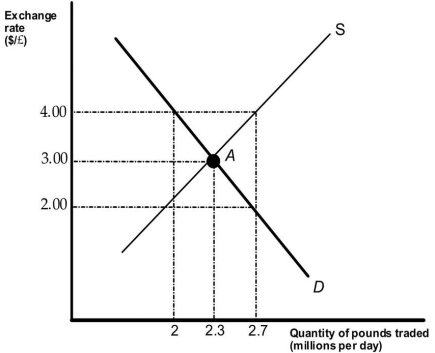 -Suppose the above graph in Figure 15.1 represents the market for the British pound under the Bretton Woods System. If the par exchange rate was set at 2 United States dollars and the situation persisted:
 (Multiple Choice)
4.9/5 (86)
(86) The anchoring feature of the Bretton Woods System was the:
(Multiple Choice)
4.7/5 (89)
(89) When countries agree to keep the exchange rates between their countries at an unchanging rate, the exchange rate system is called a:
(Multiple Choice)
5.0/5 (81)
(81) In order to maintain an undervalued yuan to encourage a trade surplus, the Chinese government must buy United States dollars and increase the supply of yuan.
(True/False)
4.8/5 (79)
(79) The 'purchasing power parity theory' of exchange rate determination states that:
(Multiple Choice)
4.8/5 (81)
(81) Under the Bretton Woods System, the par rate per British pound was defined as a fixed number of United States (US)dollars per pound. If this were set above its equilibrium value, then:
(Multiple Choice)
4.7/5 (74)
(74) Explain how a floating exchange rate can cause problems for countries that have a substantial number of foreign loans denominated in United States (US)dollars. How might a fixed exchange rate pegged to the US dollar help the country avoid these problems?
_____________________________________________________________________________________________
_____________________________________________________________________________________________
(Essay)
4.8/5 (76)
(76) 'Purchasing power parity' is the theory that in the long run, exchange rates move to equalise:
(Multiple Choice)
5.0/5 (79)
(79) Refer to Figure 15.1 for the following questions.
Figure 15.1
-Suppose the graph in Figure 15.1 represents the market for the British pound under the Bretton Woods System. If the par exchange rate was set at 4 United States dollars:
-Suppose the graph in Figure 15.1 represents the market for the British pound under the Bretton Woods System. If the par exchange rate was set at 4 United States dollars: (Multiple Choice)
4.8/5 (81)
(81) If a currency's par rate (defined as United States (US)dollars per unit of foreign currency)was ________ the equilibrium rate and this persisted, then under the Bretton Woods System, the country would be allowed a currency ________.
(Multiple Choice)
4.9/5 (88)
(88) Suppose the price of a mobile phone in Australia is $400 and 30 000 yen in Japan. If the current exchange rate is 100 yen to the dollar, then purchasing power parity theory would predict that in the long run:
(Multiple Choice)
5.0/5 (74)
(74) Under the Bretton Woods System, central banks were committed to selling ________ in exchange for their own currencies.
(Multiple Choice)
4.8/5 (79)
(79) The East Asian exchange rate crisis of the late 1990s resulted in a greater number of countries with pegged exchange rates.
(True/False)
4.9/5 (78)
(78) a. Suppose that the current equilibrium exchange rate between the US dollar and Philippine peso is $0.20 per peso and the Philippine government pegged the peso to the US dollar at the rate of $0.25 per peso. Draw the market demand and supply curve of pesos for US dollars.
b. Suppose that currency traders think that the government will soon allow the peso to float. Show on the diagram how this affects the demand and supply curves.
c. How would the events in b. affect the number of pesos that the Philippine central bank must buy or sell?
_____________________________________________________________________________________________
_____________________________________________________________________________________________
(Essay)
4.8/5 (71)
(71) If prices rise slower in the United States of America (USA)than in Australia, then:
(Multiple Choice)
4.8/5 (81)
(81) Which of the following statements about capital markets is true?
(Multiple Choice)
4.7/5 (81)
(81) 
Filters
- Essay(0)
- Multiple Choice(0)
- Short Answer(0)
- True False(0)
- Matching(0)