



 Chat with AI
Exam 15: The International Financial System

Exam 1: Economics: Foundations and Models160 Questions
Exam 2: Choices and Trade Offs in the Market192 Questions
Exam 3: Where Prices Come From: the Interaction of Demand and Supply201 Questions
Exam 4: Gdp: Measuring Total Production, Income and Economic Growth123 Questions
Exam 5: Economic Growth, the Financial System and Business Cycles132 Questions
Exam 6: Long-Run Economic Growth: Sources and Policies118 Questions
Exam 7: Unemployment120 Questions
Exam 8: Inflation110 Questions
Exam 9: Aggregate Expenditure and Output in the Short Run138 Questions
Exam 10: Aggregate Demand and Aggregate Supply Analysis134 Questions
Exam 11: Money, Banks and the Reserve Bank of Australia123 Questions
Exam 12: Monetary Policy116 Questions
Exam 13: Fiscal Policy163 Questions
Exam 14: Macroeconomics in an Open Economy141 Questions
Exam 15: The International Financial System145 Questions
Select questions type


Describe the four determinants of exchange rates in the long run.
_____________________________________________________________________________________________
_____________________________________________________________________________________________
(Essay)
4.9/5  (88)
(88) Assume that a Big Mac burger costs $3.57 in Australia and 7.80 zlotys in Poland. If the exchange rate is 3 zlotys per dollar, what is the dollar cost of a Big Mac in Poland?
(Multiple Choice)
4.7/5 (91)
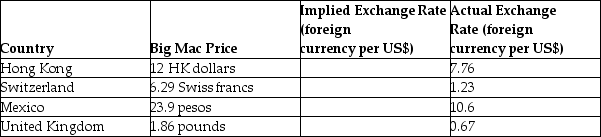
(91) Fill in the values for the implied exchange rate in the various currencies per United States (US)dollar in the following table. Assume that the Big Mac burger sells for $3.06 in the United States of America. Explain whether the US dollar is overvalued or undervalued relative to each currency and predict what will happen in the future to each exchange rate.
 _____________________________________________________________________________________________
_____________________________________________________________________________________________
_____________________________________________________________________________________________ (Essay)
4.9/5 (66)
(66) When a currency's exchange rate is pegged to the United States (US)dollar and the value is fixed below the equilibrium exchange rate as expressed in US dollars per the currency, then in order to maintain the peg, the country's central bank must:
(Multiple Choice)
4.8/5 (81)
(81) Suppose that average productivity of Chinese firms increases more rapidly than the average productivity of Australian firms, then:
(Multiple Choice)
4.8/5 (89)
(89) The model of purchasing power parity is the only way to determine whether a country's currency is undervalued or overvalued.
(True/False)
4.8/5 (76)
(76) The countries that abandoned the gold standard the earliest during the Great Depression suffered the least loss of production.
(True/False)
4.9/5 (79)
(79) The Australian dollar is partially backed by the gold held at the Reserve Bank of Australia.
(True/False)
4.7/5 (80)
(80) If a country's exchange rate is pegged above the equilibrium exchange rate, the country must:
(Multiple Choice)
4.8/5 (81)
(81) If Australians develop an increased preference for foreign goods, how will the exchange rate for the dollar respond in the long run, ceteris paribus?
(Multiple Choice)
4.8/5 (91)
(91) Today, there are some developing countries that attempt to fix their currencies against the United States dollar.
(True/False)
4.8/5 (82)
(82) Adoption of the euro as both a medium of exchange and unit of account in the EU countries serves to increase competition among European firms and decrease individual countries' monetary policy options when confronted by recessions and booms.
(True/False)
4.9/5 (74)
(74) Foreign currency prices of the Australian dollar are currently determined by a managed float exchange rate system.
(True/False)
4.7/5 (73)
(73) The greatest drawback to the gold standard was that the central bank lacked control of the supply of gold.
(True/False)
4.7/5 (83)
(83) Assume that a Big Mac burger costs $3.57 in Australia and 7.80 zlotys in Poland. If the exchange rate is 3 zlotys per dollar, purchasing power parity predicts that the dollar will:
(Multiple Choice)
4.8/5 (78)
(78) If one United States dollar could be exchanged for one Australian dollar in 1970, and one United States dollar can now be exchanged for 1.27 Australian dollars, which of the following is true?
(Multiple Choice)
4.8/5 (77)
(77) By the early 20th century, the majority of the world's major trading nations had adopted the:
(Multiple Choice)
4.7/5 (85)
(85) The International Monetary Fund was established during the Bretton Woods System to:
(Multiple Choice)
4.7/5 (73)
(73) Which of the following would increase the value of the Australian dollar in the long run?
(Multiple Choice)
4.9/5 (82)
(82) A country that imports a significant proportion of its consumer goods can avoid inflation by adopting a fixed exchange rate because it can avoid the price increases of ________ that occur when the value of the domestic currency ________.
(Multiple Choice)
4.8/5 (67)
(67) 
Filters
- Essay(0)
- Multiple Choice(0)
- Short Answer(0)
- True False(0)
- Matching(0)