



 Chat with AI
Exam 15: The Future Isnt What It Used to Be: Biotechnology

Exam 1: Science As a Way of Learning: a Guide to the Natural World54 Questions
Exam 2: Fundamental Building Blocks: Chemistry, water, and Ph74 Questions
Exam 3: Lifes Components: Biological Molecules79 Questions
Exam 4: Lifes Home: the Cell79 Questions
Exam 5: Lifes Border: the Plasma Membrane88 Questions
Exam 6: Lifes Mainspring: an Introduction to Energy78 Questions
Exam 7: Vital Harvest: Deriving Energy From Food74 Questions
Exam 8: The Green Worlds Gift: Photosynthesis79 Questions
Exam 9: The Links in Lifes Chain: Genetics and Cell Division77 Questions
Exam 10: Preparing for Sexual Reproduction: Meiosis77 Questions
Exam 11: The First Geneticist: Mendel and His Discoveries74 Questions
Exam 12: Units of Heredity: Chromosomes and Inheritance69 Questions
Exam 13: Passing on Lifes Information: Dna Structure and Replication72 Questions
Exam 14: How Proteins Are Made: Genetic Transcription, translation, and Regulation77 Questions
Exam 15: The Future Isnt What It Used to Be: Biotechnology74 Questions
Exam 16: An Introduction to Evolution: Charles Darwin, evolutionary Thought, and the Evidence for Evolution67 Questions
Exam 17: The Means of Evolution: Microevolution71 Questions
Exam 18: The Outcomes of Evolution: Macroevolution69 Questions
Exam 19: A Slow Unfolding: the History of Life on Earth80 Questions
Exam 20: Arriving Late,traveling Far: the Evolution of Human Beings56 Questions
Exam 21: Viruses,bacteria,archaea,and Protists: the Diversity of Life 168 Questions
Exam 22: Fungi: the Diversity of Life 251 Questions
Exam 23: Animals: the Diversity of Life 371 Questions
Exam 24: Plants: the Diversity of Life 453 Questions
Exam 25: The Angiosperms: Form and Function in Flowering Plants72 Questions
Exam 26: Body Support and Movement: the Integumentary, skeletal, and Muscular Systems71 Questions
Exam 27: Communication and Control 1: the Nervous System70 Questions
Exam 28: Communication and Control 2: the Endocrine System49 Questions
Exam 29: Defending the Body: the Immune System76 Questions
Exam 30: Transport and Exchange 1: Blood and Breath77 Questions
Exam 31: Transport and Exchange 2: Digestion, nutrition, and Elimination76 Questions
Exam 32: An Amazingly Detailed Script: Animal Development74 Questions
Exam 33: How the Baby Came to Be: Human Reproduction78 Questions
Exam 34: An Interactive Living World 1: Populations in Ecology76 Questions
Exam 35: An Interactive Living World 2: Communities in Ecology75 Questions
Exam 36: An Interactive Living World 3: Ecosystems and Biomes82 Questions
Select questions type


In reproductive cloning,cells are subjected to an electric current under special circumstances.What effect does this have?
(Multiple Choice)
4.8/5  (70)
(70) It is beneficial for children in underdeveloped countries to eat genetically modified "golden rice," rather than regular rice,because golden rice:
(Multiple Choice)
4.8/5 (74)
(74) Refer to the figure below, and then answer the question that follows.
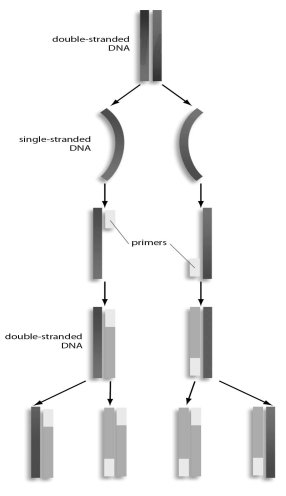 -In PCR,what is the function of the primers?
 (Multiple Choice)
4.8/5 (75)
(75) What is the advantage of genetically modifying crops such as corn,cotton,and potatoes with Bt genes?
(Multiple Choice)
4.9/5 (74)
(74) Refer to the figure below, and then answer the question that follows.
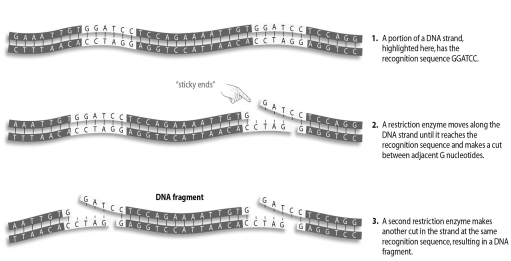 -More than one restriction enzyme can be used to cut a piece of DNA at a time.If you used the restriction enzyme BamHI,which recognizes the sequence GGATCC (shown in the figure),as well as another enzyme that recognizes the sequence AATT,how many DNA fragments would be produced from the DNA strand shown?
 (Multiple Choice)
4.9/5 (87)
(87) "Dolly" or another reproductively cloned animal is a clone of:
(Multiple Choice)
4.8/5 (67)
(67) A farmer wants to reduce his need to use insecticides on his corn crop to save money.He plants 80 percent of his field with Bt corn but has to plant the remaining 20 percent with corn that has not been genetically modified.What is the reason for planting only 80 percent of his field with Bt corn if planting 100 percent Bt corn would reduce his need for insecticide even further?
(Essay)
5.0/5 (78)
(78) Genetically modified crops have been produced mainly to benefit:
(Multiple Choice)
4.9/5 (77)
(77) Cells that can give rise to more of its kind along with at least one variety of specialized cell are known as:
(Multiple Choice)
4.8/5 (87)
(87) On what basis does forensic biotechnology distinguish one individual from another?
(Multiple Choice)
4.8/5 (81)
(81) What is the most common way of introducing recombinant DNA into bacterial cells?
(Multiple Choice)
5.0/5 (70)
(70) To identify an individual through DNA analysis of his or her blood at crime scenes,investigators look for patterns based on:
(Multiple Choice)
4.9/5 (82)
(82) You are the owner of Jurassic Park,and you want to set about populating your park with extinct animals.The first animal you want to have in your park is a wooly mammoth,and you have a remarkably well-preserved specimen that was frozen in the Arctic ice 20,000 years ago.Design a method for populating your park with many living wooly mammoths.
(Essay)
4.9/5 (59)
(59) Kary Mullis was awarded the Nobel Prize in chemistry for inventing:
(Multiple Choice)
4.8/5 (78)
(78) Much of the food crops in the United States are transgenic.This primarily has been done to give the crops what properties?
(Multiple Choice)
4.8/5 (77)
(77) 
Filters
- Essay(0)
- Multiple Choice(0)
- Short Answer(0)
- True False(0)
- Matching(0)